The Glorious Mysteries rise from the darkness of the Passion into the light of the Resurrection. They carry us forward through Pentecost, the birth of the Church, and into the heavenly life — the destiny toward which all Christian prayer is directed.
The Glorious Mysteries are the final set of the Rosary, five events of Christ's victory and Mary's glory: the Resurrection, the Ascension, the Descent of the Holy Spirit, the Assumption, and the Coronation of Mary. They are prayed on Wednesdays and Sundays.
✦ Traditionally prayed on Wednesday and Sunday
Also prayed on all Sundays of the Easter season and during Ordinary Time, outside Advent and Lent. On Sundays during Advent, Joyful Mysteries are prayed; during Lent, Sorrowful Mysteries. For praying the Rosary on these days in particular, see the Wednesday Rosary and the Sunday Rosary.
◆ When to Pray the Glorious Mysteries
Standard days
Wednesday and Sunday, outside Advent and Lent
Easter season
Sundays of Easter through Pentecost — the Resurrection cycle aligned with the Church’s season of Resurrection joy
Sundays replaced
Advent Sundays (Joyful substituted) and Lenten Sundays (Sorrowful substituted) — the Glorious Mysteries pause during these preparatory seasons
Feast of the Assumption
15 August — the Assumption (Fourth Glorious Mystery) makes this one of the most natural days for the Glorious Mysteries
Schedule authority
John Paul II, Rosarium Virginis Mariae §38 (2002); long-standing Dominican tradition prior to 2002
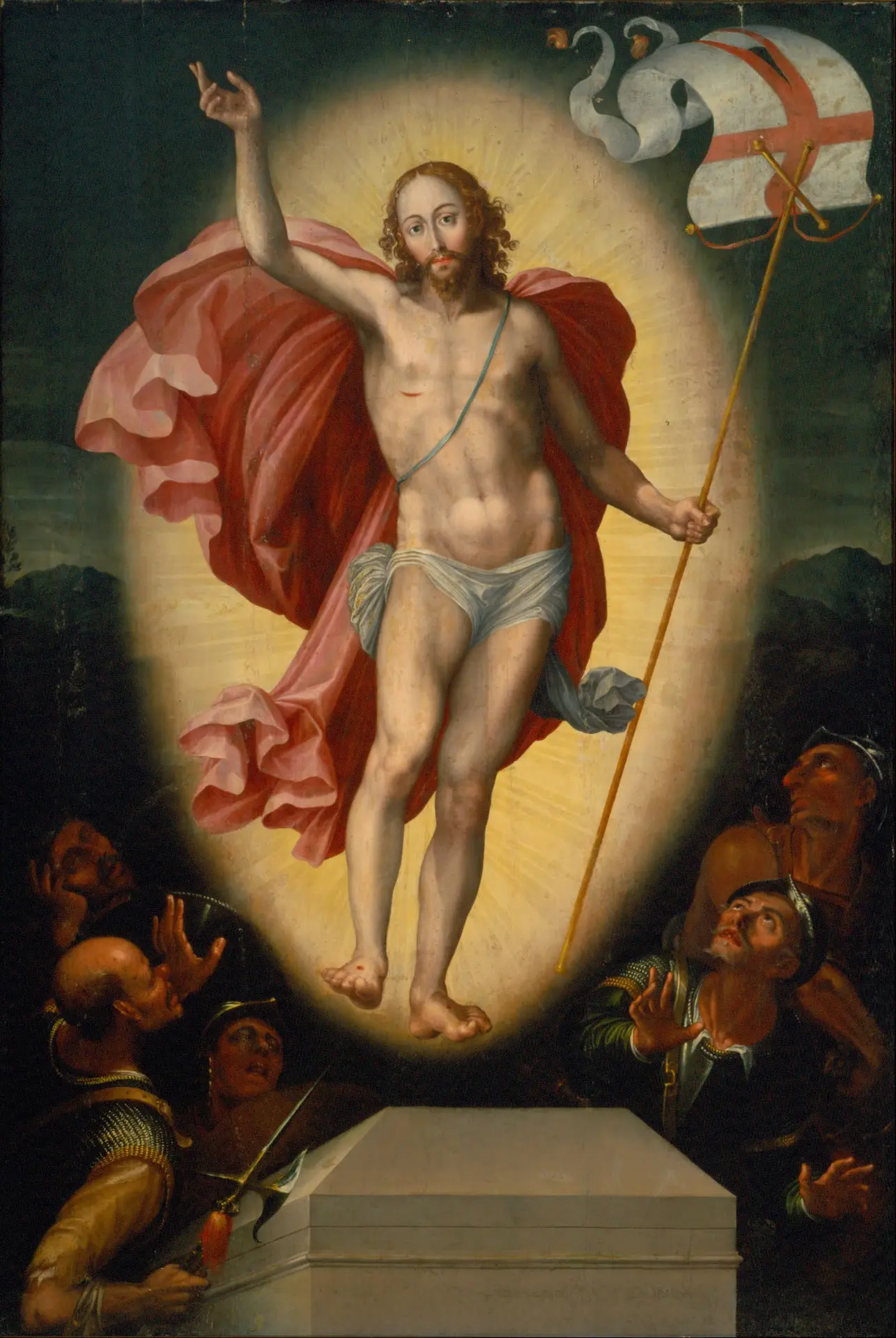
Alonso López de Herrera, The Resurrection of Christ, early 17th century. Mexico.
And it came to pass, as they were astonished in their mind at this, behold, two men stood by them, in shining apparel. And as they were afraid, and bowed down their countenance towards the ground, they said unto them: Why seek you the living with the dead? He is not here, but is risen. Luke 24:4-6
On the third day, the tomb is empty. The stone is rolled away — not to let Jesus out, but to let the disciples see in. Mary Magdalene, the apostles, the disciples on the road to Emmaus — none recognise the risen Christ immediately. Recognition comes in a word, in the breaking of bread, in the wounds He still carries. The Resurrection is not a resuscitation but a transformation: the first fruits of the new creation, the pledge of our own resurrection. The fruit is faith — the theological virtue that assents to what we cannot yet fully see, trusting in the God who raised His Son from the dead.
Why Faith?
Faith flows from the Resurrection because this is the event that requires the theological virtue of faith to assent to. Paul states it absolutely: “if Christ be not risen again, your faith is vain, for you are yet in your sins” (1 Corinthians 15:17). His creedal formula — written c. 52 AD, before any Gospel — names the appearances: Cephas, the Twelve, more than five hundred at once (of whom, he notes, “many remain until this present”, an explicit appeal to living witnesses), James, all the apostles, then Paul himself (1 Corinthians 15:3–8). This is the earliest written testimony to the Resurrection appearances in existence. The disciples did not believe the women: “these words seemed to them as idle tales” (Luke 24:11). Thomas demands physical evidence; when he meets the Risen Christ, he confesses “My Lord, and my God” (John 20:28) — the highest Christological statement in John’s Gospel, and the supreme model act of faith. Aquinas: faith assents to divine truth with a certainty greater than opinion, without the direct vision of beatitude (ST II–II, Q. 1–4).
Sources: 1 Corinthians 15:3–8, 17 (c. 52 AD — earliest written testimony) · John 20:28 · Luke 24:11 · Thomas Aquinas, ST II–II, Q. 1–4
“The contemplation of Christ’s face cannot stop at the image of the Crucified One. He is the Risen One! The Rosary has always expressed this knowledge born of faith and invited the believer to pass beyond the darkness of the Passion in order to gaze upon Christ’s glory in the Resurrection and Ascension.” John Paul II, Rosarium Virginis Mariae §23
Sacred site: Church of the Holy Sepulchre, Jerusalem — the Edicule (tomb enclosure) was restored 2016–2017. The original burial slab, sealed under Ottoman marble since 1555, was exposed for 60 hours during restoration — for the first time in nearly five centuries.
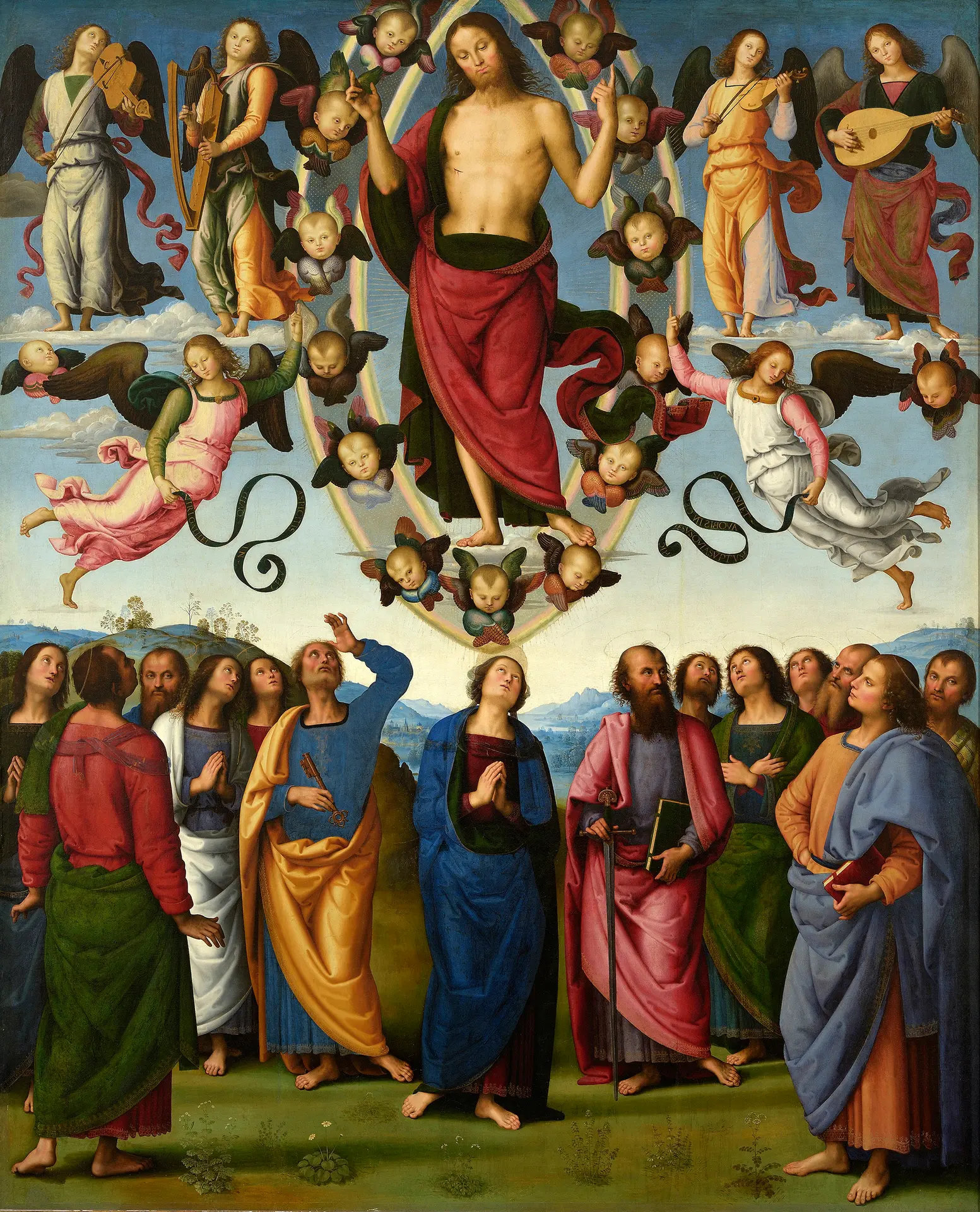
And the Lord Jesus, after he had spoken to them, was taken up into heaven, and sitteth on the right hand of God. Mark 16:19
Forty days after the Resurrection, Jesus ascends to the right hand of the Father in the presence of His disciples. He takes our human nature into the very life of the Trinity — a man now sits at the right hand of God. This is not an abandonment but a transformation of presence. The disciples stand looking into the sky until the angels redirect them: "Ye men of Galilee, why stand you looking up to heaven?" (Acts 1:11). The fruit is Christian hope: the orientation of our hearts toward the homeland to which Jesus has preceded us, and the confident expectation of reunion.
Why Christian Hope?
Christian Hope flows from the Ascension because the mystery shows our human nature already arrived at the destination toward which we are moving. A man now sits at the right hand of God. Hebrews: “hold fast the hope set before us; which we have as an anchor of the soul, sure and firm, and which entereth in even within the veil, where the forerunner Jesus is entered for us” (Hebrews 6:18–20). The Ascension is not abandonment but transformation of presence: the same letter adds that he is “always living to make intercession for us” (Hebrews 7:25) — the Ascension begins a permanent priestly intercession, it does not end his presence. The angels redirect the disciples’ upward gaze: “Ye men of Galilee, why stand you looking up to heaven?” (Acts 1:11) — hope is active orientation toward the homeland, not passive gazing. Aquinas: the object of hope is a future good, arduous but possible with divine help — and our forerunner is already there (ST II–II, Q. 17).
Sources: Hebrews 6:19–20; 7:25 · Acts 1:11 · Thomas Aquinas, ST II–II, Q. 17
“In the Ascension, Christ was raised in glory to the right hand of the Father.” John Paul II, Rosarium Virginis Mariae §23
Sacred site: Chapel of the Ascension, Mount of Olives, Jerusalem — a small octagonal Crusader structure now shared by Christians and Muslims. A rock inside is venerated as bearing the imprint of Christ’s final footstep before ascending.
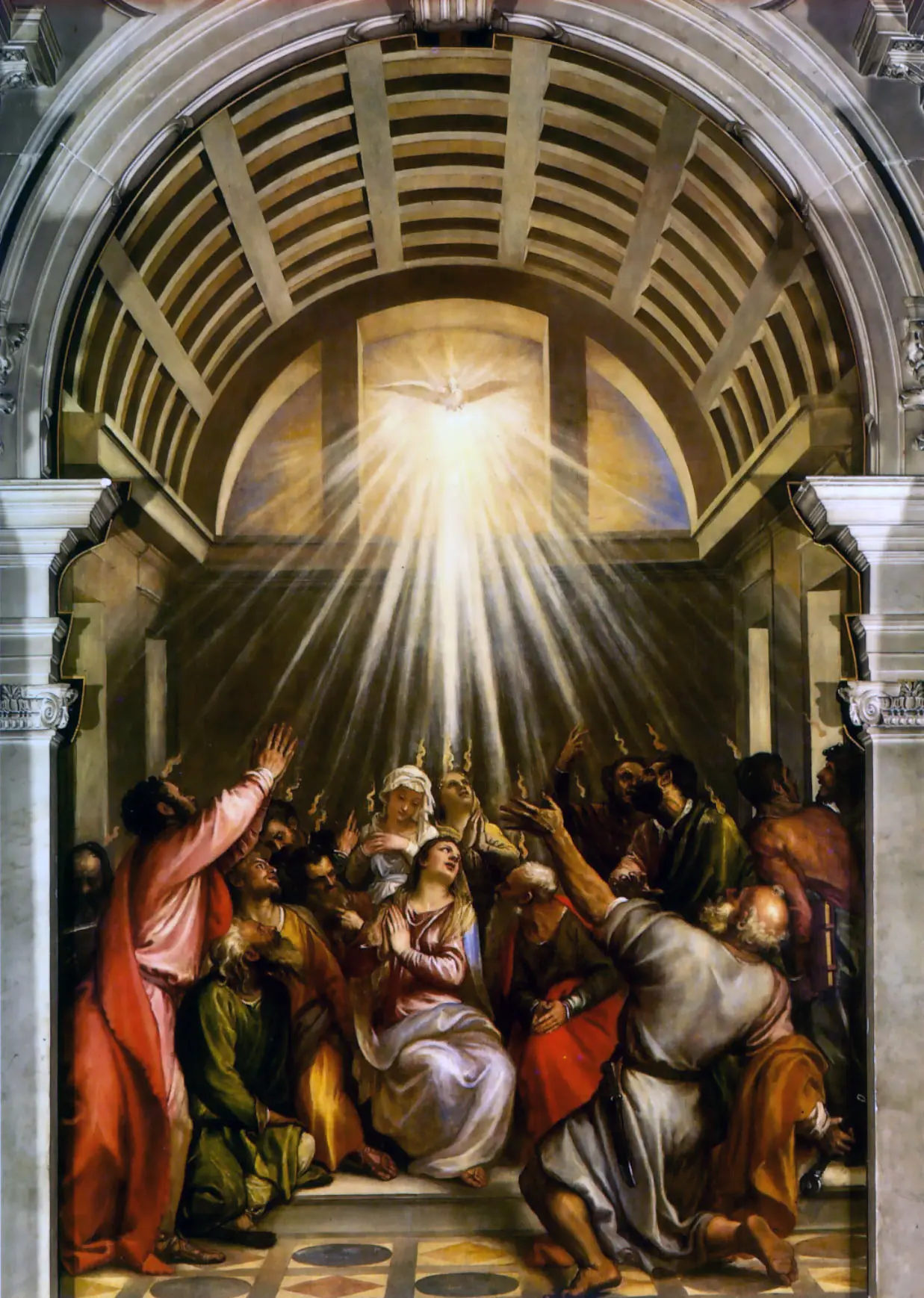
Titian, Descent of the Holy Spirit (Pentecost), c. 1545. Santa Maria della Salute, Venice.
And when the days of the Pentecost were accomplished, they were all together in one place: and suddenly there came a sound from heaven, as of a mighty wind coming, and it filled the whole house where they were sitting. And there appeared to them parted tongues as it were of fire, and it sat upon every one of them: and they were all filled with the Holy Ghost, and they began to speak with divers tongues, according as the Holy Ghost gave them to speak. Acts 2:1-4
Mary and the Apostles are gathered in prayer in the Upper Room. A rushing wind fills the house; tongues of fire rest on each person; they are filled with the Holy Spirit and proclaim the Gospel in languages they have never learned. Three thousand are baptised. The Church is born. Pentecost is not merely a historical event: the same Holy Spirit is given in Baptism and Confirmation, continues to move in the Church, and dwells in every soul in a state of grace. The fruit is the gifts of the Holy Spirit — wisdom, understanding, counsel, fortitude, knowledge, piety, and fear of the Lord — poured out to make the soul docile to God.
Why the Gifts of the Holy Spirit?
The Gifts of the Holy Spirit flow from Pentecost because the Spirit poured out at that moment brings with him the gifts by which the soul is made docile to God — the seven Isaiah names resting on the Messiah and, through him, on the baptised: “the spirit of wisdom, and of understanding, the spirit of counsel, and of fortitude, the spirit of knowledge, and of godliness... the spirit of the fear of the Lord” (Isaiah 11:2–3). Pentecost is at the same time the reversal of Babel (Genesis 11): where pride scattered languages, the Spirit restores understanding across the nations (Acts 2:9–11). The list of peoples — Parthians, Medes, Elamites, Mesopotamia, Judea, Cappadocia, Pontus, Asia, Phrygia, Pamphylia, Egypt — is a programmatic declaration of catholicity: the Church is born speaking all languages, healing the fragmentation of sin. Paul: “the Spirit searcheth all things, yea, the deep things of God... that we may know the things that are given us from God” (1 Corinthians 2:10–12). Thomas Aquinas teaches that the gifts are stable dispositions making a person readily moved by the Holy Spirit, perfecting the virtues beyond what human effort alone attains (ST I–II, Q. 68, a. 1). The fruit is the whole company of those gifts, received to be lived.
Sources: Isaiah 11:2–3 · Acts 2:1–11 (Babel reversal: Genesis 11) · 1 Corinthians 2:10–12 · Thomas Aquinas, ST I–II, Q. 68, a. 1
“The Rosary sets before us the third glorious mystery, Pentecost, which reveals the face of the Church as a family gathered together with Mary, enlivened by the powerful outpouring of the Spirit and ready for the mission of evangelization.” John Paul II, Rosarium Virginis Mariae §23
Sacred site: The Cenacle (Upper Room), Mount Zion, Jerusalem — traditional site of both the Last Supper and Pentecost. Now a bare Crusader-vaulted hall; an Ottoman mihrab was added during Muslim administration. One of the most contested sacred spaces in Jerusalem.
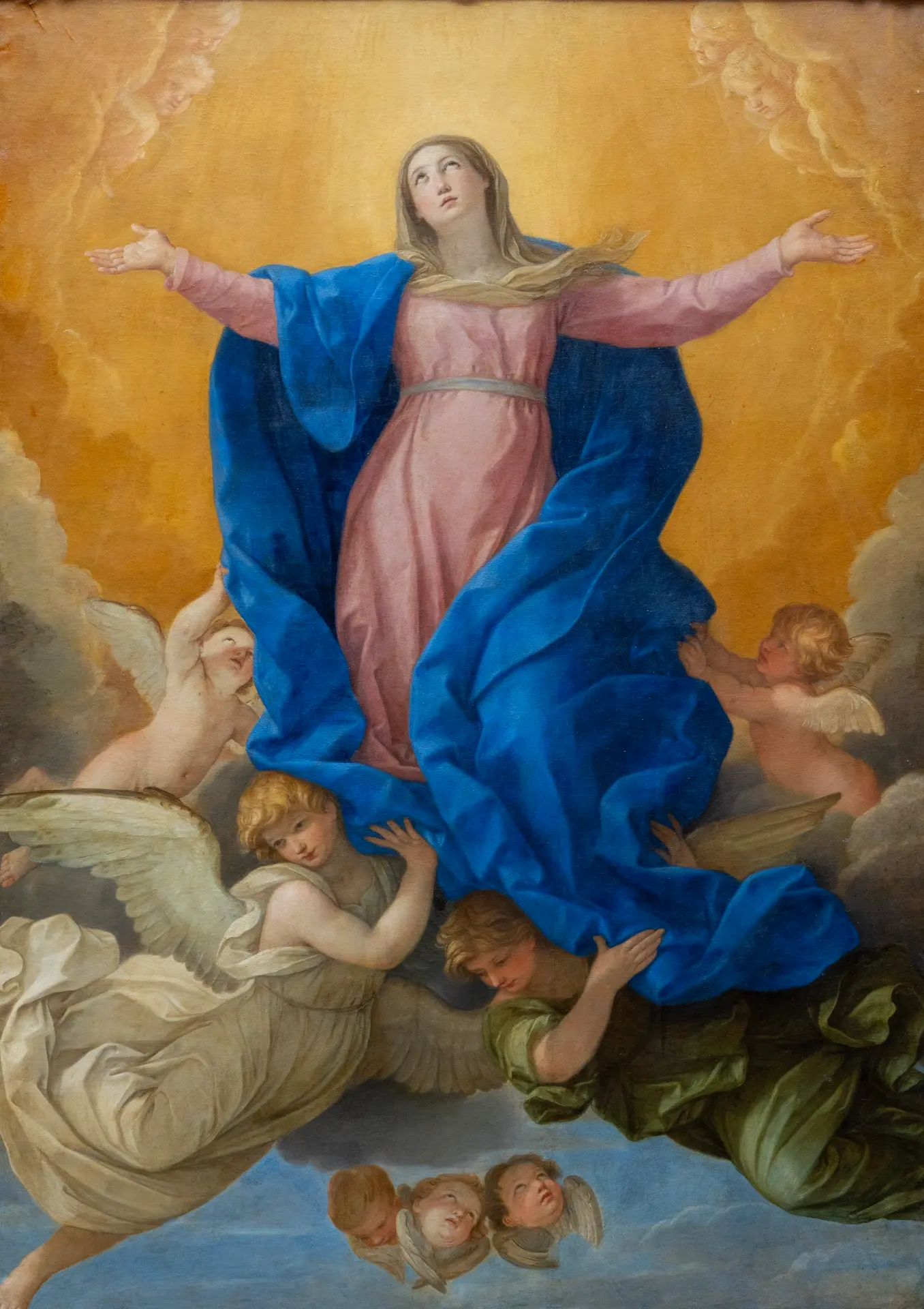
Guido Reni, Assumption of the Virgin, c. 1638 to 1639. Alte Pinakothek, Munich.
Behold from henceforth all generations shall call me blessed. Because he that is mighty hath done great things to me: and holy is his name. Luke 1:48-49
At the end of her earthly life, the Virgin Mary — who was preserved from original sin and bore Christ in her body — is assumed body and soul into heavenly glory. She does not await the general resurrection: the fullness of what is promised to all the faithful is given to her now, in anticipation of the final day. As the Catechism states: "The Immaculate Virgin, preserved free from all stain of original sin, when the course of her earthly life was finished, was taken up body and soul into heavenly glory" (CCC 966). A great sign appears in heaven — a woman clothed with the sun (Apocalypse 12:1). The fruit is desire for heaven: Mary, already body and soul in glory, draws the heart to long for the homeland where Christ has gone to prepare a place for us.
Why the Desire for Heaven?
Desire for Heaven flows from the Assumption because the mystery sets before the eyes of the Church its own destiny already fulfilled in one of its members. Mary is the first and most perfect fruit of Christ’s Redemption, and she is what all the redeemed are called to be. Defined by Pope Pius XII in Munificentissimus Deus on 1 November 1950 — the most recent exercise of papal infallibility — the dogma states that Mary was taken up body and soul into heavenly glory (CCC 966). The definition deliberately leaves open whether she died before being assumed (the dormitio held by the Eastern Church) or was assumed without dying; both traditions remain valid. Seeing her already in the glory promised to all the faithful, the heart learns to long for it: Paul confesses a “desire to be dissolved and to be with Christ, a thing by far the better” (Philippians 1:23), and bids us “seek the things that are above; where Christ is sitting at the right hand of God” (Colossians 3:1). Aquinas teaches that hope and desire reach toward God as the soul’s final beatitude, the vision for which it was made (ST I–II, Q. 3, a. 8). The fruit is desire for heaven: to live with the homeland in view, as Mary now lives.
Sources: Pius XII, Munificentissimus Deus §44 (1 November 1950) · CCC 966 · Philippians 1:23; Colossians 3:1 · Thomas Aquinas, ST I–II, Q. 3, a. 8
“Mary herself would be raised to that same glory in the Assumption, enjoying beforehand, by a unique privilege, the destiny reserved for all the just at the resurrection of the dead.” John Paul II, Rosarium Virginis Mariae §23
Sacred site: Church of the Dormition, Mount Zion, Jerusalem — marks the traditional site of Mary’s death or “falling asleep.” Benedictine abbey built 1906 on land given by the Ottoman Sultan. The lower chapel contains a recumbent statue of Mary in repose.
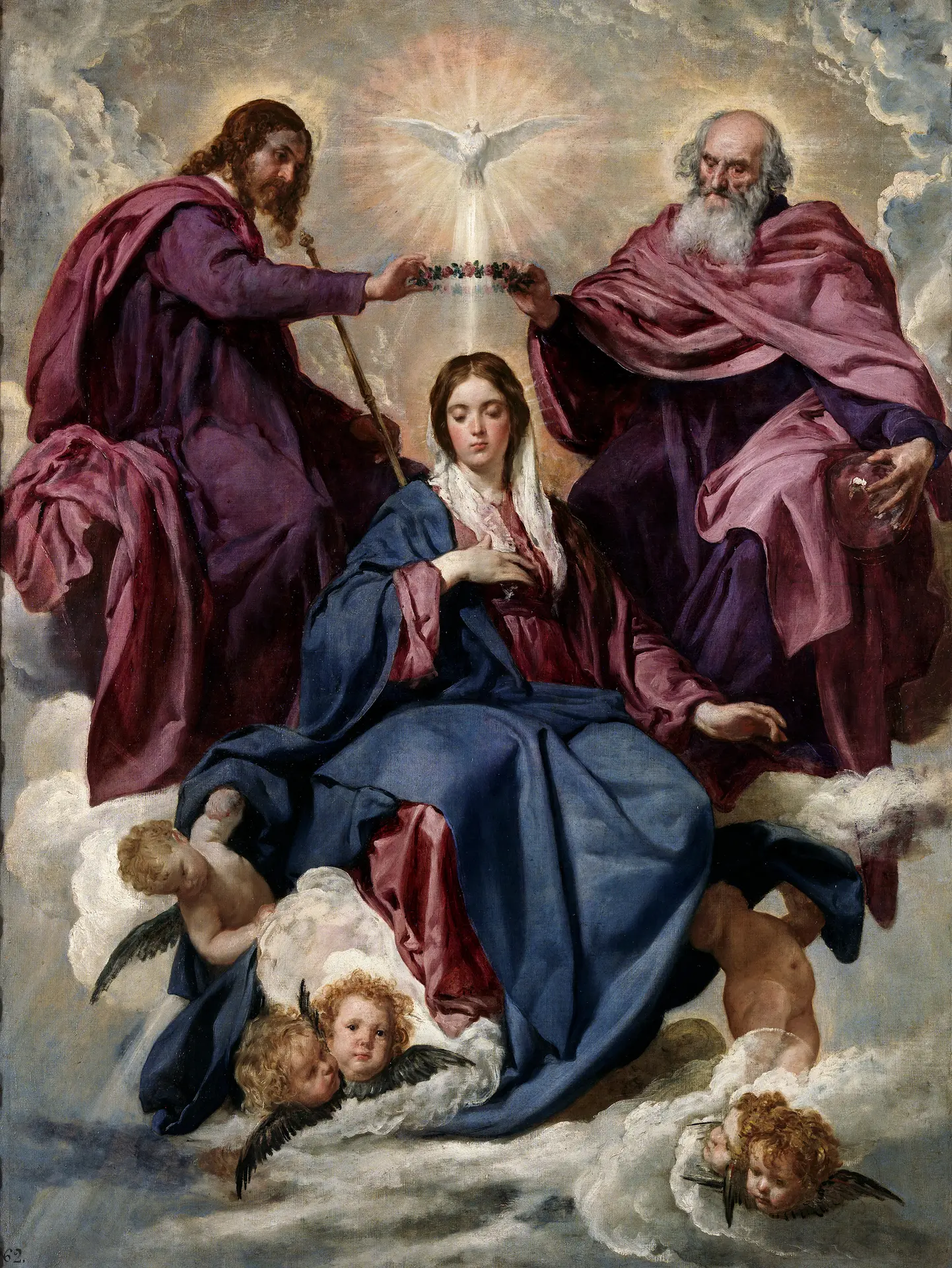
Diego Velázquez, Coronation of the Virgin, c. 1635 to 1636. Museo del Prado, Madrid.
And a great sign appeared in heaven: A woman clothed with the sun, and the moon under her feet, and on her head a crown of twelve stars. Apocalypse 12:1
Mary is crowned Queen of Heaven and Earth, Queen of Angels and Saints, reigning at the right hand of her Son. This is the culmination of the Rosary — the final Mystery toward which all the others point. She who said yes to the Annunciation is now established in glory over all creation. Her queenship is not one of domination but of intercession: she reigns by praying for us. Every Hail Mary of the Rosary is a petition entrusted to her care, brought by her before the throne of her Son — and chief among those petitions is the last: that she pray for us sinners now and at the hour of our death. The fruit is the grace of final perseverance: to be kept in God’s friendship to the end, and to die in the company of the Mother we have asked, ten thousand times, to be with us in that hour.
Why the Grace of Final Perseverance?
The Grace of Final Perseverance flows from the Coronation because Mary crowned as Queen is Mary established in the role of the gebirah — the Queen Mother of the Davidic kingdom, whom Solomon seated at his right hand and to whom he said, “Ask, my mother: for I must not turn away thy face” (3 Kings 2:19–20). When Jesus reigns as the Messianic King of David’s line, his Mother holds that intercessory role built into the royal order he fulfils — and the Church asks her intercession above all for the one grace no one can merit but every soul needs: to be found in God’s friendship at the end. The Council of Trent taught that final perseverance is a great gift, to be sought from God who alone can give it; and the Hail Mary, prayed ten thousand times across a life, asks exactly this — “pray for us sinners, now and at the hour of our death”. Thomas Aquinas treats perseverance to the end as a special divine help that carries the soul through to glory (ST I–II, Q. 109, a. 10). The fruit is the grace of final perseverance: the gift, entrusted to the Queen Mother’s prayers, of holding fast to Christ until he is reached.
Sources: 3 Kings 2:19–20 · Council of Trent (Session VI, ch. 13) · Hail Mary ("now and at the hour of our death") · Thomas Aquinas, ST I–II, Q. 109, a. 10
“Crowned in glory — as she appears in the last glorious mystery — Mary shines forth as Queen of the Angels and Saints, the anticipation and the supreme realization of the eschatological state of the Church.” John Paul II, Rosarium Virginis Mariae §23
No earthly site. The Coronation is a heavenly mystery. The Church of the Dormition on Mount Zion marks Mary’s departure from earthly life; what follows belongs to the order of glory.
Pray the Glorious Mysteries now.
Orabimus guides you through every prayer with audio in English and Latin — free, no sign-in required.
Live community · Prayer streak · No account needed
What are the Glorious Mysteries and when are they prayed?
Each decade of the Rosary meditates on one Mystery — an event from the lives of Jesus and Mary drawn from Scripture and the tradition of the Church. For each decade: announce the Mystery, pray one Our Father, ten Hail Marys while meditating on the Mystery, then one Glory Be and the Fatima Prayer.
The five Glorious Mysteries are: The Resurrection of Christ (Luke 24:1-9), The Ascension of the Lord (Mark 16:19; Acts 1:9-11), The Descent of the Holy Spirit at Pentecost (Acts 2:1-4), The Assumption of Mary (CCC 966; Luke 1:48-49), and The Coronation of Mary as Queen of Heaven (Apocalypse 12:1). They are traditionally prayed on Wednesdays and Sundays.
What are the fruits of the Glorious Mysteries?
The fruits of the Glorious Mysteries are: The Resurrection — Faith; The Ascension — Christian Hope; The Descent of the Holy Spirit — Gifts of the Holy Spirit; The Assumption of Mary — Desire for Heaven; The Coronation of Mary — Grace of Final Perseverance.
What is the Assumption of Mary?
The Assumption of Mary is the doctrine, defined by Pope Pius XII in 1950 (Munificentissimus Deus), that the Virgin Mary was taken up body and soul into heavenly glory at the end of her earthly life. It is the Fourth Glorious Mystery of the Rosary, and its fruit is the grace of a happy death. A scriptural anchor for the mystery is the Magnificat: "The Mighty One has done great things for me" (Luke 1:49).
What are all five Glorious Mysteries of the Rosary?
The five Glorious Mysteries are: 1. The Resurrection — Christ rises from the dead on the third day (Luke 24:1-9). 2. The Ascension of the Lord — Jesus ascends to the right hand of the Father (Mark 16:19; Acts 1:9-11). 3. The Descent of the Holy Spirit — at Pentecost, the Holy Spirit descends on Mary and the Apostles in tongues of fire (Acts 2:1-4). 4. The Assumption of Mary — the Virgin Mary is assumed body and soul into heavenly glory (Luke 1:48-49; CCC 966). 5. The Coronation of Mary, Queen of Heaven — Mary is crowned Queen of Heaven and Earth (Apocalypse 12:1).
What is the spiritual fruit of each Glorious Mystery?
The fruits (virtues) traditionally associated with the Glorious Mysteries are: The Resurrection — Faith; The Ascension — Christian Hope; The Descent of the Holy Spirit — Gifts of the Holy Spirit; The Assumption of Mary — Desire for Heaven; The Coronation of Mary — Grace of Final Perseverance.
What is the First Glorious Mystery?
The First Glorious Mystery is the Resurrection — Christ rising from the dead on the third day, conquering sin and death for all humanity (Luke 24:1-9). It is the central mystery of the Christian faith: without the Resurrection, St. Paul writes, 'your faith is in vain' (1 Corinthians 15:17). The spiritual fruit is faith. It is prayed as the first decade on Wednesday and Sunday. Sunday is the primary day because it is the day of the Resurrection — every Sunday is a little Easter in the Church's liturgical tradition.
What day are the Glorious Mysteries prayed?
The Glorious Mysteries are traditionally prayed on Wednesday and Sunday. Sunday is their principal day because it is the Lord's Day — the day of the Resurrection, which is the First Glorious Mystery. During Easter season they are especially fitting on Sundays. This schedule was confirmed by Pope John Paul II in his 2002 Apostolic Letter Rosarium Virginis Mariae. Before 2002, Sunday was assigned to Glorious Mysteries year-round; the revised schedule allows Joyful Mysteries on Sundays during Advent and Christmas, and Sorrowful Mysteries on Sundays during Lent.
Why is Faith the fruit of the Resurrection?
Faith is the fruit of the Resurrection because this is the event that requires the theological virtue of faith to assent to. Paul: 'if Christ be not risen again, your faith is vain, for you are yet in your sins' (1 Corinthians 15:17). His creedal formula written c. 52 AD (before any Gospel) names the appearances including more than 500 at once, 'many' of whom 'remain until this present' — an explicit appeal to living witnesses (1 Corinthians 15:3-8). Thomas's confession — 'My Lord, and my God' (John 20:28) — is the model act of faith. Aquinas: faith assents to divine truth with certainty greater than opinion (ST II-II, Q. 1-4).
Why is Christian Hope the fruit of the Ascension?
Christian Hope is the fruit of the Ascension because the mystery shows our human nature already arrived at the destination toward which we are moving. Hebrews 6:18-20: 'hold fast the hope set before us; which we have as an anchor of the soul, sure and firm, and which entereth in even within the veil, where the forerunner Jesus is entered for us.' Hebrews 7:25 adds he is 'always living to make intercession for us' — the Ascension is the beginning of permanent priestly intercession, not its end. Aquinas: hope's object is a future good, arduous but possible with divine assistance — and our forerunner is already there (ST II-II, Q. 17).
Why are the Gifts of the Holy Spirit the fruit of Pentecost?
The Gifts of the Holy Spirit are the fruit of Pentecost because the Spirit poured out at that moment brings the seven gifts Isaiah names resting on the Messiah and, through him, on the baptised: wisdom, understanding, counsel, fortitude, knowledge, godliness, and the fear of the Lord (Isaiah 11:2-3). Pentecost is simultaneously the reversal of Babel (Genesis 11) — where pride scattered languages, the Spirit restores understanding across all nations (Acts 2:9-11). Paul: 'the Spirit searcheth all things, yea, the deep things of God... that we may know the things that are given us from God' (1 Corinthians 2:10-12). Aquinas: the gifts are stable dispositions making the soul readily moved by the Holy Spirit, perfecting the virtues (ST I-II, Q. 68, a. 1).
Why is the desire for heaven the fruit of the Assumption?
The desire for heaven is the fruit of the Assumption because the mystery sets before the Church its own destiny already fulfilled in one of its members — Mary is the first and most perfect fruit of Christ's Redemption, and she is what all the redeemed are called to be. Defined by Pope Pius XII in Munificentissimus Deus on 1 November 1950 (the most recent exercise of papal infallibility), the dogma states that Mary was taken up body and soul into heavenly glory (CCC 966). Seeing her already in the glory promised to all the faithful, the heart learns to long for it: Paul desires 'to be dissolved and to be with Christ, a thing by far the better' (Philippians 1:23). Aquinas: hope reaches toward God as the soul's final beatitude (ST I-II, Q. 3, a. 8).
Why is the grace of final perseverance the fruit of the Coronation?
The grace of final perseverance is the fruit of the Coronation because Mary crowned as Queen is Mary established in the role of the gebirah — the Queen Mother of the Davidic kingdom, whom Solomon seated at his right hand and to whom he said, 'Ask, my mother: for I must not turn away thy face' (3 Kings 2:19-20). When Jesus reigns as Messianic King of David's line, his Mother holds that intercessory role — and the Church asks her prayers above all for the one grace every soul needs and none can merit: to be found in God's friendship at the end. The Hail Mary, prayed ten thousand times across a life, asks exactly this: 'pray for us sinners, now and at the hour of our death.' Aquinas treats perseverance to the end as a special divine help that carries the soul through to glory (ST I-II, Q. 109, a. 10).