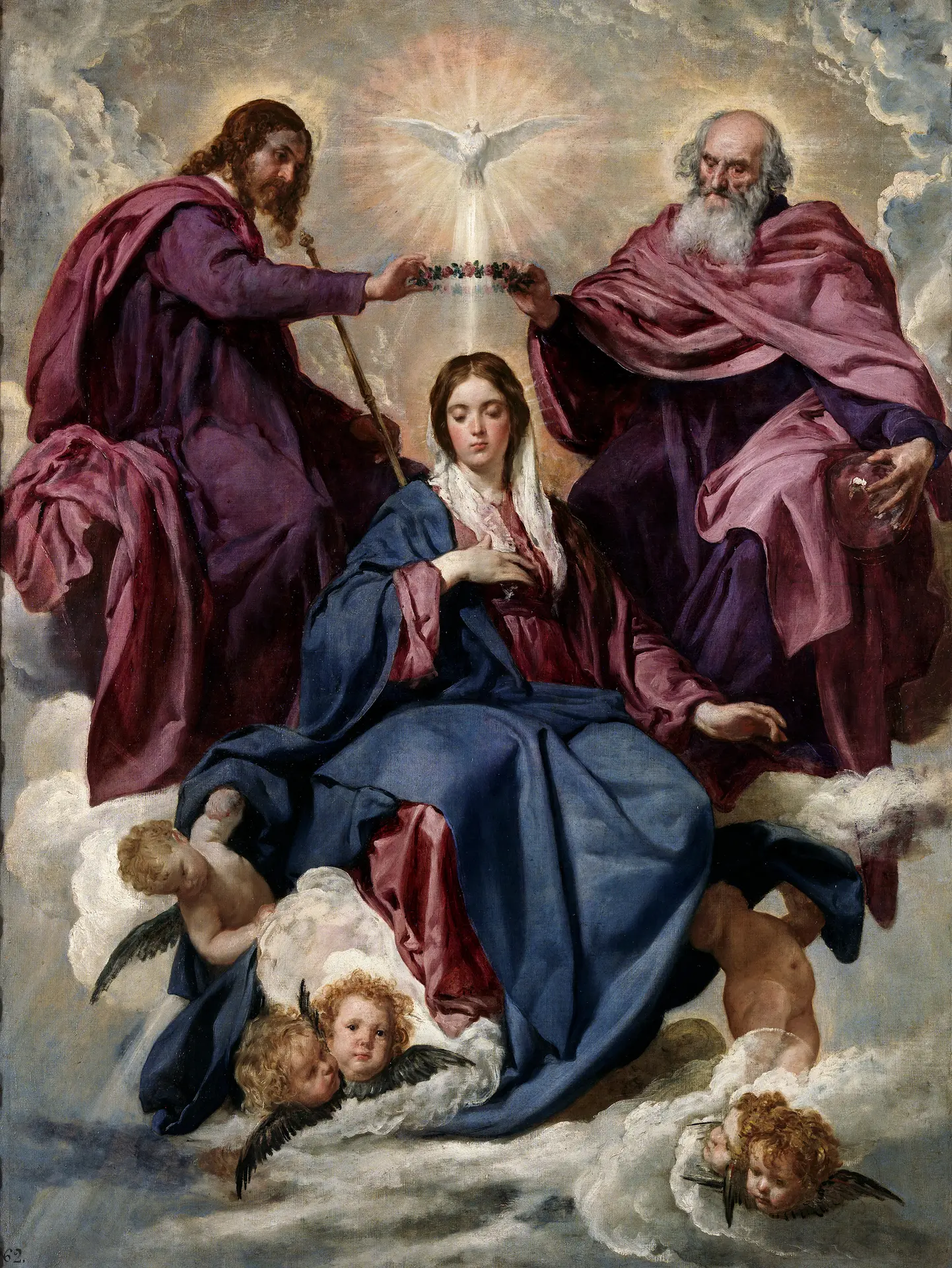
Quinta Mysteria Gloriosa · Coronatio Beatae Mariae Virginis
The Coronation of Mary
The Rosary ends where the Trinity began: in glory. Mary is crowned Queen of heaven and earth — not by her own power but by the grace of the Son whose mother she is. This mystery asks what it means for a creature to reign, and what it means for us that she does.
Diego Velázquez, Coronation of the Virgin, c. 1635 to 1636. Museo del Prado, Madrid.
5th Glorious Mystery · Prayed Wednesday & Sunday
The Coronation of Mary is the fifth Glorious Mystery of the Rosary. Taken into heaven, Mary is crowned Queen by the Holy Trinity, the woman clothed with the sun who reigns as mother and intercessor (Catechism 966). It is prayed on Wednesdays and Sundays, and its fruit is trust in Mary's intercession.
What is the Coronation of Mary?Coronatio Mariae
Fruit of the Mystery: Trust in Mary's Intercession
A great sign appeared in the sky, a woman clothed with the sun, with the moon under her feet, and on her head a crown of twelve stars. She was with child and wailed aloud in pain as she labored to give birth. Revelation 12:1–2
What is the Coronation of Mary?
The Rosary ends here. And it ends exactly where the Trinity began: in glory. The last of the twenty mysteries is the first human creature standing fully in the uncreated light — not because she achieved it, not because she earned it by accumulation of merit, but because she said yes when the angel came to Nazareth, and the one she carried to term and nursed and buried is now Lord and King of everything.
The Coronation is a mystery with almost no narrative — no scene, no Gospel passage, no Acts account of witnesses and angels. What we have is a vision from Revelation, a theological argument from the Davidic monarchy, a definition from Vatican II, and the uninterrupted praying of the Rosary across seven hundred years in which the Church has understood this mystery to be real. Let us take each of these in turn.
Revelation 12:1: "A great sign appeared in the sky, a woman clothed with the sun, with the moon under her feet, and on her head a crown of twelve stars." The figure is contested in exegesis — commentators have identified her as Israel giving birth to the Messiah, as the Church in labor with the new humanity, as Mary the mother of the Messiah, or as all three simultaneously in the layered symbolism that Revelation characteristically employs. The tradition of the Rosary has always held the Marian identification as primary without excluding the others: the woman in glory is Mary, and she is also a figure of all that she represents — Israel in faith, the Church in hope, creation restored in love.
The image of the woman clothed with the sun is one of the most powerful visual images in the New Testament. Every element of it is celestial: the sun for garment, the moon as footstool, twelve stars as crown. She is enthroned in the cosmos, wearing the light of the world. This is not modesty. The Coronation is not a subtle mystery. It is the Church's claim that a human creature, a woman from Nazareth who rode a donkey to Bethlehem and wept at the foot of a Cross, stands now in the fullness of glory that creation was always meant to reach.
The Davidic argument illuminates the Coronation's logic. In the monarchy of ancient Israel, the king had a mother — the gebirah, the Queen Mother. She was not simply a royal consort; she was an official holder of political and intercessory power. When Solomon ascended to the throne of David, his mother Bathsheba entered with him. "So Bathsheba went to King Solomon to speak to him for Adonijah... The king rose to meet her and paid her homage; then he sat down upon his throne, and a throne was provided for the king's mother, who sat at his right hand" (1 Kings 2:19). The Queen Mother sat at the right hand of the king and was the court's primary avenue of petition: "Ask it, my mother; I will not refuse you" (1 Kings 2:20). When Jesus is enthroned as the Messianic King of the line of David — fulfilling the Nathan oracle of 2 Samuel 7:13-16 — the Davidic institution of the gebirah applies. His mother is enthroned at his right hand. She exercises the intercessory role that belongs structurally to the Queen Mother in the Davidic order.
This is precisely the role she exercised at Cana, the first time: "They have no wine." She does not command. She presents. And the King does not refuse his mother's petition, even when his first response suggests he might. "Ask it, my mother; I will not refuse you." The Coronation is the permanent, heavenly form of what we already saw in the Galilean village: Mary interceding for human need before the throne of her Son.
The Second Vatican Council's dogmatic constitution Lumen Gentium (1964) dedicated its final chapter to Mary, and §59 summarizes the mystery precisely: "Finally the Immaculate Virgin, preserved free from all stain of original sin, was taken up body and soul into heavenly glory, when her earthly life was over, and exalted by the Lord as Queen over all things, so that she might be the more fully conformed to her Son, the Lord of lords and conqueror of sin and death." Two things to notice. First, her queenship is a gift of the Lord — "exalted by the Lord," not achieved. Second, its purpose is conformity to her Son: she is Queen so that she might be conformed to the King. The Coronation is not about her autonomy. It is about her participation in the glory that is his by nature and hers by grace.
What is the difference between hyperdulia and latria?
This is the mystery that requires the clearest theological distinction, because the Coronation raises the question directly: if Mary is Queen of Heaven and Earth, what exactly are we doing when we address her in prayer?
Thomas Aquinas draws the line with his characteristic precision (ST III, Q. 25). There are three levels of honor in the tradition: latria, the worship due to God alone; dulia, the honor due to the saints as friends of God; and hyperdulia, the highest possible form of honor due to a creature — accorded to Mary alone, because of the unique dignity of her divine motherhood. Latria directed to Mary would be idolatry. Hyperdulia directed to Mary is the correct response to who she is.
The distinction matters because the Coronation is sometimes misread as elevating Mary to a quasi-divine status that blurs the line. It does not. She is a creature — the most perfectly redeemed of all creatures, the first and fullest recipient of what the Redemption achieves — but a creature entirely. Her glory is derived, her queenship is given, her intercession is effective because the King whom she addresses is her Son and her Lord. She does not dispense grace; she intercedes for its bestowal by the one from whom all grace flows. Augustine: "All that Mary has, she has from God" (De Natura et Gratia 36.42). Bernard of Clairvaux is even more direct about the relationship, presenting Mary as the mediatrix who serves the one Mediator — not a rival to Christ's mediation but its human, maternal form, working within it and through it.
John of Damascus, in the Eastern tradition, coins the fullest Marian title: Theotokos — God-bearer, Mother of God. "She who bore the Author of life is rightly called the Mother of God, and death cannot overcome one who was the dwelling of eternal life" (Homily on the Dormition II). The Coronation is implied in the Theotokos: if the one she bore is King of all, she who bore him cannot be less than Queen.
The Rosary Ends in Glory — and Begins Again
There is something circular about the Rosary that the Coronation makes explicit. It begins with the Annunciation — the angel coming to Nazareth, the fiat, the Incarnation. It ends with the Coronation — the mother of the Incarnate Word in the fullness of glory. Between those two mysteries, the whole history of salvation is traversed: the childhood of Christ, his ministry, his Passion, his Resurrection and Ascension, the birth of the Church. And then it circles back. After the Coronation, the next Rosary begins again with Gabriel at Nazareth.
This circularity is not repetition. It is the shape of contemplative prayer: the same events entered again and again at different depths, each time revealing something not seen before. Augustine's Confessions end, structurally, where they began — with God, with rest, with the heart's arrival. "Thou madest us for Thyself, and our heart is restless, until it repose in Thee" (I.1). The Rosary is structured the same way: the heart that begins in the Annunciation's receptivity arrives, twenty mysteries later, at the Coronation's fullness — and then begins again, because the rest Augustine describes is not boredom but the inexhaustible contemplation of what has been given.
Sacred site: The Basilica of Santa Maria Maggiore, Rome — the oldest Marian basilica in the Western church, originally built in the 4th century. Its apse mosaic (13th century, by Jacopo Torriti) depicts the Coronation of Mary by Christ: both enthroned together in glory. The mosaic is the artistic archetype of the mystery and one of the supreme achievements of medieval Christian art. The basilica also houses the Salus Populi Romani — the icon of Mary as Protectress of the Roman People, venerated for at least a thousand years and carried in processions through Rome during plague and war.
How to Pray This Decade
Announce: The Fifth Glorious Mystery — The Coronation of the Blessed Virgin Mary as Queen of Heaven and Earth. Pray one Our Father. As you pray the ten Hail Marys, let the mystery be what it is: not a theological problem to be solved but a person to be trusted. The Coronation says that the one you address in the Hail Mary — "Holy Mary, Mother of God, pray for us sinners, now and at the hour of our death" — is at the right hand of the King who will not refuse her. You are bringing your need to the gebirah at the court of the one who said: "Ask it, my mother; I will not refuse you."
The fruit of the Coronation is trust in Mary's intercession. Not the trust that bypasses the Son — she always directs toward him — but the trust that uses the full range of the intercession available in the Church, including the Queen Mother's permanent, heavenly advocacy before her Son's throne.
The Coronation of Mary is the Fifth Glorious Mystery of the Rosary — the culminating mystery, in which Mary is exalted as Queen of heaven and earth. It draws on Revelation 12:1 (the woman clothed with the sun), the Davidic institution of the Queen Mother (gebirah), and Vatican II's Lumen Gentium §59: "She was exalted by the Lord as Queen over all things, so that she might be the more fully conformed to her Son, the Lord of lords." The spiritual fruit is trust in Mary's intercession.
What is the difference between worshipping Mary and honoring her?
Aquinas draws the line with precision (ST III, Q. 25). Latria is the worship due to God alone — the complete submission of the creature to the Creator. Dulia is the honor due to the saints as friends of God who now share his glory. Hyperdulia is the highest possible honor due to a creature, given to Mary alone because of her unique dignity as Mother of God. Directing latria to Mary would be idolatry. The Catholic tradition directs hyperdulia to Mary and has never confused the two: all that Mary has, she has from God (Augustine, De Natura et Gratia 36.42).
What is the gebirah?
The gebirah (Hebrew: Great Lady) is the Queen Mother in the Davidic monarchy — the mother of the king, who held official power and intercessory authority at court. Solomon enthroned his mother Bathsheba at his right hand (1 Kings 2:19) and told her: "Ask it, my mother; I will not refuse you" (1 Kings 2:20). The Queen Mother was the primary avenue of petition to the king. When Jesus is enthroned as Messianic King of David's line, the Davidic institution of the gebirah applies: his mother holds the intercessory role structurally built into the royal order he fulfills.
What does Lumen Gentium say about Mary's Queenship?
Vatican II's Lumen Gentium §59 defines Mary's queenship precisely: "She was taken up body and soul into heavenly glory, when her earthly life was over, and exalted by the Lord as Queen over all things, so that she might be the more fully conformed to her Son, the Lord of lords and conqueror of sin and death." Two key points: her queenship is a gift of the Lord, not a self-achieved status; and its purpose is conformity to her Son, not autonomous authority. She is Queen so that she might share fully in the glory that is his by nature and hers by grace.
Why does the Rosary end with the Coronation?
The Rosary ends with the Coronation because the mysteries follow the arc of salvation history from its human beginning (the Annunciation) to its human completion (a creature in full glory). Between those two points the whole Gospel is traversed. And the Coronation also circles back to the beginning: the same woman who said fiat to Gabriel in Nazareth now reigns in glory as gebirah at her Son's right hand. The Rosary is meant to be prayed again — it is not a linear narrative that concludes but a contemplative cycle that deepens with each repetition, entering the same events at ever greater depth, as Augustine's Confessions return again and again to the same restlessness until the heart finds its rest.
Pray the Glorious Mysteries at Orabimus.
Step-by-step, with audio in English and Latin. Free, no account required.