Quarta Mysteria Gloriosa · Assumptio Beatae Mariae Virginis
The Assumption of Mary
The Immaculate Mother of God, having completed the course of her earthly life, was assumed body and soul into heavenly glory. Not a pious story. A dogma. And behind it, the most radical claim the Church makes about what God intends for the human body.
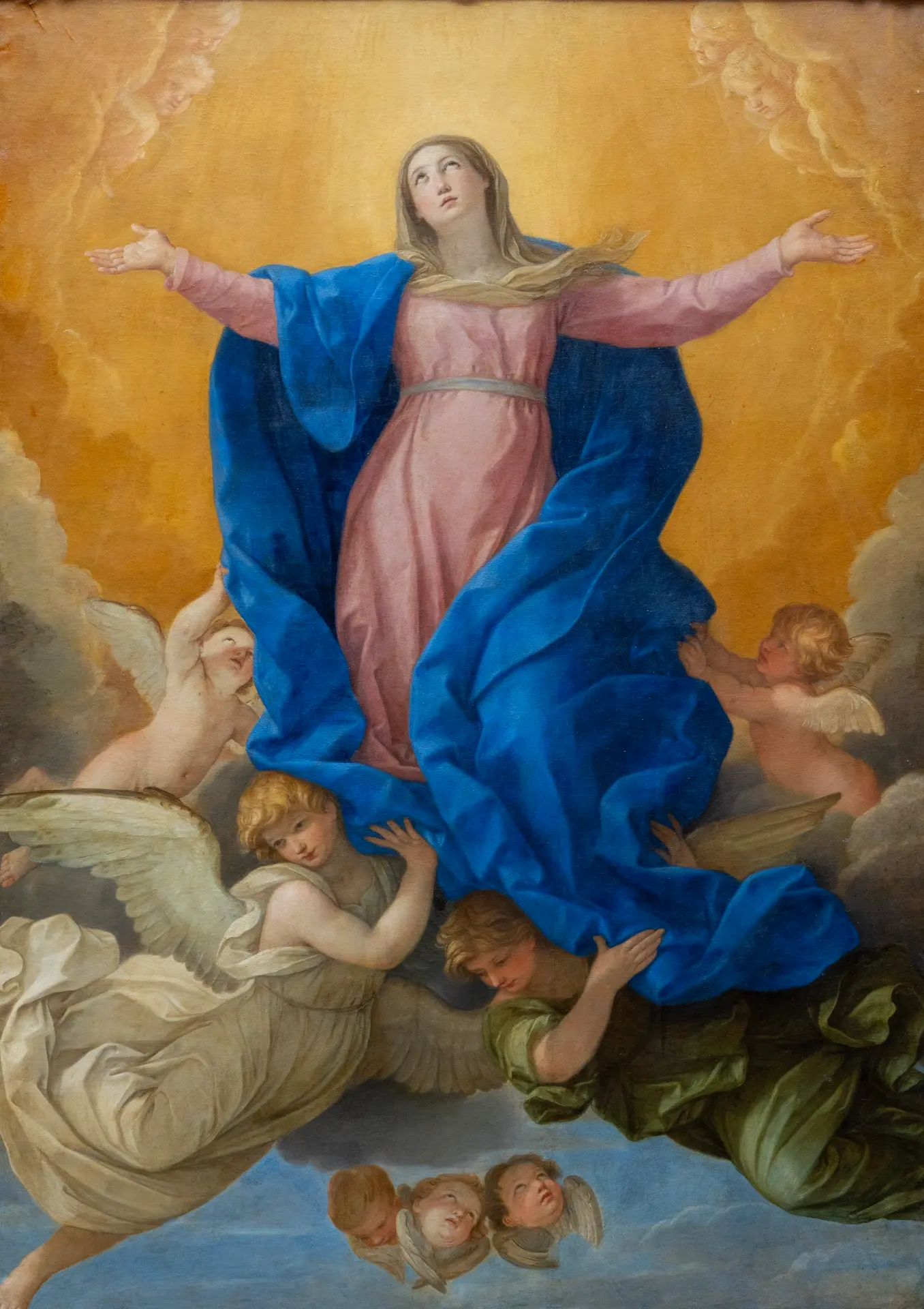
Guido Reni, Assumption of the Virgin, c. 1638 to 1639. Alte Pinakothek, Munich.
4th Glorious Mystery · Prayed Wednesday & Sunday
The Assumption is the fourth Glorious Mystery of the Rosary. At the end of her earthly life Mary is taken body and soul into heavenly glory, the first full sharing in her Son's resurrection, defined as dogma by Pius XII in 1950 (Catechism 966). It is prayed on Wednesdays and Sundays, and its fruit is the grace of a happy death.
What is the Assumption of Mary?Assumptio
Fruit of the Mystery: Grace of a Happy Death
A great sign appeared in the sky, a woman clothed with the sun, with the moon under her feet, and on her head a crown of twelve stars. Revelation 12:1
What is the Assumption of Mary?
The Assumption is the only Glorious Mystery for which we have no narrative account in Scripture — no gospel passage to open, no scene to enter through the details of a text. The New Testament does not describe the end of Mary's life. We know she was present at Pentecost (Acts 1:14). After that, she disappears from the record. The Assumption is known through the tradition of the Church — through what the Church has held and prayed and believed across the centuries — and through its formal definition by Pope Pius XII on November 1, 1950.
The definition is precise: "The Immaculate Mother of God, the ever Virgin Mary, having completed the course of her earthly life, was assumed body and soul into heavenly glory" (Munificentissimus Deus, §44). Three things to notice. First, "having completed the course of her earthly life" — this phrase is deliberately ambiguous about whether Mary died or was taken up without dying. The Church's definition does not resolve the question that theologians have debated for centuries. The Eastern tradition of the Koimesis (the Dormition — Mary "falling asleep") holds that she died; some Western theologians have held she was taken up like Enoch and Elijah, without death. The dogma covers both. What is defined is not the manner of transition but the outcome: body and soul, into glory.
Second, "body and soul." This is the theological nerve of the dogma. The Assumption is not the glorification of Mary's soul — that would be unremarkable, since every soul saved enters the presence of God at death. The Assumption is the glorification of her body. She is in heaven with the same body she was born with, bore Christ with, stood at the Cross with. The resurrection of the body — which the Creed professes for every human person at the Last Day — has already happened for Mary. She is, with the exception of the Risen Christ, the only human being whose resurrection is already accomplished.
Third, "into heavenly glory." Not into a waiting state, not into purgation, but into glory — the same glory that the Risen Christ entered at the Ascension. Mary's Assumption is her share in her Son's Resurrection and Ascension. What happened to him on Easter Sunday and Ascension Thursday happened to her — not by her own power, but by the grace of the one she bore.
The tradition surrounding the Assumption is early and consistent. John of Damascus — writing in the 8th century, but drawing on sources he describes as older — records that when the apostles gathered at Mary's death, her tomb was found empty (On the Dormition, Homilies I-III). The Feast of the Dormition was celebrated in the East from at least the 5th century, and in Rome by the 7th century. The argument of the Assumption in Scholastic theology is from Mary's Immaculate Conception: if she was preserved from original sin and its effects from the moment of her conception, then the corruption of the body — which Augustine understood as one of sin's consequences — could not apply to her. The Immaculate Conception implies the Assumption; each dogma reinforces the other.
The Tomb of the Theotokos in the Garden of Gethsemane — at the foot of the Mount of Olives, a few hundred meters from where Jesus prayed — has been venerated by both the Catholic and Orthodox churches since at least the 4th century. It is a first-century Jewish tomb, cut into the rock in the same form as the tomb from which Jesus rose. It is empty. The tomb is a witness without being able to speak: it says that the body of the one laid there is not here. It cannot say where she is. The faith of the Church completes the sentence.
Why is Mary called the Ark of the New Covenant?
The theological typology most powerfully illuminating the Assumption is the Ark of the Covenant. In the Hebrew Scriptures, the Ark was the dwelling place of God's presence — the chest containing the tablets of the Law, the manna, and Aaron's rod. It was housed in the Holy of Holies and was the most sacred object in Israel. In 2 Chronicles 35:3, just before the Babylonian exile, the Ark disappears from the record. It is carried into the Temple and never mentioned again. Where it went — whether destroyed, hidden, taken — the Old Testament does not say.
Luke's Gospel establishes Mary as the Ark of the New Covenant through the Annunciation scene. The Spirit "overshadows" her — episkiasei, Luke 1:35 — the same cloud that overshadowed the Ark of the Covenant (Exodus 40:35: "The cloud covered the tent of meeting, and the glory of the LORD filled the tabernacle"). She bears within her the Word of God in the flesh, as the Ark bore the written Word of God. When she visits Elizabeth, John leaps in the womb — and David had leaped before the Ark when it was brought to Jerusalem (2 Samuel 6:16). Elizabeth greets Mary with the same words the text implies for the Ark's arrival: "How is it that the mother of my Lord comes to me?" mirrors "How can the Ark of the Lord come to me?" (2 Samuel 6:9).
Revelation 11:19-12:1 places the connection explicitly: John sees the Ark of the Covenant appear in the heavenly temple (11:19), and immediately the sign of the woman clothed with the sun appears (12:1). The Ark that was lost from the earthly Temple is seen in heaven — and the woman who is its antitype is also there. The Assumption of Mary is the arrival in heaven of the New Ark, the dwelling place of God who became flesh, now present in glory body and soul.
Augustine on the Body's Destiny
Augustine's wrestling with the resurrection of the body in De Civitate Dei (Books 20-22) is the most sustained patristic treatment of what the Assumption implies for all human persons. He argues against those who found the resurrection of the body philosophically discomfiting — Platonists who saw the body as a prison the soul escaped at death, not a partner to be restored. Augustine insists that the body is not accidental to the person: the soul, he argues, is not the whole of the human being but only its better part, and the body is not the whole but its lower part — and so the person is not fully blessed while soul and body remain separated. The resurrection of the body is not the re-imprisonment of the soul. It is the completion of the person.
The Assumption of Mary is, in this frame, the first fully realized version of what God intends for every person who dies in Christ. What the Creed promises — "the resurrection of the body and life everlasting" — is not an abstraction. It has already happened. One human body, transformed and glorified, is already in heaven. Mary is the first fruits of the general resurrection, as Christ is the first fruits of the dead (1 Corinthians 15:20). The Assumption is not only a Marian mystery. It is a promise about the human body.
Sacred site: The Tomb of the Virgin Mary (Tomb of the Theotokos), Kidron Valley, Jerusalem — a first-century Jewish tomb venerated since at least the 4th century as the place where Mary was buried. The underground basilica housing the tomb is shared by Catholic and Orthodox Christians. The tomb is empty — which is the point of the site. The Church of the Dormition, on Mount Zion, marks the traditional site of Mary's death. Both sites are within the Old City and within walking distance of each other and the Church of the Holy Sepulchre.
How to Pray This Decade
Announce: The Fourth Glorious Mystery — The Assumption of the Blessed Virgin Mary. Pray one Our Father. As you pray the ten Hail Marys, hold the image of the empty tomb in Gethsemane: the body that was laid there is not there. What happened to Mary's body is what is promised to yours. The fruit of this mystery — grace of a happy death — is the formation of the disposition that can face death with the same confidence that she bore in her body through life: trusting that what God began in the Immaculate Conception will be completed in glory.
The Assumption is the dogma defined by Pope Pius XII on November 1, 1950 (Munificentissimus Deus): "The Immaculate Mother of God, the ever Virgin Mary, having completed the course of her earthly life, was assumed body and soul into heavenly glory." It is the Fourth Glorious Mystery of the Rosary. It holds that Mary is already in heaven with her glorified body — the first human being after Christ whose resurrection is already accomplished. The spiritual fruit is grace of a happy death.
Is the Assumption in the Bible?
The Assumption is not described in any New Testament text; no Gospel passage narrates the end of Mary's life. The dogma rests on the tradition of the Church and on theological reasoning from other defined truths (particularly the Immaculate Conception). The typological basis in Scripture is strong: Revelation 11:19-12:1 places the heavenly Ark and the woman clothed with the sun together; Luke 1:35 makes Mary the New Ark through the Spirit's overshadowing; and the empty tomb in Gethsemane, venerated since the 4th century, stands as the tradition's physical witness.
Did Mary die before the Assumption?
The Church's dogmatic definition deliberately avoids resolving this question. The phrase "having completed the course of her earthly life" covers both possibilities: that she died (the Eastern tradition of the Dormition or Koimesis) and that she was taken up without dying (the "privilege of immortality" position held by some Western theologians). Both possibilities are consistent with the defined truth. What is defined is not the mechanism but the result: she is in heaven, body and soul, in glory.
What is the fruit of the Assumption?
The fruit of the Assumption is grace of a happy death — the formation of a disposition toward one's own death that mirrors Mary's trust. The Assumption promises that the corruption of the grave is not the final word on the human body. What happened to Mary's body is what the Creed promises to all who die in Christ. The grace of a happy death is not the absence of fear but the presence of the confidence that what God began in creation and redemption he will complete in resurrection.
Pray the Glorious Mysteries at Orabimus.
Step-by-step, with audio in English and Latin. Free, no account required.