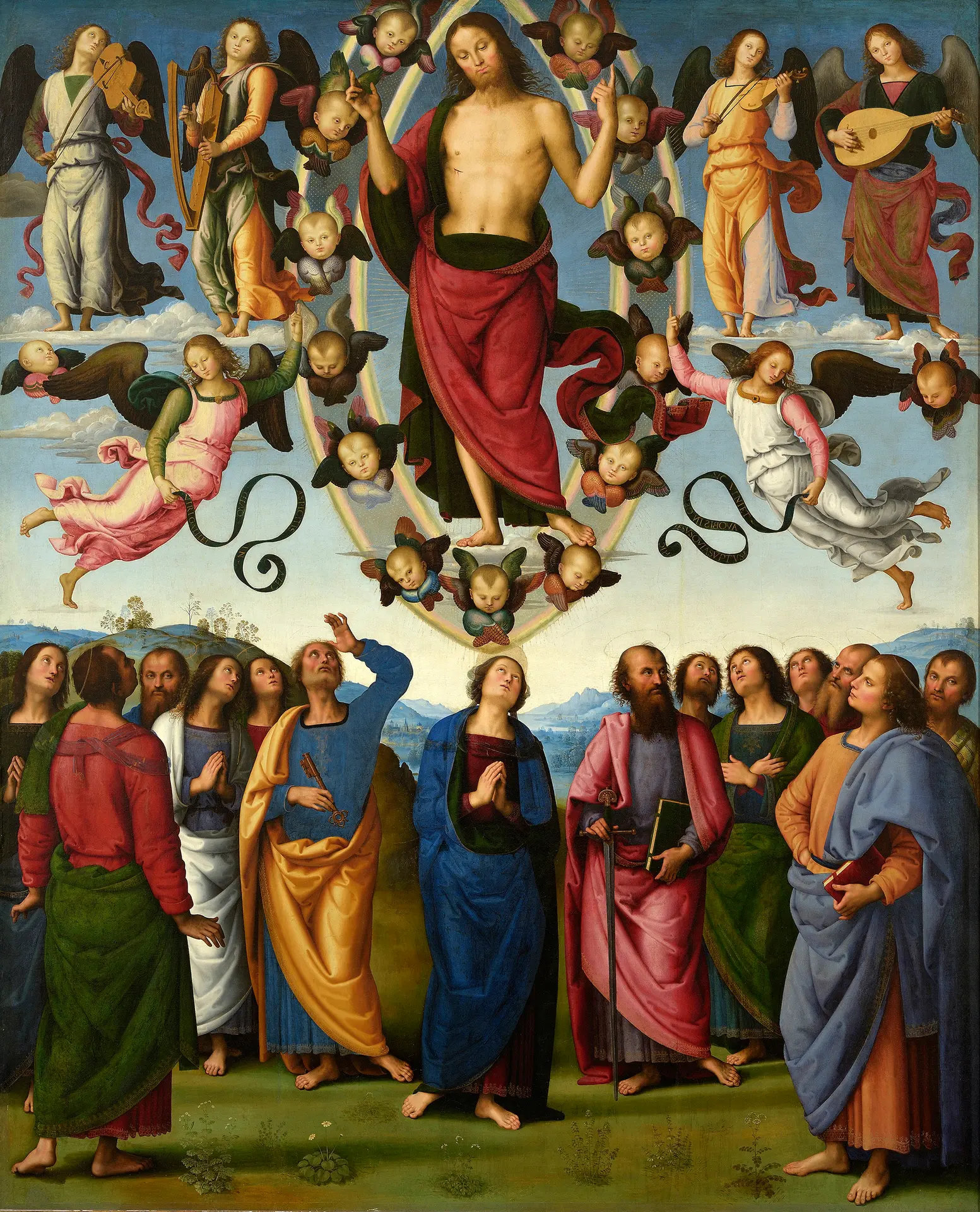
He is taken up. A cloud receives him. The disciples stand staring at the sky. Two men in white ask the obvious question that none of the disciples had thought to ask: why are you looking up there?
Pietro Perugino, Ascension of Christ, c. 1495 to 1498. Musée des Beaux-Arts, Lyon.
2nd Glorious Mystery · Prayed Wednesday & Sunday
The Ascension is the second Glorious Mystery of the Rosary. Forty days after rising, Jesus blesses the disciples and ascends to the Father's right hand, promising the Spirit and his return (Acts 1:6 to 11). It is prayed on Wednesdays and Sundays, and its fruit is hope and the desire for heaven.
What is the Ascension?Ascensio Domini
Fruit of the Mystery: Hope
He was lifted up, and a cloud took him from their sight. While they were looking intently at the sky as he was going, suddenly two men dressed in white garments stood beside them. They said, "Men of Galilee, why are you standing there looking at the sky?" Acts 1:9–11
What happened at the Ascension?
Forty days have passed since the Resurrection. Forty days of appearances — in the upper room, on the road to Emmaus, at the lakeside in Galilee, to more than five hundred at once (1 Corinthians 15:6). Forty days in which the disciples move from terrified confusion to a cautious, then a firming, conviction that the Crucified is alive. Forty days in which Jesus eats with them, walks with them, opens the Scriptures to them, and — Luke tells us — speaks to them about the kingdom of God (Acts 1:3). Forty days of instruction after three years of formation. Then, on the Mount of Olives, he leads them out.
The Mount of Olives. The same slope from which Jesus entered Jerusalem on Palm Sunday, on a donkey, with cloaks spread on the road. The same hillside he crossed on the night of the Agony in the Garden. The same mountain from which, according to Zechariah 14:4, God himself would stand at the eschaton — "his feet shall stand on the Mount of Olives." Jesus leaves from the place where the prophets said God would arrive. The geography is doing theology.
He gives them final instructions. Not the instructions you might expect — not a theology, not a creed, not a moral code. He tells them to wait. "Wait for the gift my Father promised, which you heard me speak about... you will be baptized with the Holy Spirit not many days from now" (Acts 1:4-5). And when they ask — still, even now, after everything — whether he is going to restore the kingdom to Israel at this time, he does not rebuke their political thinking. He redirects it: "It is not for you to know the times or seasons that the Father has established by his own authority. But you will receive power when the Holy Spirit comes upon you, and you will be my witnesses in Jerusalem, throughout Judea and Samaria, and to the ends of the earth" (Acts 1:7-8). Not: no kingdom. But: not that kind, not your timeline, and the Spirit hasn't come yet so you can't do it alone anyway.
Then he is taken up. Luke says "he was lifted up" — passive again, something done to him by the Father rather than something he achieved himself, consistent with the Resurrection's passive grammar. "A cloud took him from their sight." The cloud is the shekinah — the visible manifestation of God's glory and presence that led Israel through the wilderness (Exodus 13:21), that descended on Sinai when Moses received the Law (Exodus 19:9), that filled the Tabernacle at its dedication so that Moses could not enter (Exodus 40:34), that filled the Temple at Solomon's dedication (1 Kings 8:10-11). The cloud that receives Jesus is not weather. It is the sign of God's immediate presence, and it takes him into the Father's sphere.
The disciples stand there. Staring at the sky. This is a recognizable human posture: the posture of people who have just watched something extraordinary happen and cannot move, because if they move it confirms that it is over. They are looking up at a sky that is again empty and blue. Two men in white — angels, as at the tomb — appear beside them. "Men of Galilee, why are you standing there looking at the sky?" This is one of the most gently comic moments in the New Testament. The question is not unkind. It is necessary. The disciples have just been told that they will receive the Holy Spirit and be witnesses to the ends of the earth. The sky is not where that happens. "This Jesus who has been taken up from you into heaven will return in the same way as you have seen him going into heaven" (Acts 1:11). He will come back. But not now. And not by you staring upward. Go back to Jerusalem and wait.
The Ascension completes the arc of the Incarnation. The eternal Son who descended — emptying himself into the conditions of creaturely existence — now returns to the Father, but not alone and not unchanged. He takes with him the human nature he assumed in Mary's womb: the body that was born at Bethlehem, that walked the roads of Galilee, that was nailed to the Cross, that rose on the third day. That human nature is now enthroned at the Father's right hand. The Incarnation is permanent. God did not put on humanity as a temporary costume. What began in the Annunciation is now forever.
Leo the Great, preaching to his congregation in Rome on the Feast of the Ascension, said it plainly: "What was visible in our Redeemer has passed over into the sacraments" (Sermo 74.2). This is a remarkable sentence. The Ascension does not remove Christ from the world; it changes the mode of his presence. The body that healed by being touched, that taught by being heard, that fed by breaking bread — all of that is still available, but now through signs rather than through direct physical contact. The Eucharist is the body of Christ precisely because the body of Christ has been taken up into the mode of gift and presence that the sacraments enact.
Augustine adds the personal dimension: "Let us not hold onto Christ in the way of the flesh; let us eat, let us drink, let us be built up into his body; let our heart be where our treasure is" (Sermons 263.2). The Ascension is an invitation to locate the heart in a different place — not upward, not in nostalgia for what was visible, but in the mode of presence that the Spirit and the sacraments now provide. "If you loved me, you would have rejoiced that I am going to the Father" (John 14:28). Departure is not loss. It is the condition for a different and in certain ways deeper mode of presence.
The Ascension in Hebrews: The High Priestly Entry
The Epistle to the Hebrews provides the deepest theological interpretation of the Ascension in the New Testament. Hebrews reads the Ascension as the moment of the High Priest's entry into the heavenly sanctuary. On Yom Kippur — the Day of Atonement, the holiest day in the Jewish year — the High Priest entered the Holy of Holies in the Jerusalem Temple with the blood of the sacrifice and sprinkled it on the mercy seat as atonement for the sins of all Israel. Once a year, one man, in the presence of God.
The Ascension is the antetype of this entry. "We have a great high priest who has passed through the heavens, Jesus, the Son of God" (Hebrews 4:14). "He entered once for all into the sanctuary, not with the blood of goats and calves but with his own blood, thus obtaining eternal redemption" (Hebrews 9:12). Christ does not enter the earthly Holy of Holies, which was a copy and a shadow (Hebrews 8:5). He enters the original — the heavenly sanctuary of which the Temple was always only a figure. And he enters not temporarily, once a year, but permanently. "He is always able to save those who approach God through him, since he lives forever to make intercession for them" (Hebrews 7:25).
This is what the Ascension is: the permanent installation of the one whose sacrifice is complete in the position of perpetual intercession. The cloud that takes him from sight deposits him in the position where he prays for us, always, before the Father. John Chrysostom saw this as the ground of Christian confidence: "He sits above, our flesh sits above, our humanity is enthroned. Wherever the head is, there the body also is. We are already, in hope, where our head is" (Homilies on Ephesians 3.2).
What is the spiritual fruit of this mystery?The fruit: Hope and Desire for Heaven
The fruit of the Ascension is hope — and hope, for the scholastics, is not mere optimism. Thomas Aquinas defines hope as the theological virtue by which we desire as a future good what is arduous but possible to obtain through God's assistance (ST II–II, Q. 17). Three characteristics: it is a future good (not something we already possess), it is arduous (not something easily achieved), and it is possible (not a fantasy, because God has made it so through Christ's Ascension). The Ascension establishes the last condition: heaven is now occupied by the humanity of Christ, and where the head is, the body may follow. The good is real, the path is open, and the assistance is promised.
Augustine, characteristically, goes straight to the personal register: "Our heart is restless, until it repose in thee" (Confessions I.1). The restlessness Augustine describes — the inability to be finally satisfied by anything the world provides — is not a deficiency but a structural feature of the human soul made for God. The Ascension names where that restlessness is aimed. It is not aimed at a more comfortable earth. It is aimed at the permanent dwelling of the Son with the Father, into which we are invited to follow. Desire for heaven, cultivated in this decade, is not escapism. It is the correct orientation of the soul toward its own end.
Sacred site: The Chapel of the Ascension, Mount of Olives, Jerusalem — a small octagonal structure enclosing a stone bearing what tradition identifies as the last footprint of Christ before his Ascension. The present building is medieval (11th-century Crusader construction, modified in the 12th century). Both the Basilica of the Agony (Gethsemane) and the Chapel of the Ascension are within walking distance — the Mount of Olives holds both the beginning of the Passion and its conclusion within a single hillside.
How to Pray This Decade
Announce: The Second Glorious Mystery — The Ascension of the Lord. Pray one Our Father. As you pray the ten Hail Marys, hold the double movement of the mystery: the cloud taking him from sight, and the word from the angels — stop looking up there, go back to Jerusalem, wait for the Spirit.
The fruit of hope asks where your heart is currently located. Augustine's Confessions begins where the Ascension ends: the heart is restless until it rests in God. The Ascension decade is the invitation to let that restlessness be oriented correctly — not suppressed into contentment with what is insufficient, not anxiously projected onto the nearest available object, but aimed at what the Ascension has established as actually possible and actually real: the human nature of Christ seated at the Father's right hand, making intercession, making room.
The Ascension is the Second Glorious Mystery, drawn from Acts 1:6-11 and Luke 24:50-53. Forty days after the Resurrection, Jesus leads the disciples to the Mount of Olives, gives them final instructions, and is taken up into a cloud — the shekinah, the sign of God's immediate presence. Two angels appear and ask why they are staring at the sky, promising he will return in the same way. The spiritual fruit is hope and desire for heaven.
What does the Ascension mean theologically?
The Ascension means that the human nature assumed in the Incarnation is now permanently enthroned at the Father's right hand. The Incarnation is not reversed — God did not put on humanity temporarily. The Hebrews explains the Ascension as the High Priest's entry into the heavenly sanctuary with his own blood, establishing permanent intercession for all who approach God through him (Hebrews 7:25; 9:12). Leo the Great: "What was visible in our Redeemer has passed over into the sacraments" — the Ascension changes the mode of Christ's presence, not its reality.
Why is hope the fruit of the Ascension?
Hope is the fruit of the Ascension because the Ascension establishes that heaven is not an abstraction but an occupied reality. Aquinas defines hope as the theological virtue by which we desire as a future good what is arduous but possible through God's assistance (ST II–II, Q. 17). The Ascension makes it possible: the humanity of Christ is already there, the path is open, and the Spirit is promised as guide. Chrysostom: "We are already, in hope, where our head is." The desire for heaven cultivated in this decade is the correct orientation of the soul toward its own end.
What does Augustine say about the Ascension?
Augustine preaches the Ascension as the moment that transforms the mode of Christ's presence and therefore the mode of Christian desire. In his Sermons on the Ascension (263.2) he writes: "Let us not hold onto Christ in the way of the flesh; let our heart be where our treasure is." He connects this to the famous opening of the Confessions (I.1): "Our heart is restless, until it repose in thee." The Ascension names where that restlessness is aimed — not at a more comfortable earth but at the dwelling of the Son with the Father, into which we are invited to follow.
Pray the Glorious Mysteries at Orabimus.
Step-by-step, with audio in English and Latin. Free, no account required.