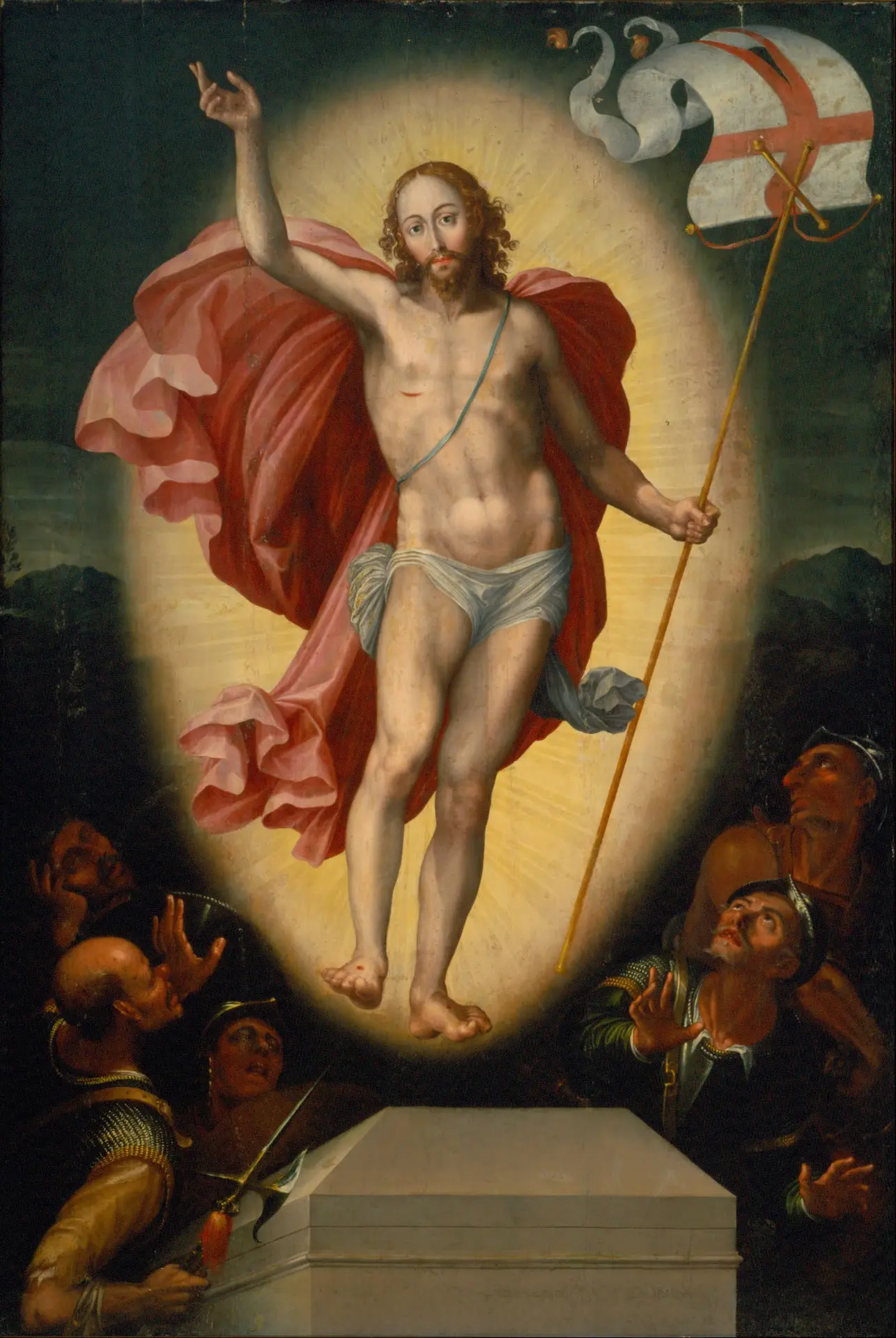
The tomb is empty. This is either the most important fact in human history or an embarrassing mistake. There is no comfortable middle ground. The Resurrection is a claim about what happened — and what is therefore possible.
Alonso López de Herrera, The Resurrection of Christ, early 17th century. Mexico.
1st Glorious Mystery · Prayed Wednesday & Sunday
The Resurrection is the first Glorious Mystery of the Rosary. On the third day Jesus rises from the dead, the tomb is found empty, and he appears first to Mary Magdalene and then to the disciples (John 20). It is prayed on Wednesdays and Sundays, and its fruit is faith.
What is the Resurrection?Resurrectio
Fruit of the Mystery: Faith
On the first day of the week, Mary of Magdala came to the tomb early in the morning, while it was still dark, and saw the stone removed from the tomb... Jesus said to her, "Mary!" She turned and said to him in Hebrew, "Rabbouni," which means Teacher.John 20:1, 16
What happened at the Resurrection?
Three days. In the Jewish reckoning, any part of a day counts as a full day — so from late Friday afternoon, through all of Saturday, to the early hours of Sunday, three days have passed since the Cross. The Sabbath has ended. The women who were present at the crucifixion, who watched where Jesus was laid, set out before dawn on Sunday morning with spices to anoint the body. They did not expect the tomb to be empty. They were expecting a corpse.
Mary Magdalene arrives while it is still dark (John 20:1). The stone — a large circular disc rolled in a groove across the entrance — has been removed. Not cracked, not broken, not destroyed. Simply removed, as if by someone who had a reason to remove it: not to let Jesus out (a risen body needs no stone moved) but to let witnesses in. Mary's first interpretation is simple and rational: "They have taken the Lord from the tomb, and we don't know where they put him" (John 20:2). She runs to Simon Peter and to the Beloved Disciple. They run back. The Beloved Disciple arrives first, looks in, sees the burial cloths. Peter enters — and sees them lying flat, with the head cloth rolled up separately. John 20:8: "He saw and believed." What exactly did he believe? That the body had been removed, or that something else had happened? The text is deliberately poised at the edge of understanding.
Mary stands outside the tomb weeping after they leave. She looks in and sees two angels in white where the body had been. They ask: "Woman, why are you weeping?" She explains. Then she turns around. A man is standing there. "Woman, why are you weeping? Whom are you looking for?" (John 20:15). She assumes he is the gardener. "Sir, if you carried him away, tell me where you laid him, and I will take him." The gardener says one word: "Mary." And she recognizes him.
One word. Her name. The same voice that had said her name before, that had freed her from seven demons, that she had followed for years — now saying her name from the other side of death. "Rabbouni." Teacher. She clings to him. He tells her: "Stop holding on to me, for I have not yet ascended to the Father" (John 20:17). Noli me tangere in the Vulgate — do not hold onto me. The Risen Christ is real — tangible, speaking, present — but not the same reality as before. The Resurrection is not a resuscitation. Something has happened that has no precedent.
Thomas, who was not there when the Risen Christ appeared to the disciples in the upper room, makes his demand: "Unless I see the mark of the nails in his hands and put my finger into the nailmarks and put my hand into his side, I will not believe" (John 20:25). A week later, Jesus appears again. He offers Thomas his hands and his side. Thomas does not touch them. He says: "My Lord and my God" (John 20:28). The wounds are offered as evidence. The Risen body still bears its history. The marks of the nails and the spear are not healed over. They are part of what the Resurrection is.
What is the spiritual fruit of this mystery?The fruit: Faith
The fruit of the Resurrection is faith — and it is worth being precise about what faith means in this context. Faith is not belief despite evidence. It is not the suspension of reason in favor of pious wish. Aquinas defines faith as the intellect's assent to what God has revealed, an assent that is firm precisely because it is grounded in God's authority and truthfulness (ST II–II, Q. 2, a. 9). The resurrection of Jesus is the foundational revelation on which Christian faith stands: "If Christ has not been raised, your faith is in vain" (1 Corinthians 15:17). Paul does not say: if Christ has not been raised, your faith is less persuasive. He says it is empty, meaningless, false.
The Resurrection decade is the place to pray through whatever is currently making faith difficult. The disciples themselves did not believe immediately: Mary thought he was the gardener, the disciples on the road to Emmaus thought he was a fellow traveller, Thomas demanded evidence. The Risen Christ met each of them where they were. He said Mary's name; he broke bread; he offered his wounds. Faith is not given all at once. It is received through encounter.
Sacred site: The Church of the Holy Sepulchre, Jerusalem — the same building that encloses Golgotha also encloses the Tomb (Kouvouklion) where Jesus was buried and from which he rose. The Edicule — the small shrine built over the Tomb itself — was last fully restored in 2017. The original tomb cut into the rock is partially visible beneath the marble cladding added in 1555. Archaeological evidence is consistent with a first-century Jewish tomb of the type described in the Gospels.
The Resurrection is the First Glorious Mystery of the Rosary. On the first day of the week, the tomb is found empty. Jesus appears to Mary Magdalene in the garden, to the disciples in the upper room, to Thomas who demanded evidence, and to many others. The Risen Christ still bears the wounds of the Crucifixion. The spiritual fruit is faith — not belief despite evidence but the intellect's assent to what God has revealed through the event of the Resurrection.
What does Noli me tangere mean?
Noli me tangere (Latin: "Do not hold onto me" or "Touch me not") is Jesus's words to Mary Magdalene in John 20:17 when she recognizes him at the tomb and clings to him. The phrase indicates that the Risen Christ is real and present but not the same kind of presence as before the Crucifixion. The Resurrection is not a resuscitation. The Risen body is tangible (Thomas can touch the wounds) but transformed — no longer subject to the ordinary limitations of physical existence. Mary cannot hold Jesus here in the way she could before.
Why does the Risen Christ still have wounds?
The Risen Christ's wounds — the nail marks in his hands, the wound in his side — appear in the Resurrection accounts not as evidence of damage but as evidence of identity. Thomas demands to see and touch them as proof that this is the same Jesus who was crucified. Jesus offers them. The wounds are not healed over but glorified — transformed into permanent marks of what happened. Hebrews 9:12 reads the Risen Christ as the eternal high priest who "entered once for all into the sanctuary, not with the blood of goats and calves but with his own blood." The wounds are his permanent intercession.
Pray the Glorious Mysteries at Orabimus.
Step-by-step, with audio in English and Latin. Free, no account required.