Tertia Mysteria Gloriosa · Descensus Spiritus Sancti
The Descent of the Holy Spirit
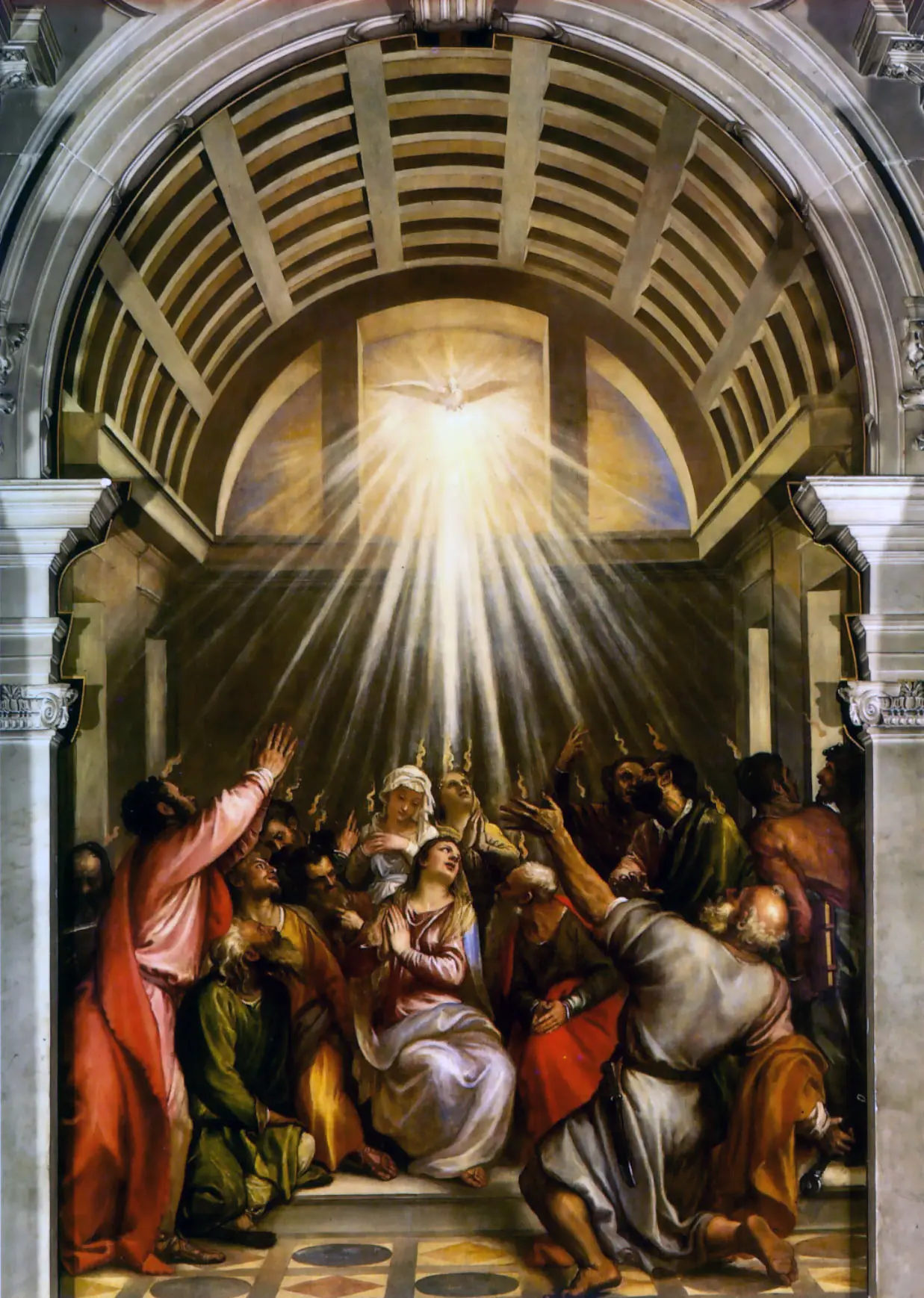
A sound like a rushing wind fills the house. Tongues like fire rest on each of them. They begin to speak in languages they do not know, and people from every nation under heaven hear them in their own tongue. Where Babel scattered, Pentecost gathers.
Titian, Descent of the Holy Spirit (Pentecost), c. 1545. Santa Maria della Salute, Venice.
3rd Glorious Mystery · Prayed Wednesday & Sunday
The Descent of the Holy Spirit is the third Glorious Mystery of the Rosary. At Pentecost the Spirit comes upon Mary and the apostles in wind and fire, reversing Babel, and Peter preaches the first sermon of the Church (Acts 2:1 to 41). It is prayed on Wednesdays and Sundays, and its fruit is wisdom.
What is the Descent of the Holy Spirit?Descensus Spiritus Sancti
Fruit of the Mystery: Wisdom
Suddenly there came from the sky a noise like a strong driving wind, and it filled the entire house in which they were. Then there appeared to them tongues as of fire, which parted and came to rest on each one of them. And they were all filled with the Holy Spirit and began to speak in different tongues, as the Spirit enabled them to proclaim. Acts 2:2–4
What happened at Pentecost?
Fifty days after Easter. The Jewish feast of Shavuot — the Feast of Weeks, the feast of the first fruits of the wheat harvest, and by the first century also commemorating the giving of the Torah on Sinai. Jerusalem is crowded with pilgrims. Devout Jews from across the diaspora have come: Parthians, Medes, Elamites, people from Mesopotamia, Judea, Cappadocia, Pontus, Asia, Phrygia, Pamphylia, Egypt, Libya, Rome, Crete, Arabia — Luke lists fifteen regions, a catalogue of the known world (Acts 2:9-11). The same Spirit who will fill the house is already drawing the audience.
They are all together in one place — the 120 of Acts 1:15, the restored Twelve, Mary the mother of Jesus, the brothers of Jesus who did not believe during the ministry and now do. All in one place. All having followed the instruction: wait. For ten days since the Ascension they have waited, together, in prayer (Acts 1:14). Then the sound comes.
A sound like a rushing, violent wind — pnoē in Greek, the same root as pneuma, the word for spirit and for breath and for wind. The Spirit comes as wind. Genesis 1:2: "The earth was formless and empty, and the Spirit of God was hovering over the face of the waters." The same Spirit that hovered over the primordial chaos at the first creation now fills the room at the beginning of the new creation. Ezekiel 37:9-10: "Come from the four winds, O breath, and breathe into these slain, that they may live." The dry bones that Ezekiel saw raised by the wind of God — the Spirit is the breath of resurrection life, and at Pentecost that breath fills the room.
Then the tongues of fire. Fire is the perennial biblical symbol of the divine presence in its most intense and transforming mode. The burning bush from which God spoke to Moses (Exodus 3:2-4) — the fire that burns but does not consume. The pillar of fire that led Israel through the wilderness by night (Exodus 13:21). The fire that fell on Elijah's sacrifice and vindicated his God against the prophets of Baal (1 Kings 18:38). The fire in Daniel's furnace in which the fourth figure walks with Shadrach, Meshach, and Abednego (Daniel 3:25). Fire is purifying (Malachi 3:2-3), illuminating, consuming of dross while leaving the essential. The tongues of fire that rest on each of the 120 are individual: one on each head, personal, undefeated by the plurality of recipients. The same Spirit given without measure.
They speak in other languages — glossais heterais, other tongues, languages not their own. And the crowds gathered outside hear each in their own native language (Acts 2:6). The miracle is in both the speaking and the hearing. What had been fractured at Babel is being mended. Genesis 11:7-9: God confused the languages of those building the tower, scattered them across the earth, and the human project of unified striving against God collapsed into mutual incomprehension. At Pentecost, the process runs in reverse: people separated by language for centuries hear, in their own tongue, the mighty works of God. The Spirit does not erase the diversity of languages but passes through it — every tongue declares the same thing in its own voice.
Peter stands up. This is the same man who denied Jesus three times by a charcoal fire in the courtyard of the high priest. That denial cost him something he has never recovered from by his own power. But the Risen Christ asked him three times by a different charcoal fire on the shore of Galilee: "Simon, son of John, do you love me?" (John 21:15-17). Three reinstatements for three denials. And now the Spirit that Jesus promised has come, and Peter stands and speaks to thousands and three thousand are baptized in a day.
His sermon is the first Christian proclamation. It is built entirely from the Hebrew Scriptures — Joel 2:28-32, Psalm 16:8-11, Psalm 110:1. He is not improvising. The Spirit that has come upon him has given him access to the whole of Scripture as a unified testimony to what has just happened. The one who could not admit knowing Jesus when a servant girl asked now declares him publicly as Lord and Christ to thousands of pilgrims from across the world.
Augustine and the Soul of the Church
Augustine provided the most enduring image for understanding the Holy Spirit's relationship to the Church. In his Sermons (267.4), he writes: "What the soul is to the body of man, that is the Holy Spirit to the body of Christ, which is the Church." The body of a person is animated, given life, held in unity, directed in its operations by the soul. Without the soul the body is a corpse. Without the Holy Spirit the Church is an institution — a collection of buildings and procedures and traditions — but not the Body of Christ. Pentecost is the moment the body breathes.
This image has consequences for understanding both the Church's unity and its diversity. A soul animates a body with multiple different organs — lungs, heart, hands, eyes — each performing a different function, yet all animated by the same principle of life. Paul develops precisely this analogy in 1 Corinthians 12: "There are different kinds of spiritual gifts but the same Spirit; there are different forms of service but the same Lord" (1 Corinthians 12:4-5). The gifts of the Spirit are not uniformity. They are the diverse expressions of the one Spirit in the many members of the one Body.
Basil of Caesarea, in his treatise On the Holy Spirit (written around 375 AD), insists on the equal dignity of the Spirit with the Father and the Son: "The Spirit is not to be ranked below the Father and the Son, as if he were inferior in nature... He who receives the Spirit from the Spirit is in God and with God, and the light that shines into him is the same light that shines in the whole Trinity" (De Spiritu Sancto 26). Basil's treatise was provoked by the Pneumatomachians — those who accepted the full divinity of the Son but denied it to the Spirit — and his response established the theological grammar of the Nicene-Constantinopolitan Creed's language about the Spirit: "the Lord and giver of life, who proceeds from the Father, who with the Father and the Son is adored and glorified."
What is the spiritual fruit of this mystery?The fruit: Wisdom
The fruit of the Descent of the Holy Spirit is wisdom — and this is the highest of the gifts Paul lists, the gift by which all the others are coordinated and directed. Aquinas distinguishes between the acquired wisdom that comes from intellectual effort (philosophical wisdom, scientia) and the infused wisdom that comes as a gift of the Holy Spirit — sapientia, which is the capacity to judge all things according to divine standards rather than merely human ones (ST II–II, Q. 45). The wise person in this sense is not the one who has mastered the most information but the one whose entire judgement has been calibrated to reality as God sees it.
This is precisely what happens to Peter at Pentecost. He does not suddenly know more facts than he knew before. He sees what the facts mean — he sees the whole of Scripture as pointing to the Risen Christ, sees the crowd as a harvest of souls, sees his own past denials as no longer definitive, sees forward into what the Spirit is now doing. The gift of wisdom is a gift of orientation: it turns the whole person to face in the right direction and then sees clearly from that position.
Sacred site: The Cenacle (Upper Room), Mount Zion, Jerusalem — the same room traditionally identified as the site of the Last Supper and understood to be the room where the disciples gathered for ten days after the Ascension. The present structure is medieval (12th-century Crusader construction). The Basilica of the Holy Spirit, also on Mount Zion, marks a nearby site of Pentecost veneration. The Church of the Holy Sepulchre, the Cenacle, and Gethsemane form a triangle of sites within which the core events of the Paschal Mystery occurred.
How to Pray This Decade
Announce: The Third Glorious Mystery — The Descent of the Holy Spirit. Pray one Our Father. As you pray the ten Hail Marys, hold the image of waiting — ten days of prayer between the Ascension and Pentecost. The Spirit was not earned. It was promised, expected, and received in readiness. The question this mystery puts: what waiting is currently required of you that you have been trying to end prematurely? And: where is the Spirit already moving that you have not yet named?
What is the Descent of the Holy Spirit in the Rosary?
The Descent of the Holy Spirit (Pentecost) is the Third Glorious Mystery of the Rosary, drawn from Acts 2:1-41. Fifty days after Easter, the 120 disciples gathered in Jerusalem are filled with the Holy Spirit, manifested as a rushing wind and tongues of fire. They speak in languages not their own, and people from fifteen regions hear them in their native tongues. Peter preaches the first Christian sermon and three thousand are baptized. The spiritual fruit is wisdom and love of God.
What is the connection between Pentecost and Babel?
Pentecost is the reversal of Babel. At Babel (Genesis 11:1-9), God confused the single human language, scattering the peoples who had united in autonomous self-sufficiency against him. At Pentecost, people from fifteen different language groups hear the disciples speaking in their own native tongues — the Spirit passes through the diversity of languages rather than erasing it, so that every tongue declares the same thing. Where Babel produced division through pride, Pentecost produces unity through the gift of the Spirit.
What did Augustine say about the Holy Spirit?
Augustine's most enduring image for the Holy Spirit appears in his Sermons (267.4): "What the soul is to the body of man, that is the Holy Spirit to the body of Christ, which is the Church." As the soul animates, unifies, and directs the body, the Spirit animates, unifies, and directs the Church. Without the Spirit the Church is an institution without life. Augustine also develops in De Trinitate the understanding of the Spirit as the mutual Love of Father and Son — the bond of love within the Trinity that is then poured out into creation and into human hearts (Romans 5:5).
What are the gifts of the Holy Spirit?
The seven gifts of the Holy Spirit, drawn from Isaiah 11:2-3 (in the Septuagint and Vulgate), are: wisdom, understanding, counsel, fortitude, knowledge, piety, and fear of the Lord. Aquinas explains them as permanent dispositions that make the soul promptly responsive to the Spirit's movements, perfecting the virtues from within (ST I-II, Q. 68). They differ from the charisms (charismata) of 1 Corinthians 12 — which are gifts for the building up of the community — in being primarily for the personal sanctification of the recipient.
Pray the Glorious Mysteries at Orabimus.
Step-by-step, with audio in English and Latin. Free, no account required.