Prima Mysteria Dolorosa · Agonia in Horto Getsemani
The Agony in the Garden
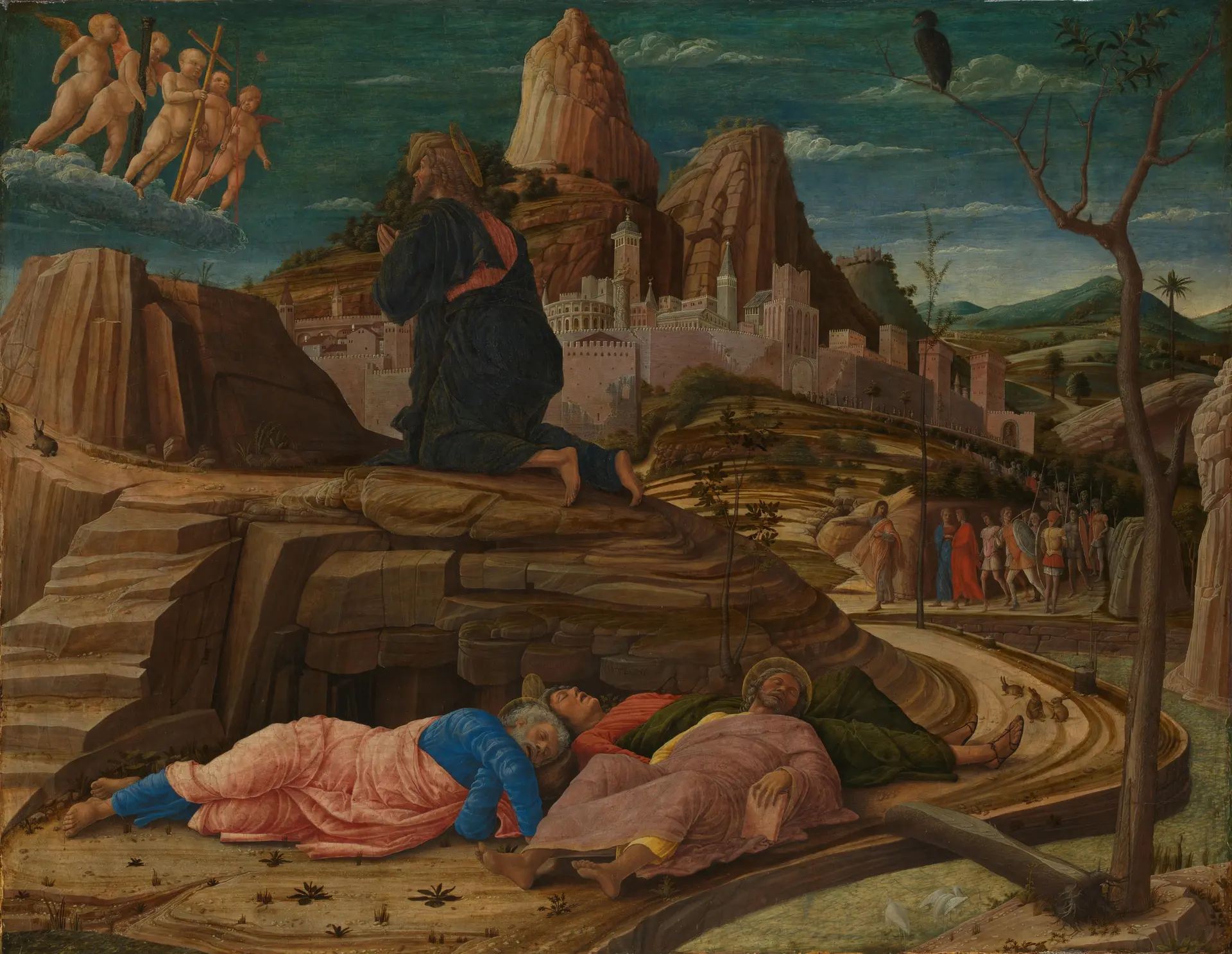
Jesus prays three times for the cup to pass. It does not pass. The disciples sleep. An angel comes not to remove the suffering but to make it possible to endure. This is the mystery of prayer that is not answered the way we asked.
Andrea Mantegna, The Agony in the Garden, c. 1458 to 1460. National Gallery, London.
1st Sorrowful Mystery · Prayed Tuesday & Friday
The Agony in the Garden is the first Sorrowful Mystery of the Rosary. On the night before he dies, Jesus prays in anguish at Gethsemane, sweating blood as he accepts the Father's will while the disciples sleep (Matthew 26:36 to 46). It is prayed on Tuesdays and Fridays, and its fruit is conformity to God's will.
What is the Agony in the Garden?Agonia in Horto
Fruit of the Mystery: Conformity to God's Will
"My Father, if it is possible, let this cup pass from me; yet, not as I will, but as you will."Matthew 26:39
What happened in the Garden of Gethsemane?
The Passover meal is over. They have sung the Hallel psalms — the great psalms of praise from Psalm 113 through 118. They have left the upper room. They are crossing the Kidron Valley in the dark, moving toward the Mount of Olives, toward the garden the disciples knew from previous visits. Gethsemane. The name means "oil press" in Aramaic — a place where olives were brought to be crushed, where the weight of a stone pressing down on gathered fruit extracts what is inside it. The name is not accidental.
Jesus tells most of the disciples to sit while he goes further with Peter, James, and John — the same three who were on the mountain of the Transfiguration. He begins to be "sorrowful and troubled" (Matthew 26:37). The Greek is lupeisthai kai adēmonein — to be grieved and distressed, overwhelmed with anxiety. He says to the three: "My soul is sorrowful even to death. Remain here and keep watch with me" (Matthew 26:38). This is not a rhetorical figure. He is telling them the truth: the weight of what is approaching is lethal in its intensity. He asks them to stay awake with him.
He goes a little farther — alone — and falls on his face. And he prays: "My Father, if it is possible, let this cup pass from me; yet, not as I will, but as you will" (Matthew 26:39). This is one of the most significant prayers in Scripture because of what it shows. Jesus, the Son of God, prays for an alternative. He asks that the Passion not happen. The prayer is not answered the way he asked. God does not remove the cup. Jesus will pray the same prayer two more times, and two more times the answer will be the same non-answer: not the removal of the cup but the strengthening to drink it. Luke 22:43 records that an angel appeared to him and strengthened him. The angel does not take the cup away. The angel makes it possible to hold it.
Luke also records the detail that his sweat became "like drops of blood falling to the ground" (Luke 22:44). The medical literature documents hematidrosis — a condition in which, under conditions of extreme psychological stress, the capillaries supplying the sweat glands rupture and blood mixes with sweat. It is rare and it is real. Jesus is not performing suffering for an audience. He is undergoing something in his body, in his autonomic nervous system, that is consistent with the approach of something he dreads with every human fiber.
He returns to the three disciples. They are asleep. "So you could not keep watch with me for one hour?" (Matthew 26:40). He does not rebuke them savagely. He is gentle: "The spirit is willing, but the flesh is weak" (Matthew 26:41). He goes away a second time. Prays the same prayer. Returns to find them asleep again — "for their eyes were heavy" (Matthew 26:43). A third time. A third return. Three times the prayer goes up; three times the disciples fail to keep watch. The number is not coincidental. Peter will deny him three times before dawn. The same human fragility operates in both scenes.
Then: "Are you still sleeping and taking your rest? Behold, the hour is at hand when the Son of Man is to be handed over to sinners. Get up, let us go. Look, my betrayer is at hand" (Matthew 26:45-46). He is ready. Not because the cup has been removed but because something has happened in the garden that makes it possible to walk toward the cup. What happened between the first prayer and the last? The third prayer was the same prayer as the first — but something in Jesus shifted in the praying of it.
What is the spiritual fruit of this mystery?The fruit: Conformity to God's Will
The fruit of the Agony in the Garden is conformity to God's will — not as I will, but as you will — and it is crucial to understand that this is an active disposition, not a passive one. Jesus does not resign himself to the Passion. He re-aligns his will with his Father's, which is a different thing. Thomas Aquinas distinguishes between the sensitive appetite (what we instinctively want, the will of the flesh) and the rational will (what we choose when we are ordered toward our highest end). In Gethsemane, Jesus's sensitive appetite recoils from what is coming — this is the prayer for the cup to pass. His rational will, ordered to the Father, re-aligns: "not as I will but as you will." This re-alignment is the act of conformity (ST III, Q. 18, a. 5).
Gregory of Nazianzus, in his famous letter to the priest Cledonius (Ep. 101) — written to defend the full humanity of Christ against those who softened it — states the soteriological principle on which the Agony in the Garden depends: "What is not assumed is not healed; what is united to God is also saved." If Jesus did not have a genuine human will that recoiled from suffering, a genuine human fear, a genuine desire for the cup to pass — then human fear and dread are not redeemed. The sweat like blood, the three prayers, the anguished "not as I will but as you will" are not weaknesses to be explained away but the necessary content of the redemption. God redeems human suffering by entering it, not by bypassing it. Gregory is precise: the Agony is not a performance. It is what salvation costs from the inside.
Maximus the Confessor, the seventh-century theologian who suffered mutilation and exile for defending the full humanity of Christ's will, developed the most refined account of what happens in Gethsemane. At the Third Council of Constantinople in 681 AD, the Church defined that Christ possessed two wills — a divine will and a genuine human will — and that these were not in contradiction but in harmony through the hypostatic union. Maximus had argued for this against the Monothelites who wanted to collapse Christ's will into one. In the Agony, the human will (thelema physikon) genuinely does not want what is coming. The divine will consents. The relationship between these two is not the suppression of the human will but its free and loving submission — and this is precisely the act that redeems the human will in every person who has ever prayed the same prayer and received the same non-answer.
The fruit of the Agony decade is the cultivation of this same re-alignment in our own lives — not the suppression of the honest prayer ("let this cup pass"), which Jesus himself prayed, but the movement through that prayer toward the deeper surrender: "not as I will but as you will." The model here is not stoic resignation but the full human prayer of someone who does not want what is coming and yet chooses to receive it because the Father wills it.
Sacred site: The Garden of Gethsemane, at the foot of the Mount of Olives, Jerusalem. Eight ancient olive trees in the garden are among the oldest known olive trees in the world. A study by the Italian National Research Council radiocarbon-dated the trunk wood of three of them to the twelfth century (around 1092, 1166 and 1198 AD); the other five are too hollow at the centre to date. Because olive trees can regrow from their roots, the living trees may be older than their datable trunks, but the evidence cannot trace them to the first century, and it is unclear whether they descend from trees that stood here in the time of Jesus. Genetic analysis has found that all eight share an identical genotype, indicating they were propagated from a single parent tree, most likely during the Crusader period. The Church of All Nations (Basilica of the Agony), completed 1924 by Antonio Barluzzi, is built around the rock traditionally venerated as the place where Jesus prostrated himself in prayer.
The Agony in the Garden is the First Sorrowful Mystery of the Rosary, drawn from Matthew 26:36-46 and parallels. After the Last Supper, Jesus goes to the garden of Gethsemane with his disciples. He prays three times that the cup of the Passion might pass from him. The disciples sleep. An angel strengthens him (Luke 22:43). He rises ready to meet his betrayer. The spiritual fruit is conformity to God's will.
What was the bloody sweat of Jesus?
Luke 22:44 records that Jesus's sweat became "like drops of blood falling to the ground" during the Agony. This describes hematidrosis — a documented medical condition in which extreme psychological stress causes the capillaries supplying sweat glands to rupture, mixing blood with sweat. It is rare but real. Jesus is not performing suffering for an audience; he is undergoing a physiological response to the approach of something he dreads with every human fiber. The Agony in the Garden is the first physical suffering of the Passion.
Why did God not take the cup away from Jesus?
The cup was not taken away because the redemption of humanity required it not to be. Jesus asked honestly — "if it is possible, let this cup pass" — and the Father's answer was not removal but strengthening: an angel appeared and gave him the capacity to bear what could not be removed. This is an important model for understanding unanswered prayer: God does not always answer by removing the suffering but by making it possible to endure it. The same pattern appears throughout Scripture — Paul's thorn in the flesh (2 Corinthians 12:7-9), the three times he asked for it to be removed, and the answer: "My grace is sufficient for you."
Pray the Sorrowful Mysteries at Orabimus.
Step-by-step, with audio in English and Latin. Free, no account required.