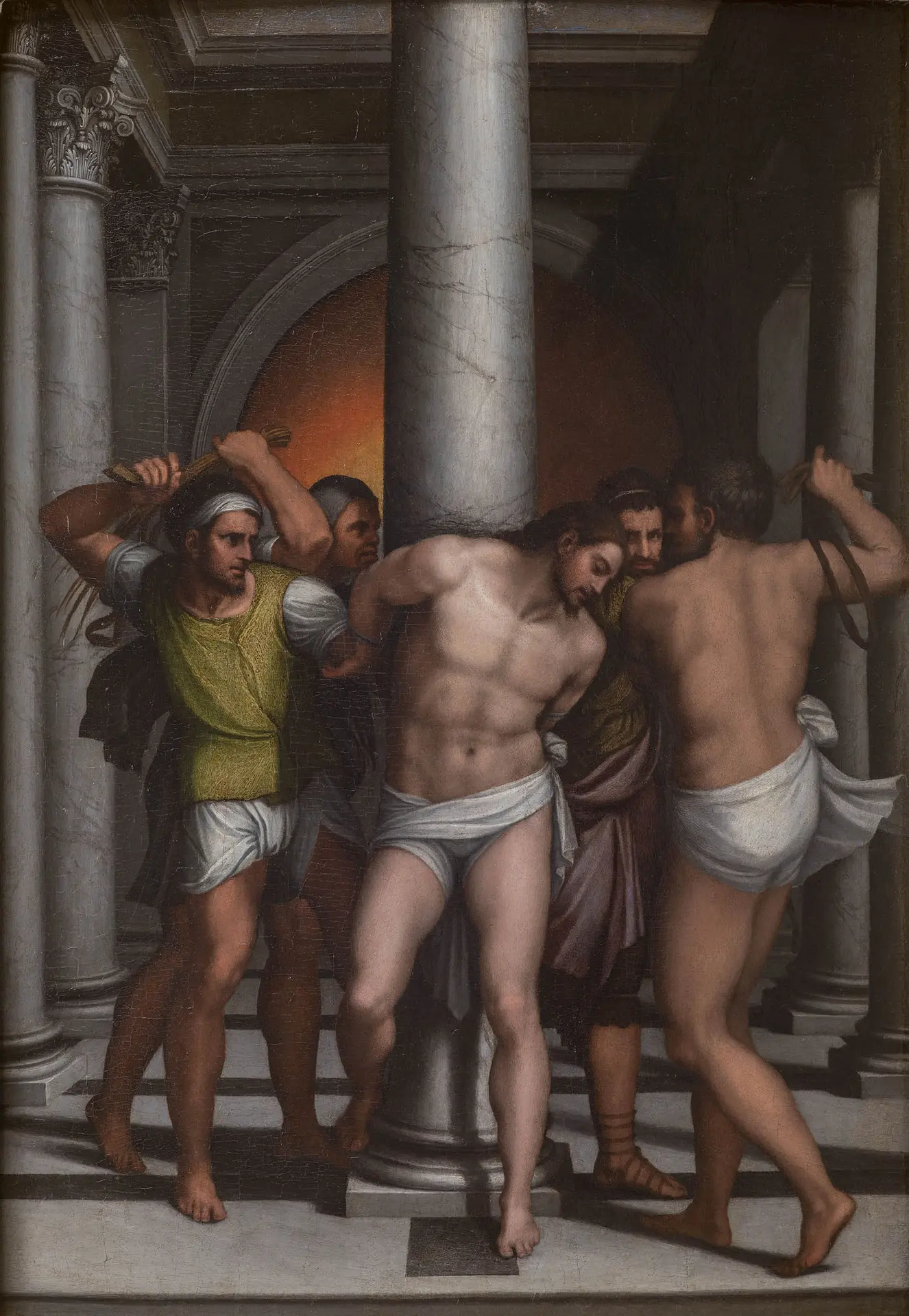
Secunda Mysteria Dolorosa · Flagellatio ad Columnam
The Scourging at the Pillar
The sentence is three words in Matthew's Gospel: he had Jesus scourged. Three words, and nothing more. The silence around it is part of what the mystery is asking us to enter.
Sebastiano del Piombo, The Flagellation of Christ (after Michelangelo), c. 1516 to 1521. San Pietro in Montorio, Rome.
2nd Sorrowful Mystery · Prayed Tuesday & Friday
The Scourging at the Pillar is the second Sorrowful Mystery of the Rosary. Pilate has Jesus stripped and brutally flogged with the Roman flagrum, fulfilling Isaiah's word that by his wounds we are healed (Matthew 27:26). It is prayed on Tuesdays and Fridays, and its fruit is mortification.
What is the Scourging at the Pillar?Flagellatio
Fruit of the Mystery: Mortification
Then he released Barabbas to them, but after he had Jesus scourged, he handed him over to be crucified.Matthew 27:26
What happened at the Scourging at the Pillar?
Matthew gives the scourging one clause in one sentence. Mark uses the same compression. Luke does not record it at all among the Synoptics. John mentions it: "Then Pilate took Jesus and had him scourged" (John 19:1). The Gospels do not linger. The tradition of Christian meditation has lingered for the Gospels, entering the silence around those three words and trying to hold what they contain.
The Roman flagrum — the scourge — was a whip with multiple leather thongs, each ending in a small piece of metal or bone. Its purpose was not execution; it was weakening. Rome flogged prisoners before crucifixion to accelerate death by exhaustion and blood loss. Jewish law capped flogging at forty stripes (Deuteronomy 25:3), which is why Paul could write of receiving "forty stripes less one" (2 Corinthians 11:24) — the rabbinical practice of stopping at thirty-nine to avoid accidentally exceeding the limit. Rome had no such limit.
Pilate has just tried to release Jesus through the Passover custom of releasing a prisoner. The crowd has chosen Barabbas instead — Barabbas, whose name in Aramaic means "son of the father," a murderous irony. Pilate, finding no guilt in Jesus, has Jesus flogged — some exegetes think Pilate may have intended the scourging as a concession to the crowd that would satisfy them without crucifixion. John's account suggests this: Pilate brings the scourged Jesus out before the crowd hoping the sight of him will be enough. "Behold the man," he says — Ecce homo. It is not enough. The crowd demands crucifixion.
The scourging is carried out in the Praetorium — Pilate's headquarters in Jerusalem, possibly the Antonia Fortress at the northwest corner of the Temple Mount or possibly the former palace of Herod in the upper city. Jesus is bound to a pillar. The soldiers begin. The Gospels record nothing of what happens during it: no words of Jesus, no description of duration, no account of who is present. There is a silence here that the Evangelists did not try to fill and that the tradition of contemplative prayer has been entering for two millennia.
Isaiah had seen it: "He was spurned and avoided by men, a man of suffering, knowing pain... he was pierced for our offenses, crushed for our sins; upon him was the chastisement that makes us whole, by his wounds we are healed" (Isaiah 53:3, 5). The Hebrew word translated "wounds" is haburah — a bruise, a stripe, a blow. Isaiah is not speaking metaphorically. The bruises are the point. The body absorbing the blow is the point. "By his wounds we are healed" is not a pious gloss on an incidental detail; it is the theological center of the mystery.
Peter, who was in the garden and fled, will later write: "He himself bore our sins in his body upon the cross... By his wounds you have been healed" (1 Peter 2:24). He was not at the scourging. But he knew what Isaiah had written, and he had seen the marks afterward. The Risen Christ still bore the marks of what was done to his body (John 20:27). The wounds did not disappear at the Resurrection. They became the evidence.
What is the spiritual fruit of this mystery?The fruit: Mortification
The fruit of the Scourging is mortification — a word that has acquired a grim and misunderstood reputation but whose meaning is precise. Mortificatio comes from mors (death) and facere (to make or do): the making-dead of what is disordered in the body and will. The Catechism describes it as part of the "ascesis and mortification" by which spiritual progress leads, through the Cross, toward the life of the Beatitudes (CCC 2015); the self-mastery this requires is what Aquinas treats under the virtue of temperance, which orders the passions and appetites to reason rather than letting them dominate (ST II–II, Q. 141). Mortification is not self-punishment. It is training — the same word Paul uses when he writes "I discipline my body and keep it under control" (1 Corinthians 9:27).
Augustine's Enarrationes in Psalmos (his expositions of the Psalms) includes a celebrated commentary on Psalm 22 — the psalm that begins with the cry of dereliction that Jesus prays from the Cross ("My God, my God, why have you forsaken me?") and ends in vindication and praise. Augustine's reading begins with one of his most characteristic moves: he hears the psalm not only as the voice of Christ but as the voice of the whole Christ, head and members — Christus totus, the entire body of those united to him. The abandonment that the psalm expresses is the abandonment that every suffering member of the Church has ever felt, placed in Christ's mouth because he has taken their suffering as his own. The silence of God during the scourging — no lightning bolt, no intervention, no angel stopping the soldiers as one stopped Abraham's hand — is the silence that every person in genuine suffering knows. And Augustine reads that silence as solidarity rather than abandonment: throughout his exposition he hears Christ speaking as the head of his body, taking on the cry of every suffering member as his own (Augustine, Enarrationes in Psalmos; the psalm is numbered 21 in his Latin text).
Leo the Great, preaching on the Lord's Passion, draws out the practical consequence for his hearers. Leo does not want his congregation to look past the scourging to the Resurrection too quickly. The humiliation is not a passage to be skipped over; it is the content of what is being accomplished. The body that absorbs each stroke is doing what the entire sacrificial system of the Temple had been symbolizing for centuries — taking onto itself what the world's sin deserves. Isaiah had seen this seven centuries earlier; Augustine and Leo are helping their congregations enter it.
The scourging shows what the body can bear when submitted to something beyond its own preferences. Jesus submits his body to what destroys it, not because the destruction is good in itself, but because what lies on the other side of it is. The fruit of the Scourging decade is the willingness to discipline the body and the will — through fasting, through prayer that costs time, through the small renunciations of comfort and convenience — not as self-hatred but as the practice of freedom: the freedom of the person whose appetites serve the spirit rather than tyrannize it.
Sacred site: The pillar of the Scourging, venerated since the early Church, is traditionally identified with a fragment now in the Basilica of Santa Prassede in Rome, brought from Jerusalem by Cardinal Giovanni Colonna in 1223. The Church of the Condemnation and Imposition of the Cross at the Antonia Fortress site in Jerusalem also marks the beginning of the Passion sequence. The Chapel of the Flagellation, also in Jerusalem near the Via Dolorosa, marks another traditional site.
What is the Scourging at the Pillar in the Rosary?
The Scourging at the Pillar is the Second Sorrowful Mystery of the Rosary, drawn from Matthew 27:26 and parallels. After Pilate condemns Jesus, he has him flogged with a Roman flagrum — a multi-thonged whip with metal or bone tips — before handing him over for crucifixion. The Gospels record the scourging in a single clause, with no words of Jesus and no description of the event. The spiritual fruit is mortification: the disciplining of the body and will toward their proper ends.
What does Isaiah 53:5 mean?
"By his wounds we are healed" (Isaiah 53:5) is the central prophecy of the Suffering Servant passage. The Hebrew word for wounds is haburah — a bruise, a stripe, a physical blow. The passage describes a figure who suffers vicariously: "he was pierced for our offenses, crushed for our sins; upon him was the chastisement that makes us whole." Peter quotes this passage explicitly in 1 Peter 2:24 and applies it to Jesus's Passion. The wounds of the Scourging are not incidental; in Isaiah's theology, they are the mechanism of healing.
What is mortification?
Mortification comes from the Latin mortificatio (to make-dead) and means the disciplining of the passions and appetites so that they serve the person's higher ends rather than dominating them. Aquinas defines it as the proper ordering of the sensitive appetite toward the rational will and ultimately toward God. It is not self-punishment or the performance of pain as piety. It is training — what Paul means when he writes "I discipline my body and keep it under control" (1 Corinthians 9:27). The scourging shows what the body can endure when submitted to something beyond its own comfort.
Pray the Sorrowful Mysteries at Orabimus.
Step-by-step, with audio in English and Latin. Free, no account required.