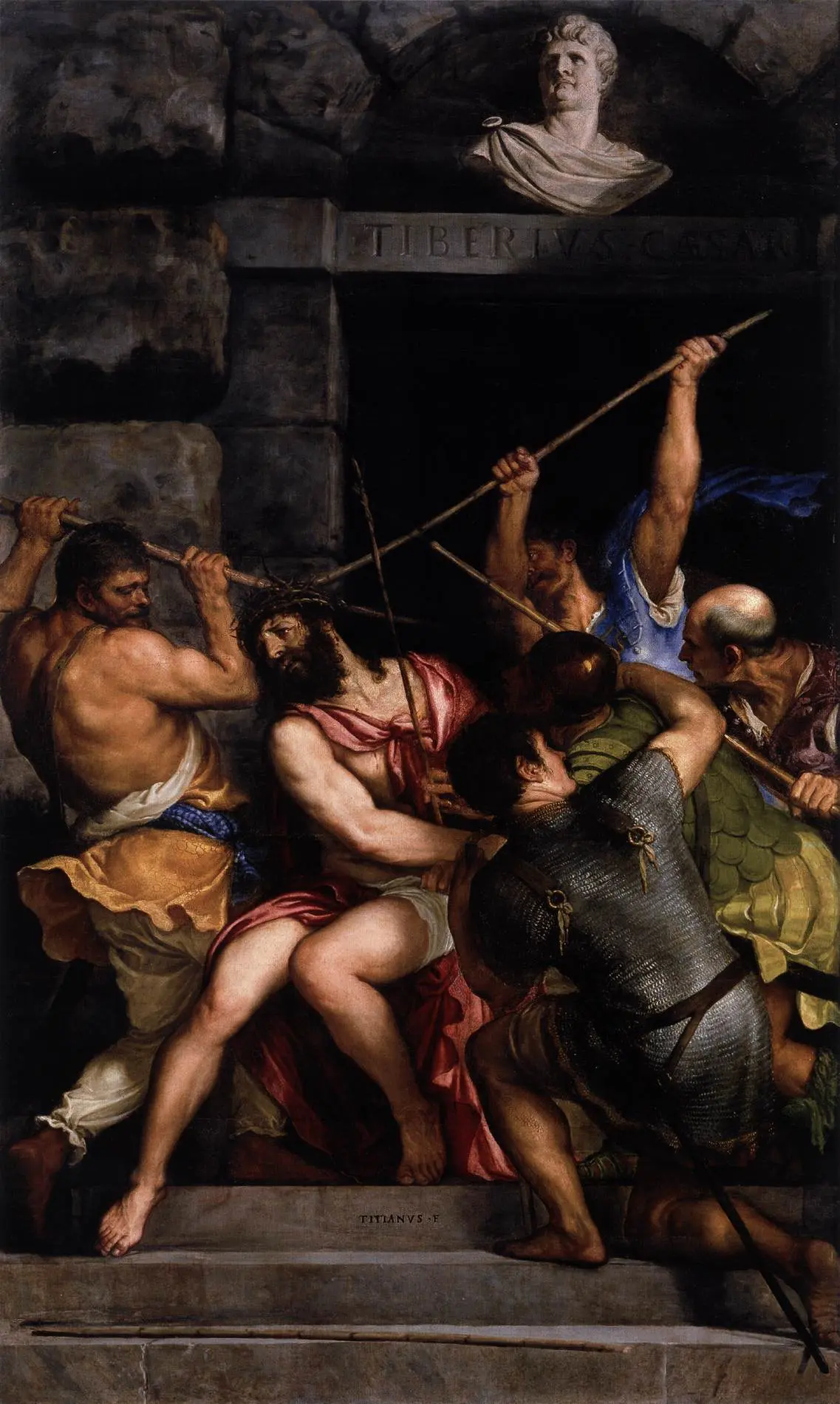
The soldiers weave thorns into a crown and set it on his head. They kneel. They mock. They have no idea they are performing the most significant coronation in history.
Titian, Christ Crowned with Thorns, c. 1542 to 1543. Louvre, Paris.
3rd Sorrowful Mystery · Prayed Tuesday & Friday
The Crowning with Thorns is the third Sorrowful Mystery of the Rosary. The soldiers press a crown of thorns onto Jesus and mock him as king, a cruelty that unknowingly proclaims the truth (Matthew 27:27 to 31). It is prayed on Tuesdays and Fridays, and its fruit is courage.
What is the Crowning with Thorns?Coronatio Spinis
Fruit of the Mystery: Courage
Weaving a crown out of thorns, they placed it on his head, and a reed in his right hand. And kneeling before him, they mocked him, saying, "Hail, King of the Jews!"Matthew 27:29
What happened at the Crowning with Thorns?
The scourging is over. The soldiers of the cohort — Matthew says "the whole cohort," possibly 200 to 600 men — assemble in the Praetorium. They strip Jesus of his own clothes and put a scarlet military cloak around him. A soldier's paludamentum, a rough imitation of royal purple. They weave thorns into a crown — the botanical identification is contested; acanthus thorns or Palestinian Christ-thorn are the most likely candidates, with spines two to four centimeters long — and press it down onto his scalp. They put a reed in his right hand as a scepter. And they perform the ritual of mockery: kneeling, saluting, calling him King of the Jews, striking him on the head with the reed, spitting on him.
What they are doing, without knowing it, is performing a coronation.
Every detail of the scene is ironically true. He is a king. The crown, painful as it is, is a crown. The scarlet cloak, crude as it is, is a robe of authority. The kneeling soldiers are doing what every creature will one day do — "at the name of Jesus every knee should bend, in heaven and on earth and under the earth" (Philippians 2:10). Their mockery is the form that acknowledgment takes when it has not yet been converted into belief. They are rehearsing the truth of what they are mocking.
The thorns carry their own theological weight. In Genesis 3:17-18, the ground is cursed because of Adam's sin: "Cursed is the ground because of you; thorns and thistles it will bear for you." The thorn is the mark of the curse, the visible sign of what sin has introduced into the world. Jesus is crowned with the mark of the curse. He puts on his head what the Fall produced. The King takes the curse onto himself — literally, painfully, with every spine that presses into his scalp.
Pilate then brings Jesus out before the crowd in the crown of thorns and the scarlet cloak. "Behold the man," he says — Ecce homo in the Vulgate (John 19:5). These two words have become one of the defining phrases of Christian iconography: the image of Jesus mocked and crowned with thorns presented to the world. Pilate means it as a contemptuous gesture: look at this pathetic figure, is this what you want crucified? The Church has taken it as a proclamation: behold the man — the representative human, the one who bears in his body what the human condition has come to, and what it is being rescued into.
What is the spiritual fruit of this mystery?The fruit: Courage
The fruit of the Crowning with Thorns is courage — and the mystery defines what kind of courage is meant. Not the courage of the fighter who inflicts pain on others, but the courage of the person who endures mockery without abandoning what is true. Jesus does not respond to the soldiers. He does not defend himself, does not explain the irony of what they are doing, does not call down fire from heaven. He stands in the crown of thorns and is what he is, while 200 soldiers perform elaborate public ridicule.
Augustine, commenting on the Passion in his tractates on John, notices that Pilate's words — Ecce homo, "Behold the man" (John 19:5) — contain more than Pilate intended. Pilate says "behold the man" as a gesture of contempt, hoping the crowd will be satisfied with a sufficiently humiliated prisoner and let him go. The Church has heard the words as a proclamation: here is the representative human, the new Adam, the one in whom humanity is both judged and rescued. "He says 'man' — and he says truth, though he does not mean truth: for in saying 'man' he calls him what he appears, not what he is. But in this, even he unknowingly proclaims the mystery, for the mystery is precisely that the King of Kings is here shown as man" (In Jo. Ev. Tr. 116.1). The mockery performs the truth. The soldiers who kneel in derision are enacting the cosmic reverence that every creature owes the Creator — they are just doing it ironically, without knowing it.
Tertullian, in his treatise De Corona (On the Soldier's Crown, ch. 14), connected the crown of thorns with the curse of Genesis 3. He asks what crown the One who is the Head of man, Christ Jesus, took up on behalf of all, and answers: a crown of thorns and thistles, the very figure of the sins that the soil of fallen flesh brought forth, which the power of the cross then took away, blunting in the Lord's suffering the sting of death. The thorn is the mark of the Fall, taken up into the Passion and worn as a crown. The curse is not annihilated; it is worn and thereby transformed.
Aquinas defines courage as the virtue by which a person faces the things most threatening to human life without either recklessness or cowardice (ST II–II, Q. 123). The specific form of courage that the Crowning asks is the courage to remain committed to what is real when the world is committed to mockery. The fruit of the Crowning decade is the formation of the disposition that does not yield to contempt, does not revise its commitments under social pressure, does not need the applause of those who are kneeling in mockery in order to know that it is a king.
Sacred site: The Chapel of the Crowning with Thorns (Lithostrotos/Gabbatha), traditionally located at the Antonia Fortress on the Via Dolorosa in Jerusalem. The stone pavement visible beneath the Sisters of Zion convent, long identified as the Gabbatha where Pilate judged Jesus (John 19:13), is now dated to the Hadrianic period (2nd century AD) rather than the first — but the location of the Praetorium and the sequence of events remains in the same general area of the old city.
The Crowning with Thorns is the Third Sorrowful Mystery of the Rosary, drawn from Matthew 27:27-31 and parallels. After the scourging, the Roman soldiers dress Jesus in a scarlet cloak, weave a crown of thorns and press it onto his scalp, put a reed scepter in his hand, and mock him as "King of the Jews" by kneeling and spitting. Pilate then presents him to the crowd: Ecce homo — Behold the man. The spiritual fruit is courage.
What is the significance of the crown of thorns?
The thorns carry the weight of Genesis 3:17-18, where God tells Adam: "Cursed is the ground because of you; thorns and thistles it will bear for you." The thorn is the mark of the curse — the visible sign of what sin introduced into creation. Jesus is crowned with the mark of the curse: he takes onto his head what the Fall produced. The King wears the crown of the world's disorder. The wood of the Cross will similarly take up the wood of Eden's tree.
What does Ecce Homo mean?
Ecce homo (Latin: "Behold the man") is Pontius Pilate's declaration when he presents the mocked and crowned Jesus to the crowd in John 19:5. Pilate intends it as a contemptuous gesture — look at this figure, is this what you want crucified? The Church has received it as a proclamation: behold the man — the representative human, bearing in his body the full weight of the human condition and what it is being redeemed into. The image has become one of the defining icons of Christian devotion.
Pray the Sorrowful Mysteries at Orabimus.
Step-by-step, with audio in English and Latin. Free, no account required.