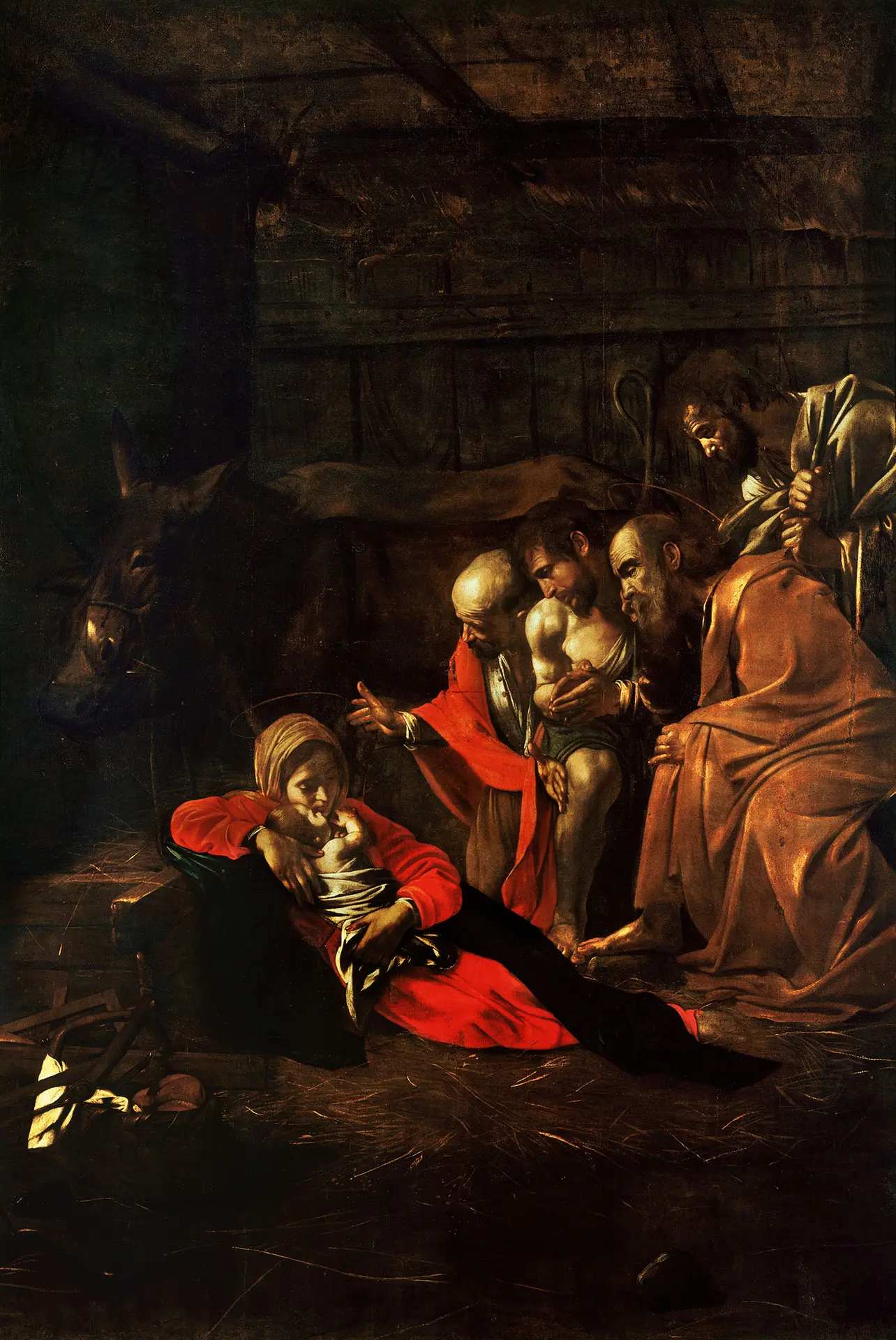
God chooses to be born in a borrowed space, laid in a feeding trough, announced to the overlooked. The Nativity is not a failure of planning. It is the shape of divine love.
Caravaggio, Adoration of the Shepherds, 1609. Museo Regionale, Messina.
3rd Joyful Mystery · Prayed Monday & Saturday
The Nativity is the third Joyful Mystery of the Rosary. Jesus is born in Bethlehem, laid in a manger, and announced first to shepherds (Luke 2:1 to 20). God empties himself to enter the world in poverty. It is prayed on Mondays and Saturdays, and its spiritual fruit is poverty of spirit.
What is the Nativity of the Lord?Nativitas
Fruit of the Mystery: Poverty
While they were there, the time came for her to have her child, and she gave birth to her firstborn son. She wrapped him in swaddling clothes and laid him in a manger, because there was no room for them in the inn. Luke 2:6–7
What happened at the Nativity?
Start with the facts of the situation, because the facts are doing the theology. Caesar Augustus has issued a decree for a census of the entire empire. Everyone must return to their ancestral town to be registered. Joseph, being of the house of David, takes Mary — now in the final weeks of her pregnancy — on the four-day journey from Nazareth south to Bethlehem, roughly 145 kilometres (about ninety miles) through the hill country of Judea. This is not a romantic journey. It is a difficult, painful, politically-compelled journey for a woman carrying a child, traveling because a distant emperor requires it.
They arrive in Bethlehem and there is no room. The Greek word Luke uses is katalyma — the same word he uses in Luke 22:11 for the upper room where Jesus will hold the Last Supper. It can mean an inn, or a guest room, or a lodging place. Whatever it is specifically, the point is that the social structure has no space for what is about to happen. The Son of God is born at the margin because the center is full.
They shelter in a place for animals — a cave or a stable — and Mary gives birth. She wraps the child in strips of cloth (swaddling clothes were standard practice, intended to keep the newborn warm and straight-limbed) and lays him in a manger: a feeding trough for cattle and donkeys. The Lord of the universe is placed where animals eat. The Word who would one day say "I am the bread of life" is laid in the bread-place, the feeding-vessel.
The night is otherwise quiet. No crowds, no ceremony, no official notice. Then, in the fields outside Bethlehem, shepherds are working the night watch over their flocks. Shepherds in first-century Judea were not picturesque figures. They were among the lowest social classes — their work made them ritually unclean by the requirements of the Law, their testimony was not accepted in court, they were broadly considered unreliable. They are nobody. And an angel appears to them, the glory of the Lord shines around them, and they are terrified.
The angel tells them: "Do not be afraid; for behold, I proclaim to you good news of great joy that will be for all the people. For today in the city of David a savior has been born for you who is Christ and Lord" (Luke 2:10-11). Then the whole host of heaven appears and sings. The most significant birth in history is announced to nobody in particular, in the dark, in a field, by a choir of angels who immediately disappear. The shepherds go immediately, find everything as they were told, and then go out and tell everyone they can find. They are the first evangelists.
This is the pattern of the Nativity: God comes not to where the world is watching but to where no one expects anything. He comes to a manger rather than a palace, to shepherds rather than to priests, to a stable rather than to the Temple. Irenaeus of Lyon saw this as the fulfillment of Isaiah's vision that the ox knows its owner and the donkey knows its master's feeding trough (Isaiah 1:3) — the manger is where you recognize the Lord.
Augustine preached on the Nativity in sermons still preserved in his Opera Omnia, and his Sermon 184 contains a line that cuts through all the tenderness to the theological nerve: "He was created of a mother whom he created. He was carried by hands that he formed. He cried in the manger in wordless infancy, he the Word, without whom all human eloquence is mute." The paradoxes pile up because reality piles up. The Word who is the condition for any speech is temporarily speechless. The Creator is carried by his own creature. The One from whom all time flows enters time at a specific point on a specific night. The manger is not only a poignant image; it is the most extreme statement of what it means for God to be serious about the Incarnation.
And Mary, Luke tells us twice, "kept all these things, reflecting on them in her heart" (Luke 2:19; 2:51). She receives what she cannot yet fully understand and holds it. The Nativity asks the same disposition of us.
What is the spiritual fruit of this mystery?The fruit: Poverty as Kenosis
The fruit of the Nativity is poverty, but this needs to be understood carefully. Not destitution — the Nativity is not a call to homelessness. Paul provides the theological key in Philippians 2:6-8: Christ, "though he was in the form of God, did not regard equality with God as something to be grasped. Rather, he emptied himself, taking the form of a slave, coming in human likeness; and found human in appearance, he humbled himself, becoming obedient to death, even death on a cross."
The Greek word is kenosis — emptying. Not the poverty of lacking things but the poverty of not grasping them. Not scarcity but detachment. The Nativity is kenosis made visible: the Creator born with nothing, in a borrowed space, announced to the overlooked. The fruit we seek in meditating on this mystery is what Paul calls the "mind of Christ" (1 Corinthians 2:16) — the interior freedom that does not require the world's structures of importance in order to be secure, the disposition that trusts what God gives without needing what God has not given.
Athanasius of Alexandria, writing his treatise On the Incarnation in the early 4th century, articulated the exchange at the heart of the Nativity with the precision that has never left theology: "He became man that we might become God" (De Incarnatione §54). This is not a sentimental flourish — it is the precise theological point that kenosis is never merely descent. The Son empties himself of the mode of divine existence not to leave divinity behind but to bring humanity into it. What the Nativity begins — the eternal Word taking on flesh, poverty, vulnerability, the cold of a Bethlehem night — is aimed at the deification of the very human nature he assumes. The manger is not the end of the story; it is the shape that the beginning of the story takes.
Leo the Great, preaching on the Nativity to his Roman congregation in the mid-fifth century, insisted on the paradox that doctrine alone cannot contain: "He who is God before all ages became man at the appointed time... He who is invisible by nature was made visible in our nature; He who could not suffer became capable of suffering" (Sermo 1 in Nativitate Domini). Leo wants his congregation to feel the weight of what they are celebrating — not a touching story about a baby in a stable but the collision of the eternal and the temporal in a specific night in a specific town. The joy of Christmas is not sentimental but ontological: something has changed in the structure of what is possible for human beings.
Paul makes the economic paradox explicit: "For you know the gracious act of our Lord Jesus Christ, that for your sake he became poor although he was rich, so that by his poverty you might become rich" (2 Corinthians 8:9). The direction of grace moves from poverty to richness — but only through the acceptance of poverty. The manger is the way to the altar.
Sacred site: Church of the Nativity, Bethlehem — the oldest continuously operating Christian church in the world. Constantine built the original basilica in 325 AD, directly over the cave traditionally identified as the birthplace. The current structure dates substantially from Justinian's rebuilding (529-565 AD). A silver star beneath the main altar marks the traditional site of the birth: Hic de Virgine Maria Jesus Christus natus est — Here Jesus Christ was born of the Virgin Mary. The entrance door has been lowered over centuries to force visitors to bow to enter.
How to Pray This Decade
Announce the mystery: The Third Joyful Mystery — The Nativity of the Lord. Pray one Our Father. As you pray the ten Hail Marys, place yourself at the edge of the stable: the animal smell, the cold, the dark, the silence that precedes the shepherds' arrival. The child wrapped in cloth. The manger. The presence of God that the world has missed because it was looking elsewhere.
The question this mystery asks: where are you currently grasping at something God has not given — security, recognition, control, comfort? The Nativity invites us into the interior freedom of not needing what we do not have, and trusting what we do. Not passivity — the shepherds went immediately when they heard the news. Kenotic poverty is active trust, not passive resignation.
The Nativity is the Third Joyful Mystery of the Rosary, drawn from Luke 2:1-20. It meditates on the birth of Jesus Christ in Bethlehem — born to the Virgin Mary in a stable, laid in a manger, announced to shepherds by angels. The spiritual fruit is poverty, understood as kenosis: detachment from the world's measure of greatness, and the interior freedom that trusts what God gives is enough.
What is the spiritual fruit of the Nativity?
The fruit of the Nativity is poverty — not destitution but kenosis, the Greek word Paul uses in Philippians 2:7 when he writes that Christ "emptied himself, taking the form of a slave." The Nativity is the literal enfleshing of that emptying: God born owning nothing, in an animal shelter, announced to shepherds (the poorest people in Judean society). The fruit we seek in meditation is the interior freedom that comes from detachment — the trust that what God gives is enough, that we need not grasp what he has not offered.
What is the significance of the manger?
The manger — a feeding trough for animals — is significant beyond its obvious indication of poverty. The Word who would later say "I am the bread of life" (John 6:35) and "Take and eat; this is my body" (Matthew 26:26) is placed at birth in the feeding vessel. There is a eucharistic symbolism that early Christian writers noticed: the Word who is food for the world is laid, at birth, in the place where animals feed. The manger is a pre-echo of the altar.
Why were the shepherds the first to hear about the birth of Jesus?
The shepherds were the first to hear of the Nativity because God consistently announces his most significant acts to those whom the world overlooks. Shepherds in first-century Judea were among the lowest social classes — their testimony was not accepted in a court of law, and their work made them ritually unclean. That God sends the angelic choir to announce the birth of the Messiah to shepherds rather than to the Temple authorities is an act consistent with everything the Magnificat had already sung: "He has lifted up the lowly."
What is kenosis?
Kenosis is the Greek term from Philippians 2:7 — "he emptied himself" (heauton ekenōsen) — used by Paul to describe what Christ did in the Incarnation. Christ, existing in the form of God, did not regard equality with God as something to be grasped, but emptied himself, taking the form of a slave, being born in the likeness of human beings. The Nativity is the visible form of kenosis: the eternal Son born in poverty, vulnerability, and obscurity. The fruit of the Nativity — poverty — is the invitation to participate in this same kenotic movement: to release rather than grasp, to trust rather than control.
Pray the Joyful Mysteries at Orabimus.
Step-by-step, with audio in English and Latin. Free, no account required.