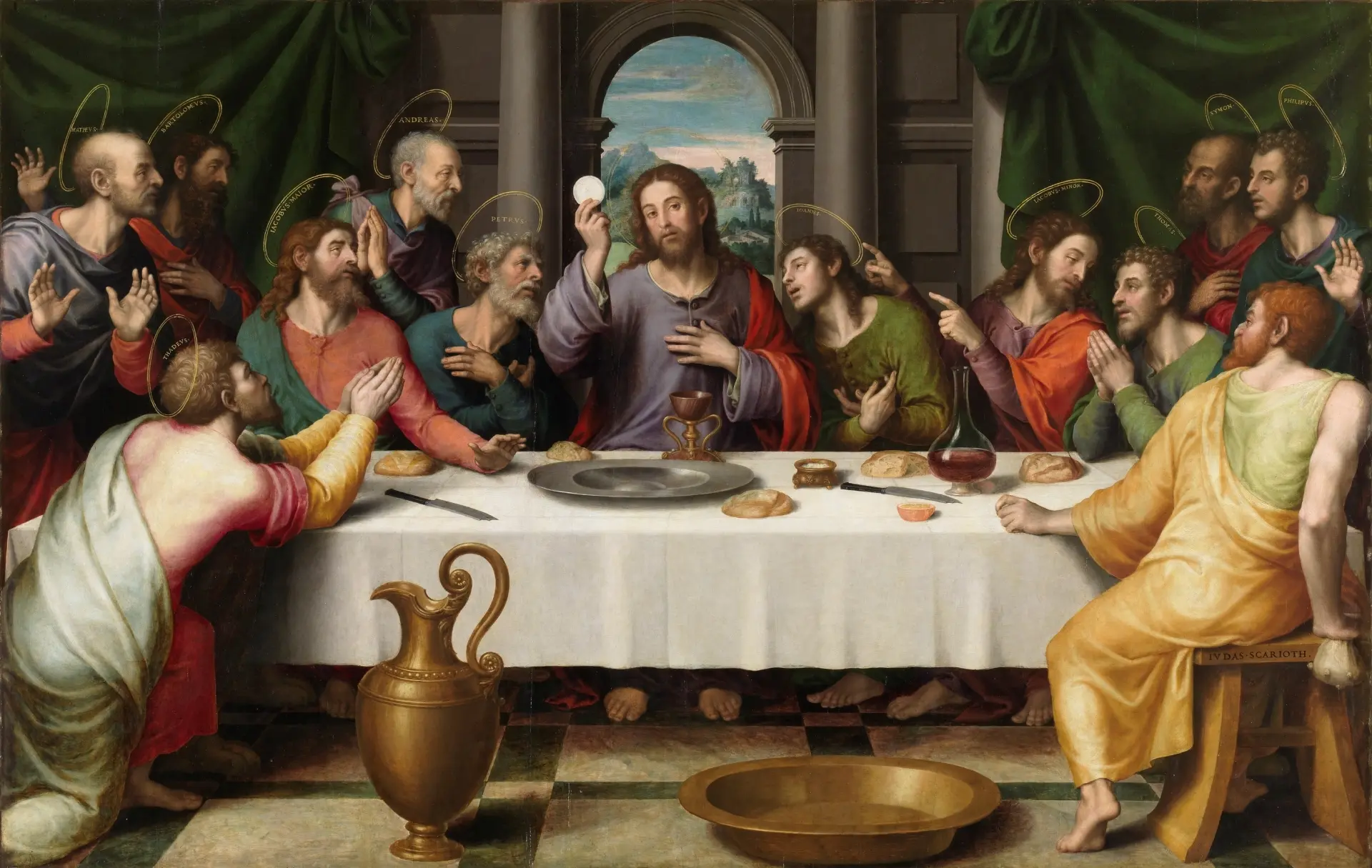
At a Passover meal in Jerusalem, Jesus takes bread and says three words that have divided and united the Church for two thousand years. Take and eat. This is my body.
Juan de Juanes, The Last Supper, c. 1562. Museo del Prado, Madrid.
5th Luminous Mystery · Prayed Thursday
The Institution of the Eucharist is the fifth Luminous Mystery of the Rosary. At the Last Supper Jesus takes bread and wine and gives his own Body and Blood, commanding the Church to do this in his memory (Matthew 26:26 to 28). It is prayed on Thursdays, and its fruit is adoration.
What is the Institution of the Eucharist?Institutio Eucharistiae
Fruit of the Mystery: Adoration
While they were eating, Jesus took bread, said the blessing, broke it, and giving it to his disciples said, "Take and eat; this is my body." Then he took a cup, gave thanks, and gave it to them, saying, "Drink from it, all of you, for this is my blood of the covenant, which will be shed on behalf of many for the forgiveness of sins."Matthew 26:26–28
What happened at the Institution of the Eucharist?
It is Passover. The lamb has been slaughtered in the Temple during the afternoon. The disciples have prepared the upper room — the katalyma, the same word Luke used for the lodging place in Bethlehem where there was no room. They have gathered at sundown, which marks the beginning of the Passover seder according to the Jewish lunar calendar. The meal follows the ancient liturgy of the Passover night: the four cups of wine, the unleavened bread, the bitter herbs, the telling of the Exodus story, the psalms of praise.
At some point during the meal — the Synoptics place it at the meal itself; John's structure is different — Jesus takes the bread. The Passover bread is unleavened, matza, the bread of haste and poverty that the Israelites ate as they fled Egypt. He says a blessing — the standard Passover blessing over bread: "Blessed are you, Lord our God, King of the universe, who brings forth bread from the earth." He breaks it. And then he departs from the script.
"Take and eat; this is my body." In the Greek: touto estin to soma mou. The word estin — is — carries no qualifier, no hedge, no "represents" or "symbolizes." The tradition of the Church, from Paul's letter to the Corinthians (written before any of the Gospels, around 54 AD) to the Council of Trent (1545-1563) to the Second Vatican Council (1962-1965), has always maintained that Jesus meant what he said without qualification.
Paul's account, the earliest written record of the Last Supper, is stark: "For I received from the Lord what I also handed on to you, that the Lord Jesus, on the night he was handed over, took bread, and, after he had given thanks, broke it and said, 'This is my body that is for you. Do this in remembrance of me'" (1 Corinthians 11:23-24). The phrase "in remembrance of me" translates the Greek eis tēn emēn anamnēsin — for my memorial, for my anamnesis. Anamnesis in Greek thought is not mere recollection. It is the kind of memorial that makes the past event actually present — the Passover itself was an anamnesis of the Exodus, not a history lesson about it. When Israel kept the Passover, they were not just remembering the Exodus; they were participating in it. "Do this in remembrance of me" asks the same thing of the Eucharist.
Then the cup. "Drink from it, all of you, for this is my blood of the covenant, which will be shed on behalf of many for the forgiveness of sins" (Matthew 26:27-28). "Blood of the covenant" is the language of Exodus 24:8, where Moses sprinkled the blood of sacrificed oxen on the people and said: "This is the blood of the covenant that the LORD has made with you." Jesus is enacting a new Exodus, a new covenant (Jeremiah 31:31-34), through his own blood. The cup of wine that is his blood is the cup of the Passover that is now also the inauguration of everything the Passover pointed toward.
John 6 — the Bread of Life discourse — provides the theological commentary that the Synoptics do not spell out. "Unless you eat the flesh of the Son of Man and drink his blood, you do not have life within you. Whoever eats my flesh and drinks my blood has eternal life, and I will raise him on the last day" (John 6:53-54). Many disciples left when he said this. Jesus did not call them back to explain that he was speaking metaphorically. He let them go.
What is the spiritual fruit of this mystery?The fruit: Adoration
The earliest non-apostolic testimony to the Eucharist outside the New Testament comes from Ignatius of Antioch, writing around 110 AD while being transported through Asia Minor to his martyrdom in Rome. In his letter to the Ephesians he calls the Eucharist the pharmakon athanasias — "the medicine of immortality and the antidote against death, which yields continuous life in union with Jesus Christ" (Eph. 20.2). Ignatius is not being poetic. He is describing the mechanism: the Eucharist works on the body's mortality the way medicine works on disease. What Jesus did at the Last Supper — and what the Church does at every Mass in his memory — is administer a substance that reverses the trajectory from death to life. This is eighty years after the Last Supper, from a man who knew the Apostles.
Justin Martyr, writing his First Apology to the Roman Emperor around 150 AD, gives the earliest description of the full Eucharistic liturgy, and he is explicit that Christian practice does not regard the Eucharist as ordinary food: "For not as common bread and common drink do we receive these; but in like manner as Jesus Christ our Saviour, having been made flesh by the Word of God, had both flesh and blood for our salvation, so likewise have we been taught that the food which is blessed by the prayer of his word... is the flesh and blood of that Jesus who was made flesh" (First Apology 66). Justin is writing in apologetics — he has no reason to exaggerate for a sympathetic audience. The claim is stated baldly, as a fact, to the emperor who would be no more likely to find it credible than a skeptic today.
Augustine, characteristically, comes at the mystery from the inside: "Why do you make ready your teeth and your stomach? Believe, and you have eaten" (In Jo. Ev. Tr. 25.12). He is explaining John 6:35 — "I am the bread of life; whoever comes to me shall not hunger" — and his point is that the primary consumption of the Eucharist is an act of faith before it is an act of digestion. Not instead of physical reception, but as its condition. To receive the Body of Christ without faith is to receive bread. To receive it in faith is to receive the Body of the one who is eternal life.
The fruit of the Institution of the Eucharist is adoration — the response that is appropriate when one is in the presence of what the Eucharist actually is. Aquinas defines adoration (latria) as the worship due to God alone, the supreme act of religion by which the soul recognizes and submits to the absolute supremacy of the divine being (ST II–II, Q. 84). If what Jesus said is true — if what is placed on the altar at every Mass is his body and blood — then the Eucharist is the most intense point of God's presence available to human beings in ordinary life, and adoration is the only appropriate response.
The fruit of the Eucharist decade is the cultivation of the disposition of adoration — the regular, deliberate orientation of the whole self toward the presence of Christ in the Eucharist. This is what Eucharistic adoration (the practice of spending time in prayer before the Blessed Sacrament, exposed in a monstrance) is designed to cultivate. But the same disposition can be cultivated in the moment of receiving Communion, in the silence after the fraction rite, in the moment of genuflection at the tabernacle. The mystery invites us to stop treating the Eucharist as one of many religious practices and to recognize it as what the Church says it is: the source and summit of Christian life.
Sacred site: The Cenacle (Upper Room), Mount Zion, Jerusalem — the traditional site of the Last Supper, located on the upper floor of a building above the traditional tomb of David. The present structure dates from the Crusader period (12th century), rebuilt and modified over the centuries. The room is venerated by Catholics, Orthodox, and Protestants alike. The same room is traditionally identified as the site of the Pentecost (Acts 2:1-4) — the same upper room, fifty days later, with the same disciples.
What is the Institution of the Eucharist in the Rosary?
The Institution of the Eucharist is the Fifth Luminous Mystery of the Rosary, drawn from Matthew 26:26-28 and parallels. At the Last Supper — a Passover meal in Jerusalem — Jesus takes bread, blesses it, breaks it, and says "This is my body." He then takes the cup and says "This is my blood of the covenant, which will be shed for many for the forgiveness of sins." The Church understands this as the institution of the Eucharist, the sacrament that the Mass enacts. The spiritual fruit is adoration.
What is anamnesis?
Anamnesis (Greek: ἀνάμνησις) is the word Jesus uses when he says "Do this in remembrance of me" (1 Corinthians 11:24-25). It does not mean simple recollection. In Greek thought and in Jewish Passover theology, an anamnesis is a memorial that makes the original event actually present — not by repeating it but by participating in it. When Israel kept the Passover, they were not merely remembering the Exodus; they were participating in it. The Eucharistic anamnesis asks the same: not a memory of the Last Supper but a participation in it.
Why is adoration the fruit of the Eucharist?
Adoration is the appropriate response to the Eucharist because of what the Church teaches the Eucharist to be. If the bread and wine become the body and blood of Christ at the consecration — if what is placed on the altar and received in Communion is Jesus himself — then the Eucharist is the most intense point of God's accessible presence in ordinary life, and adoration (latria — the worship due to God alone, as Aquinas defines it) is the only proportionate response. The fruit of this decade is the cultivation of that awareness.
Pray the Luminous Mysteries at Orabimus.
Step-by-step, with audio in English and Latin. Free, no account required.