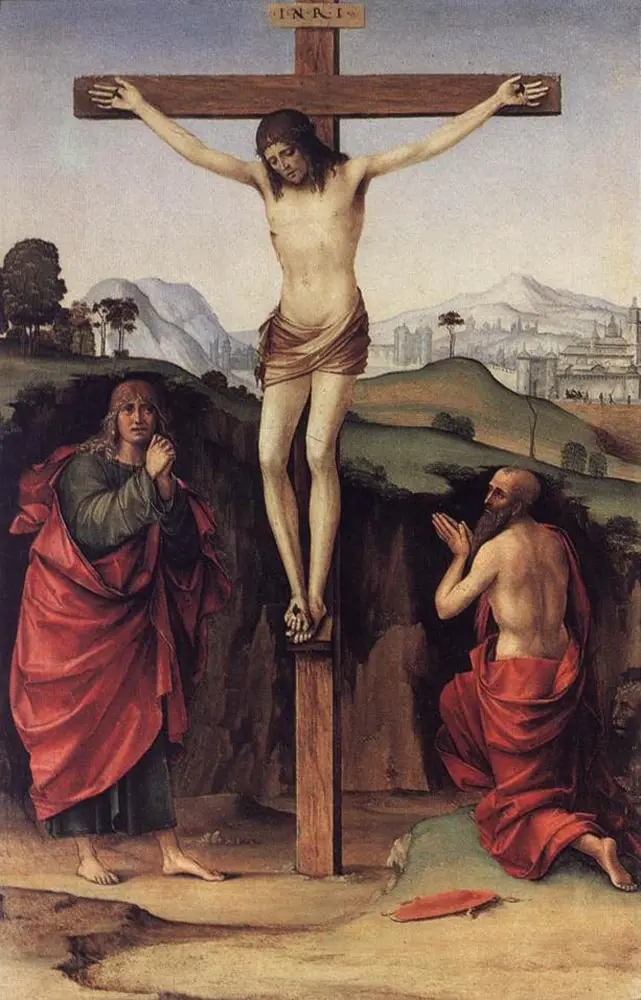
Quinta Mysteria Dolorosa · Crucifixio et Mors Domini
The Crucifixion and Death of Our Lord
He is nailed to the wood. His mother stands at the foot. The inscription reads: King of the Jews — in Hebrew, Greek, and Latin — so the whole world can read it. The torn curtain announces that the separation is over.
Francesco Francia or Marco Palmezzano (North Italian school), Crucifixion with Saints John and Jerome, c. 1490 to 1510.
5th Sorrowful Mystery · Prayed Tuesday & Friday
The Crucifixion is the fifth Sorrowful Mystery of the Rosary. Jesus is nailed to the cross, speaks his seven last words, entrusts Mary to John, and dies as the Temple veil is torn (John 19:18 to 30). It is prayed on Tuesdays and Fridays, and its fruit is salvation and true sorrow for sin.
What is the Crucifixion and Death of Our Lord?Crucifixio et Mors
Fruit of the Mystery: Salvation
"Father, forgive them, they know not what they do." ... And Jesus cried out in a loud voice, "Father, into your hands I commend my spirit"; and when he had said this he breathed his last.Luke 23:34, 46
What happened at the Crucifixion?
Golgotha — in Aramaic, the place of the skull. In Latin, Calvaria, from which English gets Calvary. The site is just outside the walls of Jerusalem, where Roman justice performed its public deterrence: a place of execution visible from the roads into the city, meant to be seen and understood. Ancient tradition holds that Adam's skull is buried at Golgotha — that the new Adam dies on the grave of the first Adam, that the tree which undoes the sin of Eden's tree is planted in the same earth.
Jesus is crucified between two criminals. The inscription above his head — ordered by Pilate over the objections of the chief priests — reads in three languages: Hebrew, Greek, Latin. Iesus Nazarenus Rex Iudaeorum. Jesus of Nazareth, King of the Jews. Written in the three languages of the known world: the language of revelation, the language of culture, the language of empire. John 19:20 notes that many Jews read the inscription because the place of crucifixion was near the city. The whole world, such as the ancient world knew it, is told who this is.
Jesus speaks seven times from the Cross. The Church has called these the Seven Last Words, and they have been the subject of meditation and music and theology for two thousand years. They come from all four Gospels, and the order is reconstructed by tradition: "Father, forgive them, they know not what they do" (Luke 23:34). "Amen, I say to you, today you will be with me in Paradise" (Luke 23:43 — to the penitent thief). "Woman, behold your son... Behold your mother" (John 19:26-27 — to Mary and John). "My God, my God, why have you forsaken me?" (Matthew 27:46; Mark 15:34 — in Aramaic: Eli, Eli, lema sabachthani). "I thirst" (John 19:28). "It is finished" (John 19:30 — Tetelestai, completed, accomplished). "Father, into your hands I commend my spirit" (Luke 23:46).
The fourth word — "My God, my God, why have you forsaken me?" — is the opening of Psalm 22. Jesus is not improvising in anguish. He is praying a psalm. Psalm 22 begins in total desolation and ends in vindication and praise: "they shall proclaim his deliverance to a people yet unborn, saying that he has done it" (Psalm 22:31). By quoting the opening, Jesus is praying the whole — including the end the soldiers around him cannot see. The prayer that sounds like abandonment contains within it the certainty of vindication. The desolation is real; so is what lies on the other side of it.
Matthew and Mark record that at the moment of death, the curtain of the Temple — the great veil separating the Holy of Holies from the rest of the sanctuary, sixty feet high, four inches thick — tears from top to bottom. From top to bottom: not from human hands below but from divine initiative above. The barrier between God's presence and human access, maintained by the entire sacrificial system of the Temple, is removed at the moment of Jesus's death. The Crucifixion is the end of the era of separation and the beginning of direct access.
The women who have followed Jesus from Galilee stand at a distance, watching. Mary Magdalene, Mary the mother of James and Joseph, the mother of the sons of Zebedee (Matthew 27:55-56). John alone records that Mary, the mother of Jesus, was at the foot of the Cross (John 19:25-27). The Twelve have fled. The women remain. They will be the first witnesses of the Resurrection. Their fidelity to the Cross is the condition for their primacy at the empty tomb.
What is the spiritual fruit of this mystery?The fruit: Salvation and Sorrow for Sin
Augustine's most sustained meditation on the Cross comes in his commentary on Psalm 22 (En. in Ps. 22) — the psalm Jesus prays from the Cross. Augustine's reading is one of the most powerful in all of Christian literature because of what he hears in the cry of dereliction. Jesus, he argues, is not reciting the opening verse as a proof-text. He is praying the whole psalm — and the whole psalm moves from abandonment ("My God, my God, why have you forsaken me?") through persecution and suffering to vindication and universal praise ("All the ends of the earth shall remember and turn to the Lord," Ps. 22:27). Augustine also hears in the cry the voice of the Christus totus — the whole Christ, head and members. The people who have been crucified throughout history in all the forms that cruelty takes, the innocent who suffer, the faithful who feel abandoned — their voice is in Christ's cry, because he has assumed them. The Cross does not only redeem what is beautiful in humanity; it redeems the cry that goes unanswered, the suffering that makes no sense, the death that feels like abandonment. "Not my suffering alone: but all my members who have suffered in me" (En. in Ps. 22.1).
Anselm of Canterbury, in his treatise Cur Deus Homo (Why God Became Man, c. 1098), gave the medieval West its most influential account of why the Cross had to happen at all. Sin, in Anselm's account, is an infinite dishonour done to an infinite God — and a finite creature cannot offer infinite satisfaction for an infinite offence. Only one who is both God (and thus capable of infinite satisfaction) and man (and thus capable of offering it on humanity's behalf) can accomplish the redemption. This is not the only way to read the Cross — the patristic tradition offers many others — but it explains why the Crucifixion is not a tragedy rescued from meaninglessness but a necessity written into the structure of what justice and mercy together require. What looks like defeat is, in Anselm's reading, the only form that victory could take.
Leo the Great, in his sermon on the Lord's Passion, gives the pastoral distillation: "The Cross of Christ is the standard of victory, not the mark of dishonour; it is the throne of dominion, not the instrument of punishment" (Sermo 55.3). The inscription INRI — Jesus of Nazareth, King of the Jews — is not Pilate's contempt but an involuntary proclamation of the truth. The torn Temple curtain is not God's abandonment but his arrival. The earthquake is not chaos but the world recognizing its Lord. Leo wants his congregation to see the Crucifixion with the eyes the Cross itself opens: not as defeat but as the form that glory takes when love enters suffering all the way to the end.
The fruit of the Crucifixion is salvation — and within that, sorrow for sin, which is the subjective entry into what the Cross makes available. The Cross is not a tragedy that God rescued from meaninglessness. It is the appointed means by which the debt of sin is paid, not with a legal fiction but with the infinite weight of the Son's love given to the Father in the form of obedience unto death. Paul: "God demonstrates his love for us in that while we were still sinners, Christ died for us" (Romans 5:8).
Sorrow for sin — contrition — is the appropriate response when one is standing at the foot of the Cross and understanding what paid for what. Not guilt-driven self-hatred, which is turned inward. But grief directed outward at what love cost — and gratitude, which is the fruit of fully received grace. The Crucifixion decade is the place in the Rosary where this movement of contrition can be made: not the performance of penitence but the genuine recognition, standing at Golgotha, that the thorns and the nails and the words of abandonment are the form that love took for our sake.
Sacred site: The Church of the Holy Sepulchre, Jerusalem — built over the sites of both Golgotha (Calvary) and the tomb, within a single structure whose earliest layers date to Constantine (326 AD). Golgotha is enclosed in the southeast corner of the church, reached by steep stairs to a chapel with a hole in the floor where the Cross stood. The rock itself is visible through glass panels. The site is shared by multiple Christian denominations and is among the most intensely venerated locations on earth.
The Crucifixion is the Fifth Sorrowful Mystery of the Rosary, drawing on all four Gospels. Jesus is crucified at Golgotha between two criminals. The inscription INRI (Jesus of Nazareth, King of the Jews) is posted in three languages. He speaks seven times from the Cross. At his death, the Temple curtain tears from top to bottom, the earth shakes, and the tombs of the righteous open. The spiritual fruit is salvation and sorrow for sin.
What are the Seven Last Words of Jesus?
The Seven Last Words are Jesus's seven sayings from the Cross, reconstructed from all four Gospels: 1. "Father, forgive them, they know not what they do" (Luke 23:34). 2. "Today you will be with me in Paradise" (Luke 23:43). 3. "Woman, behold your son... Behold your mother" (John 19:26-27). 4. "My God, my God, why have you forsaken me?" (Matthew 27:46). 5. "I thirst" (John 19:28). 6. "It is finished" (John 19:30). 7. "Father, into your hands I commend my spirit" (Luke 23:46).
Why did the Temple curtain tear at the Crucifixion?
The Temple curtain that tore at the moment of Jesus's death was the great veil separating the Holy of Holies — the innermost sanctuary representing God's immediate presence — from the rest of the Temple. It tore from top to bottom (Matthew 27:51), indicating divine initiative rather than human action. The tearing signals the end of the era of restricted access: the barrier between God's presence and human approach, maintained by the entire Levitical sacrificial system, is removed at the moment the definitive sacrifice is completed. The Epistle to the Hebrews develops this theology extensively (Hebrews 9:1-28; 10:19-22).
Pray the Sorrowful Mysteries at Orabimus.
Step-by-step, with audio in English and Latin. Free, no account required.