Quinta Mysteria Gaudiosa · Inventio Iesu in Templo
The Finding of Jesus in the Temple
Three days of anxious searching. Found on the third day, in his Father's house. His first recorded words reveal everything about who he is — and where to look for him.
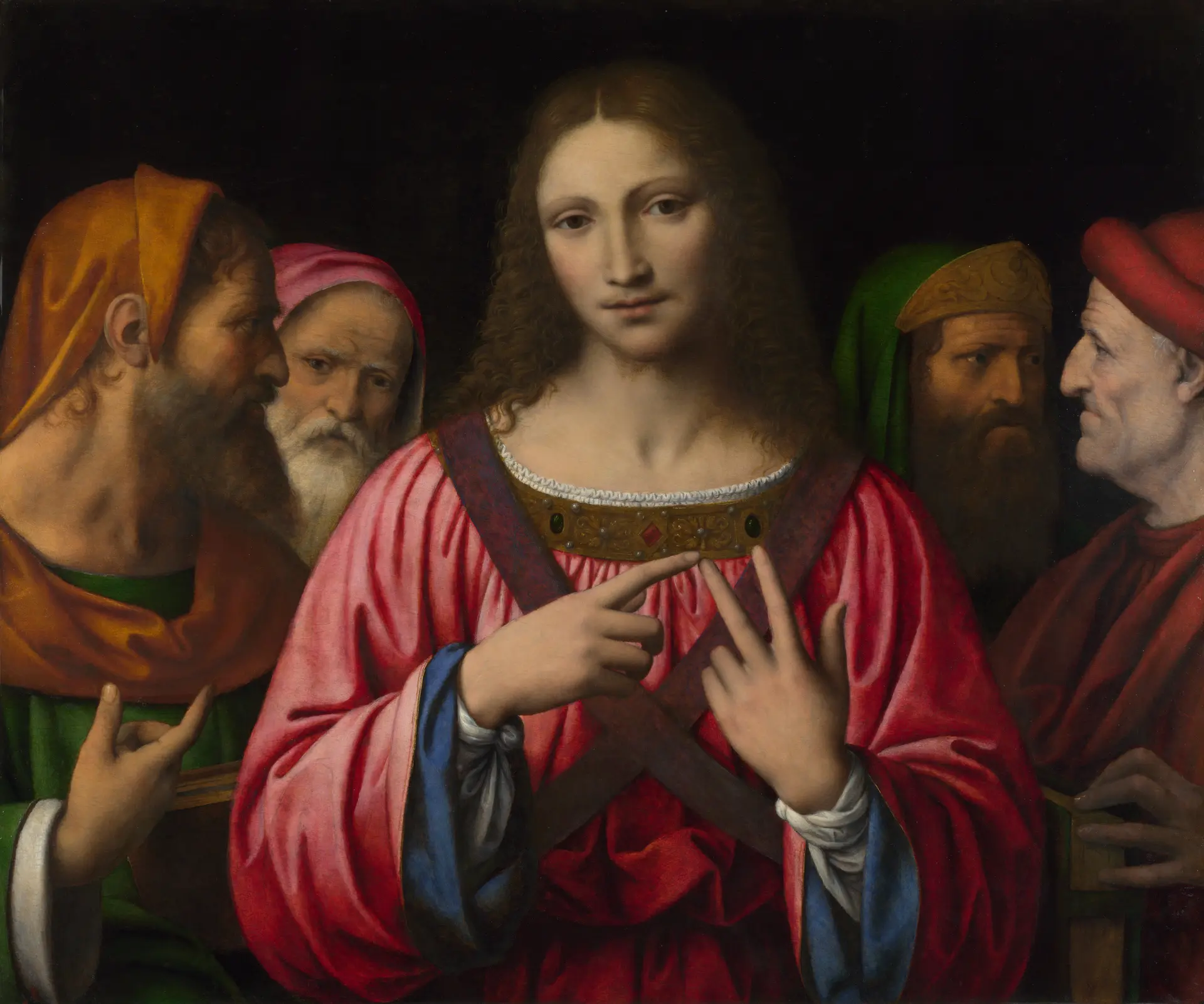
Bernardino Luini, Christ among the Doctors, c. 1515 to 1530. National Gallery, London.
5th Joyful Mystery · Prayed Monday & Saturday
The Finding in the Temple is the fifth Joyful Mystery of the Rosary. After three days of searching, Mary and Joseph find the twelve year old Jesus among the teachers, and he speaks of being in his Father's house (Luke 2:41 to 52). It is prayed on Mondays and Saturdays, and its fruit is piety.
What is the Finding of Jesus in the Temple?Inventio Iesu in Templo
Fruit of the Mystery: Piety
After three days they found him in the temple, sitting in the midst of the teachers, listening to them and asking them questions, and all who heard him were astounded at his understanding and his answers. Luke 2:46–47
What happened when Jesus was found in the Temple?
Every year Mary and Joseph made the pilgrimage to Jerusalem for Passover — a legal obligation for adult Jewish men and a pious custom for families. The journey from Nazareth takes three or four days. They travel in a caravan, the way pilgrims did: families and neighbors and extended community moving together, the children ranging freely between households, the adults assuming each child is with someone else. The festival ends. The caravan turns north for home. A day out from Jerusalem — a day's walk — Mary and Joseph begin to look for Jesus. He is not there. He is not in the caravan at all. He is still in Jerusalem.
They turn back. Another day's walk to Jerusalem. Three days of searching — and on the third day they find him in the Temple, in the midst of the teachers, listening and asking questions. Twelve years old. The teachers are astounded. His parents are not astounded in quite the same way. Mary asks the question any mother would: "Son, why have you done this to us? Your father and I have been looking for you with great anxiety" (Luke 2:48).
His answer is the first recorded speech of Jesus in the Gospels. "Why were you looking for me? Did you not know that I must be in my Father's house?" (Luke 2:49). The Greek for "must" is dei — divine necessity, the same word he uses when he says he must go to Jerusalem to suffer and die (Luke 9:22), when he says he must be lifted up (John 3:14), when he says the Son of Man must be handed over to sinners (Mark 9:31). It is the word of cosmic obligation. He must be in his Father's house. This is not a choice; it is what he is.
And they did not understand what he said to them. Luke records this without any sign of embarrassment: the parents of the Son of God did not understand him. Mary does what she always does when she cannot understand: "His mother kept all these things in her heart" (Luke 2:51). The Greek dietērei means she carefully guarded them, held them in preservation. She does not resolve the mystery. She holds it.
Then he goes back to Nazareth with them. He is subject to them. Eighteen years of ordinary life follow — the hidden years, about which Luke says only that "Jesus advanced in wisdom and age and favor before God and man" (Luke 2:52). Eighteen years of carpentry, of synagogue, of Sabbath meals, of learning the trade, of growing up. The mystery of the Finding is the last glimpse we have of Jesus before his public ministry begins — and it ends not with a bang but with submission: he returns to Nazareth and is obedient to Mary and Joseph.
Augustine saw in the three days of searching the pattern of the Passion: three days of loss, finding on the third day, the Father's house as the place of resurrection. The shape is the same. The Finding in the Temple is Paschal in form — the Resurrection hidden inside a childhood story about a pilgrimage.
What is the spiritual fruit of this mystery?The fruit: Piety and Devotion to Jesus
The fruit of the Finding is piety — not in the diminished sense of religious nicety but in Aquinas's precise definition: giving due honor and service to those to whom we owe a debt of duty, supremely to God (ST II–II, Q. 121). Piety is the virtue of one who knows who God is and acts accordingly — who seeks him where he is, honors him as he deserves, brings to the relationship what it actually requires.
Bernard of Clairvaux, in his Sermones in Cantica Canticorum (Sermons on the Song of Songs), dwells at length on the spiritual pattern the Finding illustrates: the soul that loses its beloved, searches, and finds — and what changes in the finding. Commenting on the Song of Songs, where the beloved seeks her love through the city streets (cf. Song 3:2) and at last finds him, Bernard notes that what she has is not the same as what she had before the loss. The three days of searching are part of the discovery. Mary and Joseph's anguish at losing Jesus — "son, why have you done this to us?" (Luke 2:48) — is not a failure of faith but the form that love takes when its object is absent. The fruit of the Finding, piety, includes the willingness to seek what has gone missing and to bear the grief of the search honestly, as they did.
Jesus's answer to Mary and Joseph defines this: "Did you not know that I must be in my Father's house?" The answer implies that they should have known where to look. They searched everywhere else first. The fruit of this mystery is the formation of the habit of looking first in the right place — in prayer, in Scripture, in the sacraments, in the Church. Not because God is confined to these places but because these are the places where his presence is reliably, structurally, always to be found. Devotion to Jesus is the practice of going where he is.
Sacred site: The Temple Mount, Jerusalem. The Second Temple, where the twelve-year-old Jesus sat among the teachers in the Court of the Gentiles, was destroyed by the Romans in 70 AD, forty years after the Crucifixion. The Western Wall (the Kotel) is the closest accessible point to the location of the sanctuary. Rabbinical tradition preserves the memory of specific teachers active in Jerusalem at this time — Hillel died around 10 AD, Shammai around 30 AD. The twelve-year-old Jesus sat in the company of the greatest minds of his religious world and they were astounded by him.
How to Pray This Decade
Announce: The Fifth Joyful Mystery — The Finding of Jesus in the Temple. Pray one Our Father. As you pray the ten Hail Marys, hold the scene: three days of anxious searching, and then the moment of finding. The relief. The question. The answer: "Did you not know that I must be in my Father's house?"
The fruit of piety asks: where are you currently looking for Jesus that is not his Father's house? What would it mean to go looking first in the right place — in prayer, in the Eucharist, in Scripture, in silence? The Fifth Joyful Mystery is the invitation to develop the habit of the Father's house.
The Finding in the Temple is the Fifth Joyful Mystery of the Rosary, drawn from Luke 2:41-52. Mary and Joseph lose the twelve-year-old Jesus for three days during the Passover pilgrimage to Jerusalem and find him in the Temple, sitting among the teachers, listening and asking questions. Jesus answers their anxious question with his first recorded words: "Did you not know that I must be in my Father's house?" The spiritual fruit is piety and devotion to Jesus.
What does "I must be in my Father's house" mean?
The Greek word translated "must" is dei — divine necessity, the same word Jesus uses when he says he must go to Jerusalem to suffer and die (Luke 9:22). His first recorded words establish his orientation completely: he must be about his Father's business, in his Father's house. Augustine noted that the three-day loss and finding on the third day prefigures the three days of the Passion and the Resurrection — the Finding in the Temple has a Paschal shape.
How old was Jesus when found in the Temple?
Jesus was twelve years old when Mary and Joseph found him in the Temple. In Jewish tradition, thirteen is the age of bar mitzvah — when a boy becomes responsible for his own observance of the commandments. Jesus at twelve is on the threshold of this transition. His capacity to engage the Temple teachers reflects both his intelligence and his thorough formation in the Law. The teachers were not teaching him; he was engaging them as an interlocutor, and they were astonished at his understanding.
Pray the Joyful Mysteries at Orabimus.
Step-by-step, with audio in English and Latin. Free, no account required.