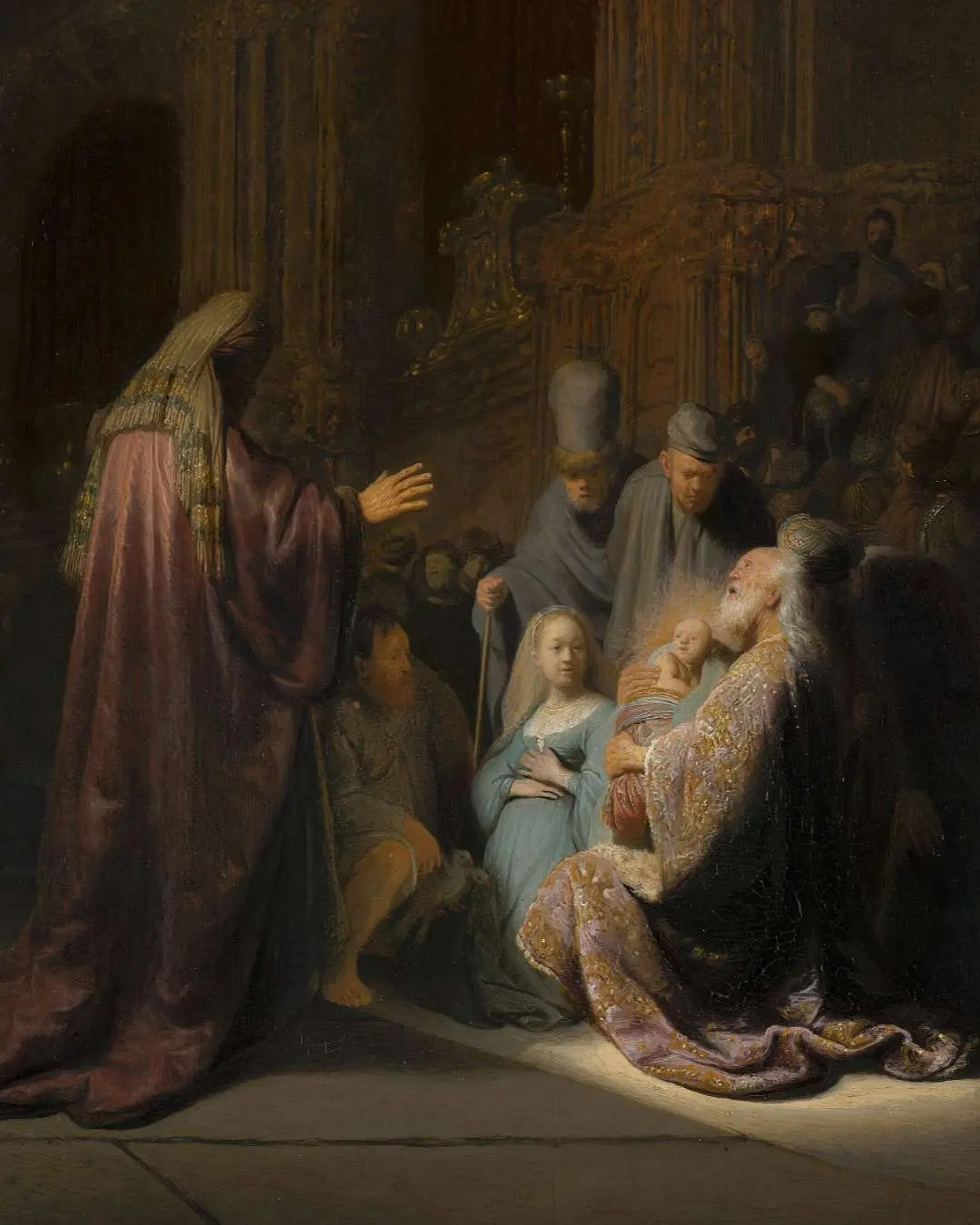
An old man has spent his entire life waiting for one thing. When the child is placed in his arms, he is ready to die. The Presentation is the mystery of pure intention meeting its object — and the sword that comes with it.
Rembrandt, Simeon's Song of Praise, 1631. Mauritshuis, The Hague.
4th Joyful Mystery · Prayed Monday & Saturday
The Presentation is the fourth Joyful Mystery of the Rosary. Mary and Joseph bring the infant Jesus to the Temple, where Simeon sings the Nunc Dimittis and foretells the sword that will pierce Mary's heart (Luke 2:22 to 38). It is prayed on Mondays and Saturdays, and its fruit is purity of heart.
What is the Presentation of the Lord?Praesentatio
Fruit of the Mystery: Purity of Heart
When the days were completed for their purification according to the law of Moses, they took him up to Jerusalem to present him to the Lord, just as it is written in the law of the Lord, "Every male that opens the womb shall be consecrated to the Lord," and to offer the sacrifice of "a pair of turtledoves or two young pigeons." Luke 2:22–24
What happened at the Presentation in the Temple?
Forty days after the birth — forty days of nursing, of recovery, of the ordinary business of a newborn life in Bethlehem — Mary and Joseph bring the child to the Temple. They are being faithful to the Law of Moses, which required the firstborn male child to be presented and consecrated to the Lord (Exodus 13:2) and the mother to undergo a purification rite forty days after the birth of a son (Leviticus 12:1-8). They bring their offering: two turtledoves or two young pigeons, which was the allowance for families who could not afford a lamb. This is the offering of the poor. Even here, at the moment of consecration, they have nothing extra.
They enter the Temple courts. And there is a man waiting for them. Luke introduces him with quiet ceremony: "Now there was a man in Jerusalem whose name was Simeon. This man was righteous and devout, awaiting the consolation of Israel, and the Holy Spirit was upon him. It had been revealed to him by the Holy Spirit that he should not see death before he had seen the Christ of the Lord" (Luke 2:25-26). Simeon has been told something that most people are not told: he will not die before the Messiah comes. He has been waiting. For how long, Luke does not say — but "awaiting the consolation of Israel" suggests the full weight of a people's hope, not just one man's longing.
The Spirit moves him to go to the Temple on this particular day. He sees Mary and Joseph. He takes the child in his arms. And he prays words the Church has prayed in her evening worship since at least the 4th century, now sung each night at Compline: "Now, Master, you may let your servant go in peace, according to your word, for my eyes have seen your salvation, which you prepared in sight of all the peoples, a light for revelation to the Gentiles, and glory for your people Israel" (Luke 2:29-32). Simeon is done. He has seen what he was told he would see. He can die.
Notice what he says the child is. Not only the glory of Israel — but a light for the Gentiles. This infant who has not yet spoken a word is already designated for the whole world. The Temple, the center of Jewish particularity, is the place where the most universal proclamation is first made.
Then Simeon turns to Mary. He blesses her and speaks directly to her, and his words shift register from praise to prophecy: "Behold, this child is destined for the fall and rise of many in Israel, and to be a sign that will be contradicted — and you yourself a sword will pierce — so that the thoughts of many hearts may be revealed" (Luke 2:34-35). The sword. The presentation is framed between two gestures: the arms that receive the child and the sword that will one day pierce his mother. The joy and the sorrow are present at the same moment, in the same room, in the same blessing.
Anna is also there — a prophetess, widowed after only seven years of marriage, now eighty-four years old, who had "never left the temple, but worshiped night and day with fasting and prayer" (Luke 2:37). She gives thanks and speaks of the child to all who were waiting for the redemption of Jerusalem. Two aged people, one man and one woman, both having waited their entire lives, both recognizing in this forty-day-old child the answer to everything they prayed for. The Presentation is where the long patience of Israel meets its object.
What is the spiritual fruit of this mystery?The fruit: Purity of Heart
The fruit of the Presentation is purity of heart — and the mystery shows what this means more concretely than any definition could. Purity of heart is not a negative thing (the absence of impurity) but a positive disposition: the right ordering of the whole person — will, intellect, desire — toward God. The Catechism locates it in "purity of intention" — the disposition by which a person attunes intellect and will to God and seeks to fulfil his will in everything (CCC 2518–2520).
Simeon embodies this. He has waited, with pure intention, for nothing other than God's promise to be fulfilled. He has not filled the waiting with alternatives, has not grown cynical, has not decided that the consolation of Israel will probably not come in his lifetime after all. He has waited, purely, with his whole life ordered toward the single thing the Spirit promised. And because his heart is pure — undivided, rightly ordered — he recognizes the Messiah when no one else does. Matthew 5:8: "Blessed are the pure in heart, for they will see God." Simeon sees.
Origen, in his Homilies on Luke (Hom. 15), asks why the Holy Spirit had specifically promised Simeon that he would not see death before he saw the Messiah. His answer goes to the heart of the mystery's fruit: Simeon could recognize the Messiah because he had been waiting for nothing else. His desire had been simplified to a single object, his heart ordered to a single hope. He is the scriptural demonstration of what Augustine will later formulate in the Confessions: the heart is restless until it rests in God. Simeon's restlessness has been resolved — not by abandoning hope but by the arrival of its object. His Nunc Dimittis ("Now you may dismiss your servant in peace") is the prayer of a soul whose single desire has been satisfied, and who therefore has no unfinished business with this world.
Ambrose of Milan, commenting on the same scene in his Expositio Evangelii Secundum Lucam (Bk. II), emphasises the sword that Simeon prophesies over Mary (Luke 2:35) as inseparable from the purity the mystery teaches. Purity of heart does not mean the absence of suffering; it means the willingness to receive even the sword without filtering it through what one would prefer to hear. Mary's purity is demonstrated not only in the beauty of the Annunciation but in her willingness to stand under the weight of Simeon's prophecy — to hold simultaneously the glory of the Nunc Dimittis and the foreknowledge of the Cross — without flinching from either.
The sword prophecy is part of this fruit. Purity of heart does not mean freedom from suffering. It means the willingness to receive even painful truth without flinching, to hold what God gives without filtering it through what we would prefer. Mary's purity is precisely demonstrated in her willingness to receive the sword as well as the child — to hold the whole truth of what the Presentation offers, not only the part that is beautiful.
Sacred site: The Temple Mount, Jerusalem — the Second Temple where the Presentation occurred was destroyed by the Romans in 70 AD. The Western Wall (Kotel) is the closest accessible point to where the sanctuary stood. The Nunc Dimittis that Simeon sang at the Presentation has been part of the Church's daily evening prayer for at least 1,600 years and is the canticle appointed for Compline (Night Prayer), making the Presentation one of the most continuously commemorated scenes in the Gospels.
How to Pray This Decade
Announce the mystery: The Fourth Joyful Mystery — The Presentation of the Lord. Pray one Our Father. As you pray the ten Hail Marys, hold Simeon's image: an old man who has spent his entire life waiting for one thing, and who recognizes it the moment it arrives. The Nunc Dimittis — "Now you may dismiss your servant in peace" — is the prayer of a person whose only desire has been satisfied.
The fruit of purity of heart asks: what is your heart divided toward? What are you trying to want alongside the one thing? The Presentation invites a simplification — the ordering of desire toward what God has promised, and the patience to wait for it without substitution.
The Presentation is the Fourth Joyful Mystery of the Rosary, drawn from Luke 2:22-38. Mary and Joseph bring the infant Jesus to the Temple in Jerusalem, forty days after his birth, to fulfill the requirements of the Mosaic Law. There they encounter Simeon, who takes the child in his arms and sings the Nunc Dimittis, and Anna the prophetess. Simeon prophesies that the child is destined to be a sign of contradiction and that a sword will pierce Mary's own soul. The spiritual fruit is purity of heart.
What is the Nunc Dimittis?
The Nunc Dimittis (Latin: "Now you may dismiss") is Simeon's canticle in Luke 2:29-32: "Now, Master, you may let your servant go in peace, according to your word, for my eyes have seen your salvation, which you prepared in sight of all the peoples, a light for revelation to the Gentiles, and glory for your people Israel." The Church has prayed this canticle as part of her evening prayer since at least the 4th century — it appears in the Apostolic Constitutions — and in the Roman Office it is the canticle appointed for Compline (Night Prayer). It is Simeon's declaration that his life's purpose has been fulfilled.
What does "a sword will pierce your soul" mean?
Simeon's prophecy to Mary — "you yourself a sword will pierce" (Luke 2:35) — has been interpreted by the Church as a reference to the suffering Mary would undergo in witnessing the Passion and death of her son. The sword of Hebrews 4:12 is the word of God that divides. The "thoughts of many hearts" will be revealed — the Messiah will force a decision in everyone who encounters him, and the pain of watching this, and of losing him to crucifixion, will be the sword that pierces Mary. The seven swords of Mary's sorrow are a traditional elaboration of this prophecy.
Who was Anna the prophetess?
Anna is described in Luke 2:36-38 as a prophetess from the tribe of Asher, the daughter of Phanuel. She had been widowed after seven years of marriage and was now eighty-four years old. She had "never left the temple, but worshiped night and day with fasting and prayer." She comes up to the Holy Family at the moment of the Presentation and gives thanks, then speaks of the child to all who were waiting for the redemption of Jerusalem. She is one of the few women in the Gospels explicitly given the title of prophet.
Pray the Joyful Mysteries at Orabimus.
Step-by-step, with audio in English and Latin. Free, no account required.