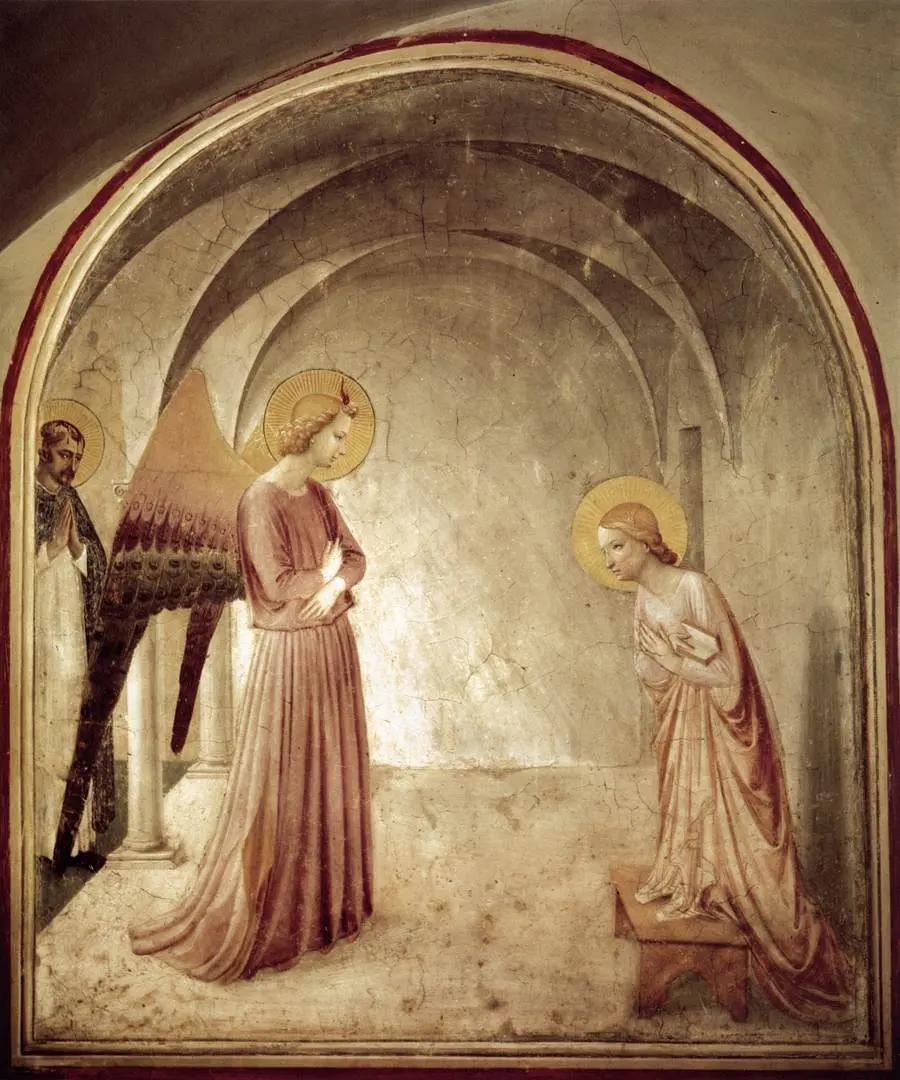
The angel Gabriel comes to a young woman in Nazareth. She is not a queen, not a philosopher, not a figure the world has been watching. She is nobody in particular — and in thirty-eight verses of Luke, the history of everything turns on what she says next.
Fra Angelico, The Annunciation, c. 1440 to 1442. Convent of San Marco, Florence.
1st Joyful Mystery · Prayed Monday & Saturday
The Annunciation is the first Joyful Mystery of the Rosary. The angel Gabriel tells Mary she will conceive Jesus by the Holy Spirit, and her yes, her fiat, opens the way for God to become man (Luke 1:26 to 38). Catholics pray it on Mondays and Saturdays, and its spiritual fruit is humility.
What is the Annunciation?Annuntiatio
Fruit of the Mystery: Humility
In the sixth month, the angel Gabriel was sent from God to a town of Galilee called Nazareth, to a virgin betrothed to a man named Joseph, of the house of David, and the virgin's name was Mary. And coming to her, he said, "Hail, full of grace! The Lord is with you." But she was greatly troubled at what was said and pondered what sort of greeting this might be. Luke 1:26–29
What happened at the Annunciation?
Start with the place. Nazareth in the first century is a village of perhaps four hundred people in the hill country of lower Galilee, ninety kilometers north of Jerusalem and well off any major trade route. It has no strategic importance. It appears in no list of notable Jewish towns. When Nathanael hears that the Messiah might come from Nazareth, his response is the response of anyone paying attention to history: "Can anything good come from Nazareth?" (John 1:46). The answer that the Gospel gives — and that the Annunciation begins to give — is yes, precisely because nothing is expected from there.
This is where God sends the angel.
Mary is young — the Greek parthenos indicates virginity, and the context of betrothal to Joseph places her in the period between the two stages of Jewish marriage: the formal legal union was complete, but she had not yet gone to live with her husband. In this in-between state, suspended between two households, the angel arrives.
Gabriel's first word — chaire — is usually translated "Hail" or "Rejoice." It is the standard Greek greeting, but in the Septuagint (the Greek Old Testament that Luke's audience knew), it carries a specific prophetic resonance. The prophet Zephaniah had addressed the daughter of Zion with exactly this word: "Rejoice, daughter of Zion... The Lord, your God, is in your midst, a warrior who gives victory" (Zephaniah 3:14-17). Zechariah does the same: "Rejoice greatly, daughter of Zion!" (Zechariah 9:9). Gabriel is not just saying hello. He is greeting the person who fulfills what the prophets had been saying for centuries — that God was coming to dwell with his people, and that there would be a daughter of Zion who would receive him.
Then comes the phrase that has no parallel in the New Testament: kecharitomene. Full of grace. Highly favored. The word is a perfect passive participle — grammatically, it means that something has been done to Mary and its effect is still present. She has been filled with grace and remains in that state. Gabriel uses it instead of her name: not "Mary" but "the one who has been filled with grace." This is her identity as God sees it. It is the name by which she is known in heaven. Every time you pray the Hail Mary — "full of grace" — you are using Gabriel's name for her.
Mary is troubled. The text is careful about what troubles her: not the appearance of an angel (she doesn't seem frightened by the angel itself) but by what was said. She hears the greeting and immediately begins working on it: "she pondered what sort of greeting this might be" (Luke 1:29). The Greek dielogizeto — she reasoned through it, debated with herself. She is not passive before the extraordinary. She thinks.
Gabriel reassures her: "Do not be afraid, Mary, for you have found favor with God." This is the beginning of the announcement: she has found favor. Then the three parts of the message come in sequence. She will conceive and bear a son — that is the fact. His name will be Jesus — that is the commission. He will be great and will be called Son of the Most High; the Lord God will give him the throne of his ancestor David; he will rule over the house of Jacob forever; of his kingdom there will be no end — that is the description.
Mary's question cuts through the description and goes straight to the mechanism: "How can this be, since I have no relations with a man?" (Luke 1:34). This is not doubt. Zechariah had asked something similar earlier in the same chapter — "How shall I know this? For I am an old man, and my wife is advanced in years" (Luke 1:18) — and Gabriel had rebuked him for it, leaving him mute until the birth. Mary receives no rebuke. Aquinas distinguishes the two questions: Zechariah asks for a sign because he does not believe; Mary asks about the manner because she does believe but wants to understand. The question is the question of intelligence, not of suspicion.
Gabriel's answer is not an explanation — it is a description of what God will do: "The Holy Spirit will come upon you, and the power of the Most High will overshadow you." The word episkiasei — will overshadow — is the word used in Exodus for the cloud of God's presence settling on the Tabernacle: "The cloud covered the tent of meeting, and the glory of the Lord filled the tabernacle" (Exodus 40:34). Mary will become what the Ark of the Covenant was: the place where God's glory dwells. John's Gospel will say the same thing from a different angle: "the Word became flesh and dwelt among us" — the Greek for "dwelt" is eskēnōsen, "pitched his tent," the Tabernacle language again. The Annunciation is God coming to tent among us, and Mary is the tent.
Gabriel offers a sign: Elizabeth, Mary's elderly cousin, is already six months pregnant. "For nothing will be impossible for God" (Luke 1:37). And then Mary speaks her answer.
"Behold, I am the handmaid of the Lord; let it be done to me according to your word." Eighteen words in English. Ten in the Greek. Eight in the Vulgate Latin: ecce ancilla Domini fiat mihi secundum verbum tuum. The hinge of history.
Notice what she does not say. She does not say "I accept" or "I agree" or "I will do it." She says let it be done to me — the passive voice again, the same grammatical structure as kecharitomene. She is not the agent here. She is the recipient. She opens herself to what God will do. She does not grasp the gift; she receives it. And the Incarnation — the Word becoming flesh — happens in that moment of reception. The eternal Son of God takes human nature in the womb of a young woman who said yes.
Irenaeus, writing around 180 AD, saw the pattern immediately: "The knot of Eve's disobedience was untied through Mary's obedience; for what the virgin Eve had bound through unbelief, the Virgin Mary loosed through faith" (Adversus Haereses 3.22.4). Eve had grasped what was not offered — equality with God. Mary receives what she did not reach for. Same human freedom, opposite direction. The Fall is reversed at the Annunciation. It is reversed not by strength but by receptivity.
What is the spiritual fruit of this mystery?The fruit: Humility
The spiritual fruit assigned to the Annunciation is humility, and it is precisely chosen. Humility does not mean thinking poorly of yourself. It does not mean self-effacement or false modesty or the performance of smallness. Thomas Aquinas defines it as having an accurate estimate of one's own capacity — but more importantly, as a disposition toward God: the willingness to receive what God gives rather than to grasp what is not offered (Summa Theologica II–II, Q. 161).
In this sense, Mary's fiat is the purest act of humility in human history. She had, by this point, every reason to be astonished at what was being offered — not just pregnancy, but the divine motherhood, the bearing of the Messiah, the fulfillment of prophecies that her people had been living toward for a thousand years. She could have been overwhelmed by the magnitude of it, or suspicious of it, or proud of being chosen. Instead, she places herself in the passive voice: "let it be done." The ego is not the subject of the sentence. God is.
Augustine makes the further point that the Incarnation itself is an act of divine humility — "God emptied himself, taking the form of a slave" (Philippians 2:7; De Sancta Virginitate §31). The Creator of the universe becomes a zygote in a teenager's womb. The humility that flows from the Annunciation is thus not only Mary's but God's: we are invited to imitate both — to receive what God gives without grasping, and to give ourselves without condition.
Bernard of Clairvaux, in his sermon In Laudibus Virginis Matris (Hom. 4, 8–9), dramatises the moment of the fiat with an urgency that has never been equalled. He imagines the whole of human history suspended in the silence before Mary speaks, and addresses her directly: "The angel awaits an answer; it is time for him to return to God who sent him. We too are waiting, O Lady, for your word of compassion; the sentence of condemnation weighs heavily upon us." Then he urges her: "Answer quickly, O Virgin. Reply in haste to the angel, or rather through the angel to the Lord. Answer with a word, receive the Word of God. Speak your own word, conceive the divine Word." What Bernard sees is that the Incarnation was not simply executed upon Mary — it required her yes. History, in this reading, hinged on one woman's willingness to receive. The disposition of humility that is the mystery's fruit is what made that yes possible: she did not grasp, she opened.
Gregory of Nazianzus, writing to the priest Cledonius around 382 AD in a letter that became one of the foundations of Christology, pressed the theological stakes of the Annunciation to their sharpest point: "What is not assumed is not healed; what is united to God is also saved" (Ep. 101). He was defending the full humanity of Christ against those who softened it — arguing that if Christ did not truly take on human flesh, human flesh is not redeemed. The Annunciation is the moment this assumption occurs. Gabriel does not visit a symbol; the Spirit does not overshadow a metaphor. The redemption of the human body, human emotion, human anxiety and joy and grief — all of it begins precisely here, in the womb of a young woman in Nazareth, because what is not assumed is not healed.
Praying the Annunciation decade, the question that returns with each Hail Mary is: in what area of my life am I grasping rather than receiving? Where am I insisting that things be arranged according to my will rather than opened to God's? Mary's fiat is not a resignation — it is an active, trusting, intelligent opening. The humility she models is not the humility of the defeated; it is the humility of the person who knows that the best things are received, not seized.
The Scripture in Depth
The Annunciation occurs in Luke 1:26-38. Luke is the Gospel most attentive to women and to the inner life of prayer; he is writing for a Gentile audience that would not automatically know the Jewish prophetic background, so he encodes it in the way Gabriel speaks rather than explaining it.
Three Greek words are worth pausing on. Chaire (v. 28) — the greeting — recalls the Septuagint's prophetic summons to Zion (Zephaniah 3:14, Zechariah 9:9). Kecharitomene (v. 28) — full of grace — is unique in the New Testament; the closest parallel is Ephesians 1:6, where Paul says God has "graced us" (echaritōsen) in the Beloved, but the perfect passive construction here is stronger. Fiat — from the Latin of verse 38 — is not actually in the Greek at all; the Greek says simply "let it be done to me" (genoito moi). The Latin renders it with a single word that has become one of the most loaded words in the Christian vocabulary: let it be.
The passage also contains the most compressed statement of who Jesus is in any single sentence of the Gospels: "He will be great and will be called Son of the Most High, and the Lord God will give him the throne of David his father, and he will reign over the house of Jacob forever, and of his kingdom there will be no end" (Luke 1:32-33). In twenty-five words, Luke establishes the Davidic kingship, the eternal reign, the divine sonship, and the fulfillment of the Nathan oracle (2 Samuel 7:13-16). He will be the son David never had in the right sense — the one whose kingdom doesn't end when he dies.
Sacred site: The Basilica of the Annunciation, Nazareth — built over the traditional site of Mary's house, where the Annunciation is believed to have occurred. The lower church contains the remains of earlier Byzantine and Crusader churches, and the grotto itself, venerated since at least the 3rd century. The current basilica was completed in 1969 by the Italian architect Giovanni Muzio. An octagonal shrine marks the traditional spot. It is the largest church in the Middle East.
How to Pray This Decade
Announce the mystery: The First Joyful Mystery — The Annunciation. Then pray one Our Father. As you begin the ten Hail Marys, let your imagination settle on the scene: a small room in Nazareth, a young woman, an angel. You do not need to visualize it in elaborate detail. Simply hold the scene — and hold the question the mystery puts to you.
The question of the Annunciation decade is the question of receptivity: where in your life is God offering something that you have not yet opened yourself to receive? Perhaps it is a vocation, a person, a suffering, a change of direction. The ten Hail Marys are ten opportunities to enter, with Mary, into the posture of fiat. Not resignation — active, trusting, intelligent opening.
After the tenth Hail Mary, pray one Glory Be and the Fatima Prayer. Then pause for a moment before announcing the Second Joyful Mystery — the Visitation, where Mary takes what she has received and immediately gives it in service to another.
The Annunciation is the event described in Luke 1:26-38 in which the angel Gabriel appears to the Virgin Mary in Nazareth and announces that she will conceive and bear the Son of God. Mary's response — "Behold, I am the handmaid of the Lord; let it be done to me according to your word" — is the fiat that enabled the Incarnation. The Church celebrates the Feast of the Annunciation on March 25. It is the First Joyful Mystery of the Rosary, traditionally prayed on Monday and Saturday.
What does "kecharitomene" mean?
Kecharitomene (Greek: κεχαριτωμένη) is Gabriel's address to Mary — usually translated "full of grace" or "highly favored." It is a perfect passive participle of the verb charitoo (to fill with grace), indicating a completed state that remains in effect: Mary has been filled with grace and remains so. Gabriel uses it as her name — not "Mary" but "the one who has been filled with grace." No other person in Scripture receives this address. The Council of Trent confirmed the Vulgate's rendering gratia plena (full of grace). The first part of the Hail Mary draws directly from this word: "Hail, full of grace."
What is the fruit of the Annunciation?
The spiritual fruit of the Annunciation is Humility. The connection is precise: the mystery is structurally the reversal of the Fall. Eve grasped at equality with God (Genesis 3:5); Mary received what she did not reach for. Irenaeus of Lyons (c. 180 AD) wrote: "The knot of Eve's disobedience was untied through Mary's obedience" (Adversus Haereses 3.22.4). The humility Mary models is not self-deprecation — it is the disposition of receptivity that allows God's grace to work. Her fiat demonstrates what this looks like: not "I will do this" but "let it be done to me."
Why did Mary ask "how can this be"?
Mary's question — "How can this be, since I have no relations with a man?" (Luke 1:34) — is not doubt but a genuine question about mechanism, arising from her understanding that she was to remain a virgin. This is why Gabriel explains the manner: "The Holy Spirit will come upon you, and the power of the Most High will overshadow you" (Luke 1:35). Aquinas distinguished Mary's question from Zechariah's doubt earlier in the same chapter: Zechariah asked for a sign and was rebuked; Mary asked how something would happen and received an explanation. Her question is the question of intelligence seeking understanding, not of suspicion withdrawing trust.
What is the connection between the Annunciation and the Hail Mary?
The Hail Mary is built from the Annunciation scene. The first half — "Hail Mary, full of grace, the Lord is with you; blessed are you among women" — comes directly from Luke 1:28 (Gabriel's greeting: "Hail, full of grace! The Lord is with you") and Luke 1:42 (Elizabeth's greeting at the Visitation: "Most blessed are you among women"). The second half — "Holy Mary, Mother of God, pray for us sinners, now and at the hour of our death" — is the Church's petition, added gradually from the 11th century onward and fixed in its current form by the Roman Catechism (1566). When you pray the First Joyful Mystery, you return to the Annunciation scene ten times, with each Hail Mary.
What day is the Feast of the Annunciation?
The Feast of the Annunciation is celebrated on March 25 — exactly nine months before Christmas. The date was chosen in the Roman calendar by the 4th century, coordinating with the calculation that placed the Crucifixion and Incarnation on the same date (a typological reasoning about the completion of the first creation and the beginning of the new). When March 25 falls within Holy Week or the Easter Octave, it is transferred to the Monday after the Second Sunday of Easter. In English tradition it is sometimes called Lady Day, and it historically marked the beginning of the legal new year.
Pray the Joyful Mysteries at Orabimus.
Step-by-step, with audio in English and Latin. Free, no account required.