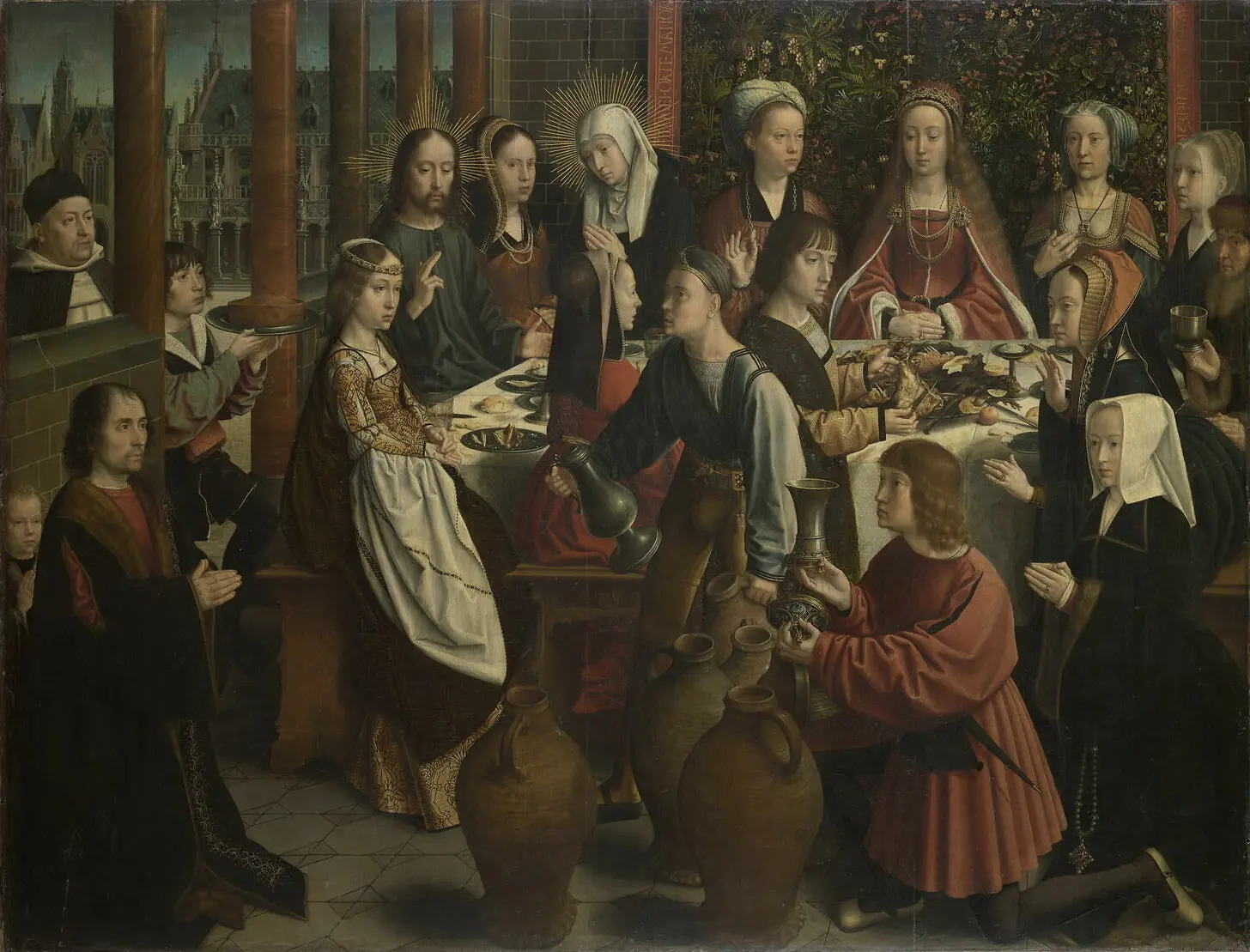
Secunda Mysteria Luminosa · Nuptiae in Cana Galileae
The Wedding at Cana
The wine runs out. Mary says three words to her Son. He says his hour has not yet come. She turns to the servants and says: do whatever he tells you. As much as a hundred and eighty gallons of the finest wine follow.
Gerard David, The Marriage at Cana, c. 1500 to 1503. Louvre, Paris.
2nd Luminous Mystery · Prayed Thursday
The Wedding at Cana is the second Luminous Mystery of the Rosary. At his mother's prompting, Jesus turns water into wine, his first public sign, and Mary tells the servants to do whatever he tells them (John 2:1 to 11). It is prayed on Thursdays, and its fruit is going to Jesus through Mary.
What is the Wedding at Cana?Nuptiae in Cana
Fruit of the Mystery: To Jesus Through Mary
His mother said to him, "They have no wine." And Jesus said to her, "Woman, how does your concern affect me? My hour has not yet come." His mother said to the servers, "Do whatever he tells you." John 2:3–5
What happened at the Wedding at Cana?
A wedding in Cana of Galilee, in the first days of Jesus's public ministry. Mary is there. Jesus and his disciples have been invited. Somewhere in the middle of the celebration, the wine runs out.
Running out of wine at a first-century Jewish wedding was not a minor social embarrassment. A wedding feast lasted seven days. Wine was not optional. To run short of wine for guests was a serious failure of hospitality — the kind of thing that could mark a family for years in a small community. The unnamed couple at the center of the celebration is in trouble, and they don't know it yet, or can't fix it, or are too humiliated to speak.
Mary notices. She goes to Jesus. Her statement to him is not a request — it contains no verb of asking, no petition, no "please." She says simply: "They have no wine" (John 2:3). Three words in Greek: oinon ouk echousin. She does not tell him what to do. She does not suggest a course of action. She places the need in front of him and trusts that his attention is sufficient. This is the method of Marian intercession in its purest form: not directing God toward a solution but presenting the situation to his awareness with complete confidence that his awareness is enough.
Jesus's response is one of the most puzzling in the Gospels: "Woman, how does your concern affect me? My hour has not yet come" (John 2:4). The word "Woman" — gynai — is not rude in Greek; it is the same address he uses to Mary Magdalene after the Resurrection (John 20:15) and to his mother from the Cross (John 19:26). But it is formal, distanced. And "my hour" — hōra — in John always refers to the Passion. Jesus is saying: my public ministry, which culminates in the Cross, has not yet begun. What you are asking would initiate something.
Mary hears all of this. She turns to the servants and says: "Do whatever he tells you" (John 2:5). This is the last sentence Mary speaks in the canonical Gospels. She has heard a "no" — or at least a "not yet" — and she instructs the servants to follow whatever comes next. Her confidence is total. She does not argue, does not repeat the request, does not remind him of the need. She simply redirects the servants' attention toward him. And Jesus acts.
Six stone jars stand there, each holding twenty to thirty gallons — the kind used for Jewish purification rites. Jesus tells the servants to fill them with water. They fill them to the brim. He tells them to draw some out and take it to the headwaiter. They do. The headwaiter tastes it and does not know what has happened. He calls the bridegroom over and says: "Everyone serves good wine first, and then when people have drunk freely, an inferior one; but you have kept the good wine until now" (John 2:10).
One hundred and twenty to one hundred and eighty gallons of the finest wine, created from water, for a party that has already been going on long enough for the original supply to run out. The extravagance is deliberate. This is not a practical miracle — it is a sign of what the Kingdom looks like. Isaiah had prophesied that the messianic age would be marked by an abundance of wine: "On this mountain the LORD of hosts will provide for all peoples a feast of rich food and choice wines" (Isaiah 25:6). When Jesus creates wine in Cana, he is performing a parable of the Kingdom before he begins to preach it.
John concludes: "Jesus did this as the beginning of his signs in Cana in Galilee and so revealed his glory, and his disciples began to believe in him" (John 2:11). The miracle at Cana is not a private act of kindness. It is a sign — sēmeion in John's vocabulary — pointing beyond itself to the one who performed it. The wine at Cana points to the blood at Calvary. The wedding feast of Cana points to the wedding feast of the Lamb (Revelation 19:9). The "hour" that has not yet come at Cana arrives at the Last Supper, when he takes the cup of wine and says "this is my blood."
What is the spiritual fruit of this mystery?The fruit: To Jesus Through Mary
Augustine, preaching on the opening of John's Gospel to his congregation in Hippo, begins his eighth tractate with a remark that reframes the miracle entirely: "He who made wine at the wedding feast, in those six water-pots which he commanded to be filled with water — the self-same does this every year in vines. For even as that which the servants put into the water-pots was turned into wine by the doing of the Lord, so likewise is what the clouds pour forth changed into wine by the doing of the same Lord. But we do not wonder at the latter, because it happens every year; it has lost its marvellousness by its constant recurrence" (In Jo. Ev. Tr. 8.1). For Augustine, the miracle at Cana is not a suspension of natural law but nature made suddenly visible. What God does slowly in the vineyard, he did suddenly in the water-jars — and the only difference is the speed. The sign points not to an exception but to the rule: the Lord is always doing this.
Augustine's ninth tractate deepens the typology: the six stone water-jars, each holding twenty to thirty gallons, represent for him the six ages of the world — from Adam to the Flood, from the Flood to Abraham, from Abraham to David, from David to the Exile, from the Exile to John the Baptist, from John to Christ. The jars are filled with water — with the Old Testament, as it were — and Jesus transforms that water into wine. "Prophecies are fulfilled, the water-pots are full; but that the water may be turned into wine, Christ must be understood in that whole prophecy" (In Jo. Ev. Tr. 9.6). The Cana miracle is the transformation of the entire prior revelation into the New. Every page of the Law and the Prophets is a water-jar waiting for its wine.
The fruit of the Wedding at Cana is the Marian method of prayer: bringing needs to Mary, who brings them to her Son. This is not a detour — it is a route. Mary's intercession at Cana does not bypass Jesus; it leads directly to him. Her confidence that his attention to a need is sufficient moves him to act, even when the act would initiate something larger than the occasion required.
Aquinas explains the logic of intercessory prayer generally: the saints pray for us not because God's knowledge needs to be supplemented, but because prayer is a form of participation in God's providence — the means through which God has chosen to distribute certain graces (ST II–II, Q. 83, a. 11). Mary's intercession at Cana is the paradigm case. She sees the need. She brings it to Jesus. She trusts his response, even when it sounds like a refusal. She directs attention toward him. And the miracle follows.
"Do whatever he tells you" — Mary's last recorded words — are also the instruction she gives to every person who comes to her in prayer. She does not offer herself as the destination. She is the direction.
Sacred site: Kafr Kanna, in Galilee, 8 kilometers northeast of Nazareth — the traditional site of Cana. Two churches mark the spot: the Franciscan Wedding Church and the Greek Orthodox Church of St. George. Archaeological excavations have uncovered stone vessels of the type described in John 2, consistent with first-century Jewish purification practice.
How to Pray This Decade
Announce: The Second Luminous Mystery — The Wedding at Cana. Pray one Our Father. As you pray the ten Hail Marys, hold Mary's three-word intercession: "They have no wine." Bring your own need before her with the same simplicity. Not a long explanation. Not a negotiation. Just the fact of the situation, placed in her awareness, with the confidence that she will take it to him — and with the willingness to do whatever he tells you.
The Wedding at Cana is the Second Luminous Mystery of the Rosary, drawn from John 2:1-11. At a wedding feast in Cana of Galilee, the wine runs out. Mary tells Jesus: "They have no wine." Jesus initially responds that his hour has not yet come, but Mary instructs the servants: "Do whatever he tells you." Jesus fills six large stone jars with water, which becomes wine — approximately 120-180 gallons of the finest quality. John calls it the beginning of his signs, through which he revealed his glory. The spiritual fruit is the practice of going to Jesus through Mary.
What does Mary's intercession at Cana teach us?
Mary's intercession at Cana teaches the Marian method of prayer: she does not petition God with elaborate requests but simply places the need before her Son — "They have no wine" — with complete trust that his awareness is sufficient. When he seems to refuse, she does not argue but redirects attention toward him: "Do whatever he tells you." These are the last words Mary speaks in the Gospels, and they are her permanent instruction to everyone who comes to her in prayer: she is not the destination, she is the direction — always pointing toward her Son.
Why did Jesus turn water into wine?
John calls the miracle at Cana a "sign" — sēmeion — not just a miracle. Signs in John point beyond themselves. The wine at Cana points to: the messianic banquet prophesied by Isaiah (25:6, "a feast of rich food and choice wines"); the blood of the Passover lamb and ultimately of the Eucharist; the eschatological wedding feast of the Lamb (Revelation 19:9). The extravagance — 120-180 gallons of finest wine for a party already running short — is intentional. It is the sign of a Kingdom where the best wine comes last, where what God gives exceeds all human expectation.
What does "my hour has not yet come" mean?
"My hour" in John's Gospel consistently refers to the Passion — the Cross, death, and glorification of Jesus (John 7:30; 8:20; 12:23; 13:1; 17:1). When Jesus says at Cana that his hour has not yet come, he is acknowledging that performing this sign would initiate his public ministry and set in motion the sequence that leads to Calvary. The "hour" that has not yet come at Cana arrives at the Last Supper, when he takes the cup of wine and says "this is my blood of the covenant." The wine of Cana and the blood of the Eucharist are connected.
Pray the Luminous Mysteries at Orabimus.
Step-by-step, with audio in English and Latin. Free, no account required.