This is the time of fulfillment. The kingdom of God is at hand. Repent, and believe in the gospel. Nineteen words that contain the whole substance of everything Jesus came to do.
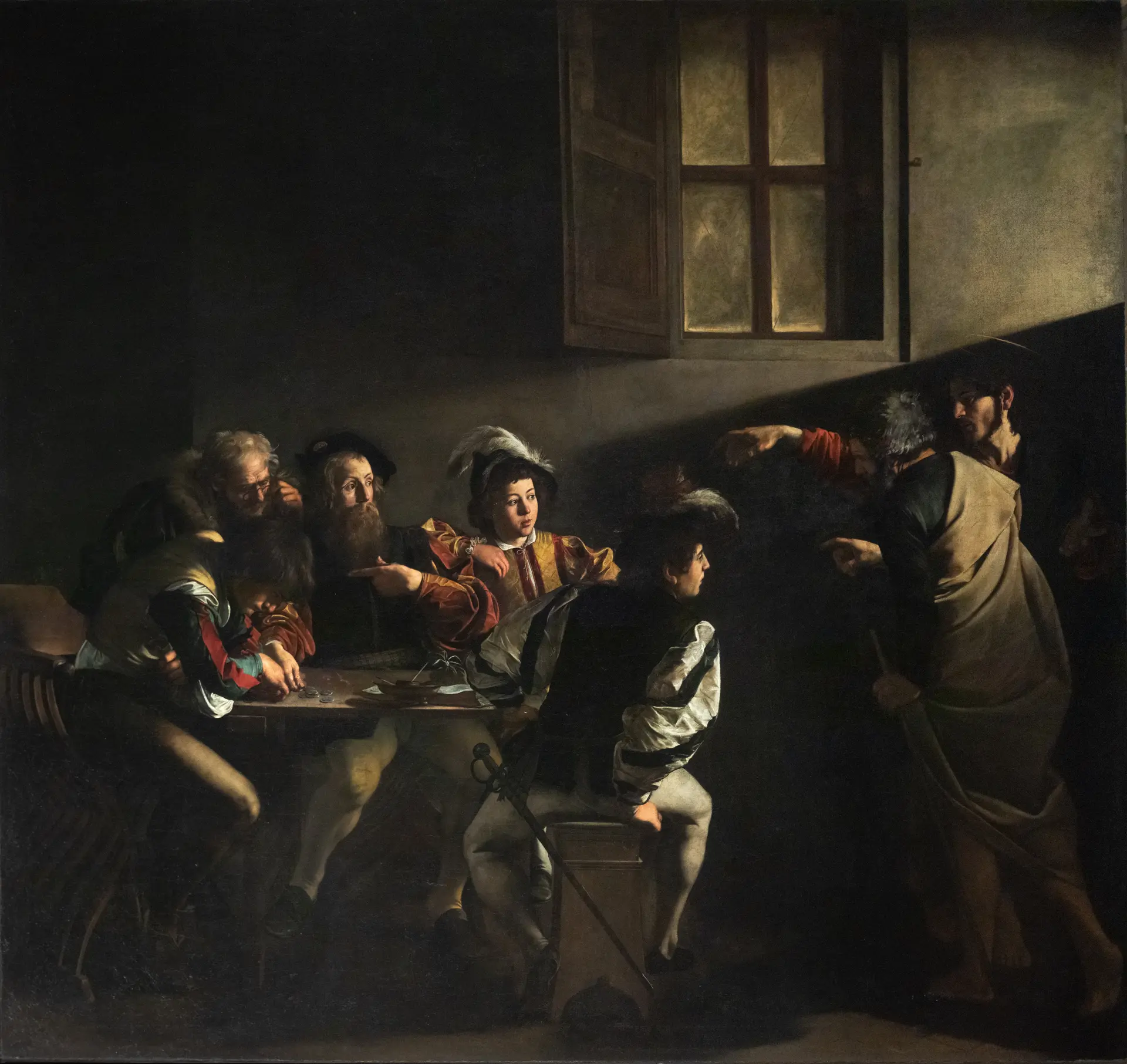
Caravaggio, The Calling of Saint Matthew, c. 1599 to 1600. San Luigi dei Francesi, Rome.
3rd Luminous Mystery · Prayed Thursday
The Proclamation of the Kingdom is the third Luminous Mystery of the Rosary. Jesus announces that the Kingdom of God is at hand, calling all to repentance and faith as he heals, forgives, and gathers disciples (Mark 1:14 to 15). It is prayed on Thursdays, and its fruit is conversion.
What is the Proclamation of the Kingdom?Praedicatio Regni
Fruit of the Mystery: Conversion
After John had been arrested, Jesus came to Galilee proclaiming the gospel of God: "This is the time of fulfillment. The kingdom of God is at hand. Repent, and believe in the gospel." Mark 1:14–15
What is the Proclamation of the Kingdom?
After John the Baptist is arrested — after the one who prepared the way is silenced — Jesus comes to Galilee and begins to preach. His first public words in Mark's Gospel are nineteen words that contain the whole substance of his ministry: "This is the time of fulfillment. The kingdom of God is at hand. Repent, and believe in the gospel."
The Third Luminous Mystery is the broadest of the five — it covers the entire public ministry of Jesus, from the first sermon to the last parable, from the calling of the Twelve to the healing of the sick, from the Sermon on the Mount to the forgiveness of sins. John Paul II asked us to meditate on this mystery as a whole: the proclamation of the Kingdom in word, in action, in forgiveness, in the calling of disciples, in the embrace of the marginalized.
Start with the word kairos. Mark uses the Greek word for time that means the appointed moment, the decisive hour, the right season — as opposed to chronos, the ordinary tick of the clock. "The kairos is fulfilled." This is not just any time; it is the time the entire history of Israel has been moving toward. The Exodus, the prophets, the return from exile, the centuries of waiting — all of it has arrived at this moment, in this province, in this person.
"The kingdom of God is at hand." Engiken — has come near, has drawn close. Not "will come" but "is at hand." The Kingdom is not a future political arrangement. It is the active reign of God breaking into the present — wherever Jesus is, the Kingdom is present, because the King is present. Every healing, every forgiveness, every parable about lost sheep and prodigal sons and treasure hidden in a field is a demonstration of the Kingdom's reality.
"Repent." The Greek is metanoeite — change your mind, your nous, the deepest organ of thinking and perceiving. This is not behavioral reform, not the cleaning up of individual bad habits. It is a reorientation of the entire frame through which you see reality. Repentance in this sense is what happens when you recognize that the Kingdom is at hand and your whole previous way of reading the world needs to be revised. What you thought was primary is secondary. What you thought was impossible is happening. What you thought God was like needs to be updated.
The radical inclusivity of Jesus's ministry is the Kingdom's visible face. He eats with tax collectors and sinners — social outcasts, ritual outsiders, collaborators with Rome — not to condone what they do but to draw them into the Kingdom's reach. He touches lepers when the Law says not to touch them. He allows a woman with a hemorrhage to touch him without recoiling. He speaks to a Samaritan woman at a well, ignoring the triple prohibition (Jewish men did not speak to Samaritan women in public). He praises a Roman centurion's faith. He delivers a Syrophoenician woman's daughter from a demon at a distance. The Kingdom, as Jesus proclaims and demonstrates it, has no natural boundary except the willingness to receive it.
The forgiveness of sins is the Kingdom's most concentrated sign. When Jesus tells the paralytic "your sins are forgiven" (Mark 2:5) before healing his body, the scribes recognize immediately that this is a divine prerogative: "Who can forgive sins but God alone?" (Mark 2:7). Jesus does not dispute their theology. He accepts the claim. "Which is easier: to say to the paralytic, 'Your sins are forgiven,' or to say, 'Rise, take up your mat and walk'? But that you may know that the Son of Man has authority on earth to forgive sins..." He heals the man. The Kingdom's forgiveness is not a theological abstraction; it is a body rising from a mat.
What is the spiritual fruit of this mystery?The fruit: Conversion (Metanoia)
The fruit of the Proclamation of the Kingdom is conversion — metanoia in the Greek, which means not just repentance but a fundamental change of mind. Aquinas distinguishes between attrition (sorrow for sin motivated by fear of punishment) and contrition (sorrow motivated by love of God) — true conversion is the movement from one to the other, and ultimately beyond both, into the reorientation of the whole person toward the Kingdom (a distinction Aquinas develops in his treatment of penance).
Augustine's De Civitate Dei (City of God), the theological monument he wrote after the sack of Rome in 410 AD, is in its entirety a sustained meditation on the nature of the Kingdom. Augustine distinguishes two cities — not a church and a state, but two loves: the love of self to the contempt of God, which builds the earthly city, and the love of God to the contempt of self, which builds the heavenly. The proclamation of the Kingdom is therefore, in Augustine's reading, not primarily a political announcement but an invitation to reorder the deepest love. "Our heart is restless, until it repose in thee" (Conf. I.1) — the restlessness is the symptom of a self still organized around the wrong love, still building the wrong city. Metanoia, for Augustine, is the moment the restless heart recognizes where rest actually lies and turns toward it.
John Chrysostom, preaching on the Sermon on the Mount in his Homilies on Matthew (Hom. 15), notices that the Beatitudes — the concentrated form of the Kingdom's ethics — consistently bless what the world dismisses. The poor in spirit, the meek, the mourning, those who hunger and thirst for righteousness. Each of these is someone the earthly city passes over. The Kingdom, in Chrysostom's reading, is not a rearrangement of the same prizes but a different set of prizes entirely — and the conversion metanoia calls for is precisely the shift in what one considers worth having.
Meditating on the Third Luminous Mystery, the question conversion puts to us is: where is my mind still organized around a set of priorities that the Kingdom has overturned? Where am I still operating on the pre-Kingdom map — where power means domination, where success means accumulation, where safety means self-protection? The proclamation of the Kingdom announces that these maps are wrong. The repentance the mystery invites is the ongoing willingness to keep revising them.
Sacred sites: Capernaum, on the northern shore of the Sea of Galilee — the base of Jesus's Galilean ministry. The synagogue where he preached (Mark 1:21-28) has been excavated; its basalt foundations are visible beneath the later 4th-century limestone synagogue. The Church of the Beatitudes on the hillside north of Capernaum marks the traditional site of the Sermon on the Mount. These places of teaching and healing are the geographic heart of the Kingdom's proclamation.
How to Pray This Decade
Announce: The Third Luminous Mystery — The Proclamation of the Kingdom of God. Pray one Our Father. As you pray the ten Hail Marys, hold the range of Jesus's ministry before you — the teaching, the healing, the meals with outcasts, the forgiveness. The Kingdom is already present wherever he is. The question this mystery puts to you: what in your way of seeing the world still needs to be converted to align with the Kingdom's reality?
What is the Proclamation of the Kingdom in the Rosary?
The Proclamation of the Kingdom is the Third Luminous Mystery of the Rosary, added by Pope John Paul II in his 2002 apostolic letter Rosarium Virginis Mariae. It covers the entire public ministry of Jesus — his preaching of the Kingdom, his healings, his calling of disciples, his forgiveness of sins, and his radical inclusivity. Mark 1:14-15 provides the summary text: "This is the time of fulfillment. The kingdom of God is at hand. Repent, and believe in the gospel." The spiritual fruit is conversion.
What does "the kingdom of God is at hand" mean?
"The kingdom of God is at hand" uses the Greek word engiken — has drawn near, has come close. The Kingdom is not primarily a future political state but the active reign of God breaking into the present wherever Jesus is. Every healing, every forgiveness, every parable is a demonstration of the Kingdom's reality. The Kingdom is not waiting to arrive; it has arrived with the King. "If it is by the finger of God that I drive out demons, then the kingdom of God has come upon you" (Luke 11:20).
What is metanoia?
Metanoia is the Greek word translated "repentance" in Mark 1:15. It means literally a change of mind — a reorientation of the nous, the deepest organ of perception and understanding. It is not merely behavioral reform or the correction of individual sins but a fundamental shift in the frame through which one reads reality. Jesus's call to metanoia is a call to revise the entire map by which one navigates life — to recognize that the Kingdom has inverted the world's priority structures and to reorient accordingly.
Pray the Luminous Mysteries at Orabimus.
Step-by-step, with audio in English and Latin. Free, no account required.