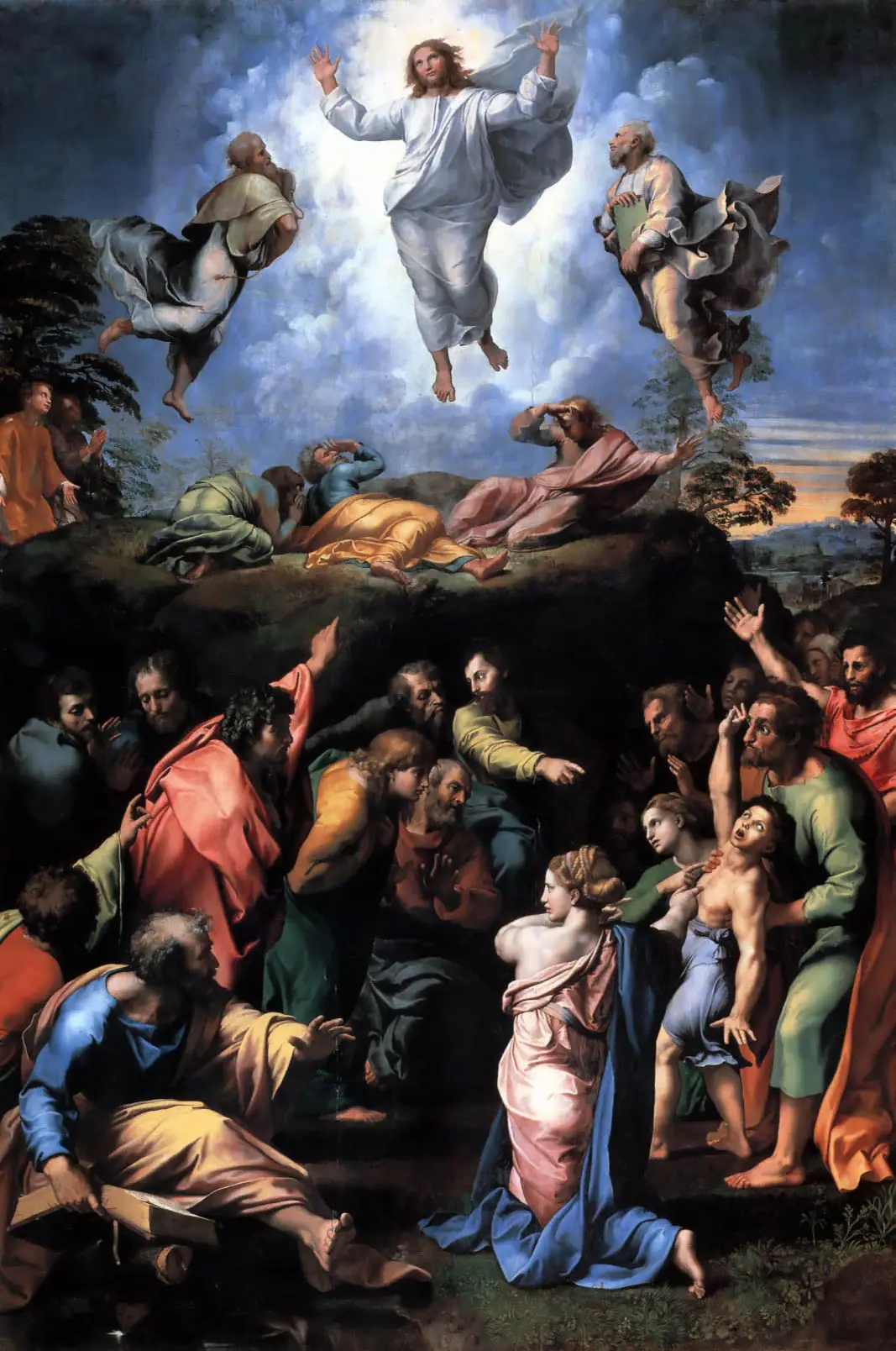
Jesus takes three disciples up a high mountain and is transfigured before them. His face shines like the sun. Moses and Elijah appear. A cloud covers them. God speaks. And Peter, characteristically, wants to build something and stay.
Raphael, The Transfiguration, 1516 to 1520. Pinacoteca Vaticana, Vatican.
4th Luminous Mystery · Prayed Thursday
The Transfiguration is the fourth Luminous Mystery of the Rosary. On the mountain Jesus is transfigured in dazzling light beside Moses and Elijah, and the Father says from the cloud, listen to him (Matthew 17:1 to 9). It is prayed on Thursdays, and its fruit is the desire for holiness.
What is the Transfiguration?Transfiguratio
Fruit of the Mystery: Desire for Holiness
And he was transfigured before them; his face shone like the sun and his clothes became white as light. And behold, Moses and Elijah appeared to them, conversing with him.Matthew 17:2–3
What happened at the Transfiguration?
Six days after Peter's confession at Caesarea Philippi — six days after Peter named Jesus as the Messiah and was told not to tell anyone, six days after Jesus began to speak openly about suffering and death — Jesus takes Peter, James, and John up a high mountain. He leaves the other nine disciples at the base and goes up with the inner three. The high mountain is probably Tabor, the traditional identification, or possibly Hermon in the north; what matters is the altitude — above the world, in a place of elevation and exposure, where the ordinary coordinates of daily life do not apply.
Then, in front of them, something happens to Jesus. The Greek is metemorphōthē — he was transformed, metamorphosed. His face shone like the sun. His garments became white as light — white the way no earthly bleaching could achieve (Mark 9:3 specifies this). The glory that is his by nature, ordinarily veiled by his humanity, breaks through for a moment. What the disciples are seeing is what Jesus actually is, what he has always been — the eternal Son, uncreated light, the brightness of the Father's glory (Hebrews 1:3). The Transfiguration does not make Jesus something he was not. It shows what he is.
Moses and Elijah appear with him. In Jewish theological imagination, these two figures represent the Law and the Prophets — the whole of the Hebrew Scripture. Moses gave the Law at Sinai; Elijah was the greatest of the prophets. Both had had their own encounters with God on a mountain. Both had been given a vision of God's glory. Both had died in unusual circumstances and were the subject of traditions about their continued existence (Moses's body was never found; Elijah was taken up in a chariot of fire). And both had encountered God in the same way — not in the earthquake or the fire, but in the still small voice (1 Kings 19:12). They appear with Jesus, discussing — Luke tells us — "his departure, which he was about to accomplish in Jerusalem" (Luke 9:31). The Greek for "departure" is exodon. His exodus. The whole of the Law and the Prophets have been converging toward this exodus from the beginning.
Peter speaks. This is almost always a sign that something is about to go sideways. "Lord, it is good that we are here. If you wish, I will make three tents here, one for you, one for Moses, and one for Elijah" (Matthew 17:4). Peter wants to stop. He wants to mark the moment, to institutionalize it, to build something that will let him stay in the experience of glory rather than return to the foot of the mountain where the epileptic boy is suffering and the disciples can't heal him (Matthew 17:14-16). He is still speaking when a bright cloud overshadows them.
The cloud is the shekinah — God's visible presence. The same cloud that covered Sinai when Moses received the Law (Exodus 19:9), the same cloud that filled the Tabernacle and the Temple at their dedications (Exodus 40:34; 1 Kings 8:10-11). Out of the cloud a voice speaks: "This is my beloved Son, with whom I am well pleased; listen to him" (Matthew 17:5). The first two clauses repeat what the voice said at the Baptism. The third is new: "listen to him." Not "be like him." Not "worship him." Listen. The voice's single imperative is hearing.
The disciples fall on their faces, overwhelmed. Jesus comes to them, touches them — the same gesture he uses when healing — and says: "Rise, and do not be afraid" (Matthew 17:7). When they look up, they see only Jesus. Moses and Elijah are gone. The cloud has lifted. The face is no longer shining. They go down the mountain. On the way down he tells them not to speak of what they have seen until after the Son of Man is raised from the dead.
What is the spiritual fruit of this mystery?The fruit: Desire for Holiness
The fruit of the Transfiguration is desire for holiness — and Paul identifies the mechanism. In Romans 12:2 he writes: "Do not conform to this age, but be transformed by the renewal of your mind." The Greek for "be transformed" is metamorphousthe — the same root as the Transfiguration's metemorphōthē. The Transfiguration is not only an event that happened to Jesus on a mountain; it is the template for what is meant to happen to every person in prayer. "We all, with unveiled face, beholding the glory of the Lord, are being changed into his likeness from one degree of glory to another" (2 Corinthians 3:18).
Leo the Great, in his sermon on the Transfiguration, identifies the pastoral purpose of the event with characteristic directness: "The Lord revealed his glory before chosen witnesses... in order to banish from the hearts of the disciples all the scandal of the Cross, and to prevent the humiliation of the Passion from disturbing the faith of those who had witnessed the surpassing magnificence of the hidden dignity" (Sermo 51.3). Leo's reading is precisely calibrated. The disciples have just been told, for the first time, that the Messiah must suffer and die (Matthew 16:21). Peter has just rebuked Jesus for saying so and been called Satan in return. The Transfiguration follows immediately — six days later — as the answer to their scandal: this is the same person, and this light is what the Cross is moving toward, not away from. You can endure the Cross only if you have seen the light that awaits on the other side of it.
Origen, commenting on the Transfiguration in his Commentary on Matthew (In Matt. XII.36-43), adds a dimension Leo does not develop: the disciples see Jesus transfigured as he will appear at the Second Coming. The dazzling white, the face shining like the sun — this is not only the present reality of who Christ is but the promised appearance of Christ at the Parousia. The disciples on Tabor are being given a preview of the end of history so that they can navigate the middle of it without despair. Origen also notes that when the cloud lifts and they see "Jesus only" (Matthew 17:8), Moses and Elijah are gone: the Law and the Prophets recede, and Christ alone remains. This is the shape of all authentic Christian contemplation: moving through Scripture and tradition toward the direct encounter with the person.
Holiness in Aquinas's account is not moral improvement managed by willpower. It is participation in the divine nature (2 Peter 1:4) — the gradual illumination of the whole person by the divine light. The desire for holiness that this mystery cultivates is the desire to be changed from within, not to change oneself. The disciples on the mountain did nothing. They were overwhelmed, they fell on their faces, Jesus touched them and said "do not be afraid." The transformation was done to them. The fruit of the Transfiguration decade is the willingness to be transformed — to stop building tents and let the cloud come.
Sacred site: Mount Tabor, Jezreel Valley, Israel — the traditional site of the Transfiguration, an isolated dome-shaped mountain 588 meters high rising abruptly from the valley floor. The Basilica of the Transfiguration (completed 1924, architect Antonio Barluzzi) crowns the summit. Two chapels flanking the main apse represent Moses and Elijah. At dawn, when the sun rises behind the mountain and illuminates its dome, the connection between the site and the mystery becomes visceral.
The Transfiguration is the Fourth Luminous Mystery of the Rosary, drawn from Matthew 17:1-9 and parallels. Jesus takes Peter, James, and John up a high mountain, where he is transfigured before them — his face shining like the sun, his garments white as light. Moses and Elijah appear, and a voice from a cloud declares: "This is my beloved Son, listen to him." The spiritual fruit is desire for holiness.
Why did Moses and Elijah appear at the Transfiguration?
Moses and Elijah represent the Law and the Prophets — the entirety of the Hebrew Scripture. Their appearance with Jesus signals that he is the fulfillment of everything they embodied: the Law Moses gave at Sinai and the prophetic tradition Elijah initiated. Both had had mountaintop encounters with God. Luke 9:31 specifies that they were discussing "his departure which he was about to accomplish in Jerusalem" — using the Greek word exodon, his Exodus. The Law and the Prophets have been pointing toward this exodus all along.
What did the voice from the cloud say at the Transfiguration?
"This is my beloved Son, with whom I am well pleased; listen to him" (Matthew 17:5). The first two clauses repeat the voice at the Baptism. The third is unique to the Transfiguration: "listen to him." Not "follow him" or "worship him" but listen. It is the simplest and most demanding of imperatives. The disciples are being told that the authority Jesus carries in his teaching is the authority of God, and the appropriate response to this authority is sustained, attentive hearing.
Pray the Luminous Mysteries at Orabimus.
Step-by-step, with audio in English and Latin. Free, no account required.