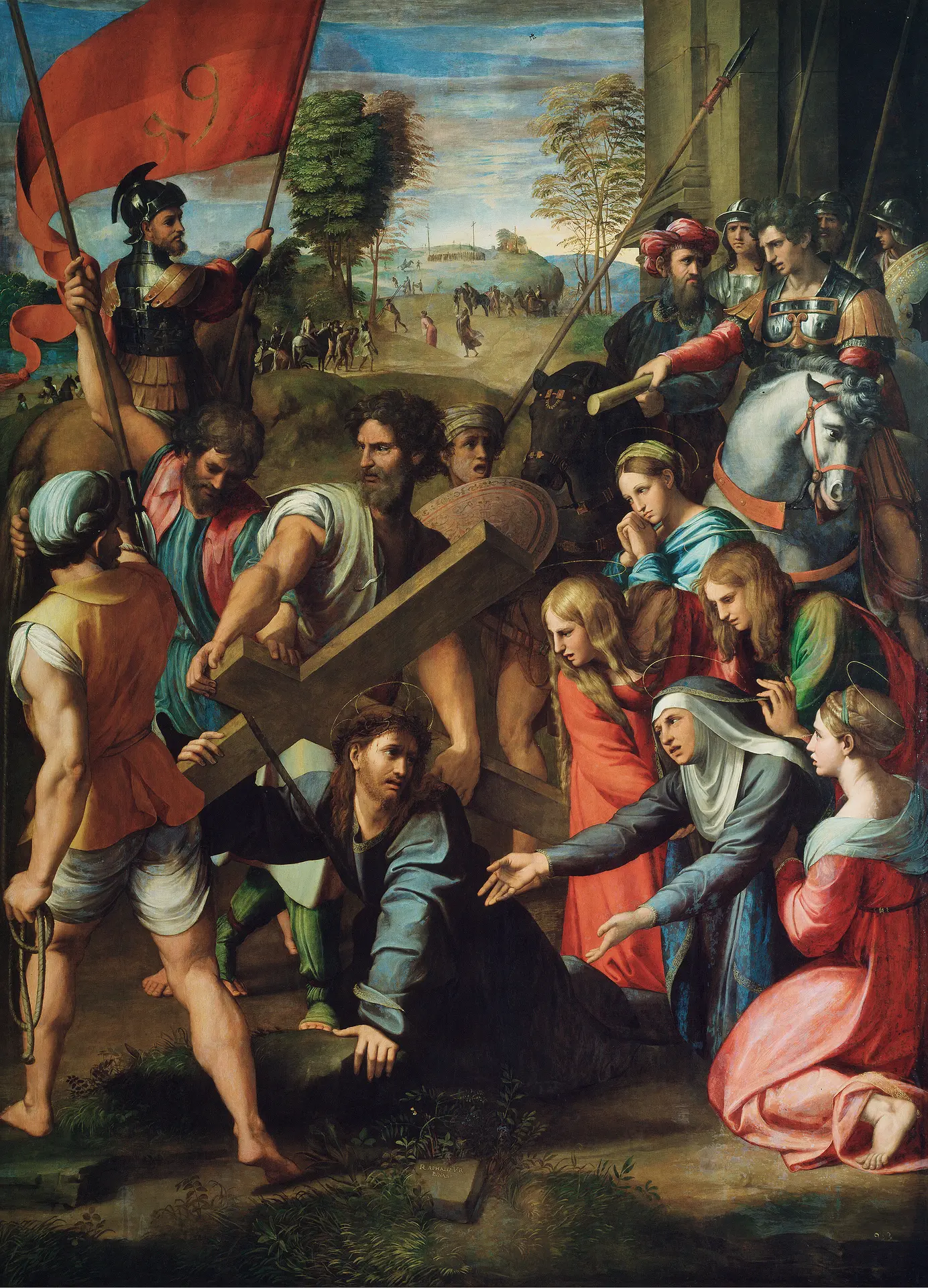
Simon of Cyrene is pressed from the crowd to carry the cross of a man he does not know, going somewhere he did not plan to go. Everyone who has ever been conscripted by suffering recognizes him.
Raphael, Christ Falling on the Way to Calvary (Lo Spasimo di Sicilia), c. 1515 to 1516. Museo del Prado, Madrid.
4th Sorrowful Mystery · Prayed Tuesday & Friday
The Carrying of the Cross is the fourth Sorrowful Mystery of the Rosary. Jesus carries his cross along the way to Calvary, helped by Simon of Cyrene and met by the weeping women of Jerusalem (John 19:17). It is prayed on Tuesdays and Fridays, and its fruit is patience.
What is the Carrying of the Cross?Baiulatio Crucis
Fruit of the Mystery: Patience
They pressed into service a passer-by, Simon, a Cyrenian, who was coming in from the country, the father of Alexander and Rufus, to carry his cross. They brought him to the place of Golgotha (which is translated Place of the Skull).Mark 15:21–22
What happened on the way to Calvary?
Jesus is dressed again in his own clothes after the mocking. The soldiers lead him out. He is carrying the patibulum — the crossbeam, not the entire cross. The upright post was a permanent fixture at Golgotha. What condemned prisoners carried was the horizontal beam, perhaps thirty to forty kilograms, lashed across their shoulders or arms. The weight, after the scourging, is enormous. The distance from the Praetorium to Golgotha is roughly 600 meters.
At some point along the way — the Synoptics do not specify where — Jesus can no longer manage the beam alone. The soldiers conscript a passerby. Mark is careful with the details: his name is Simon, he is from Cyrene (a city in North Africa with a significant Jewish community), he is coming in from the country — a farmer, perhaps, arriving in Jerusalem for Passover — and he is the father of Alexander and Rufus. That last detail is unusual. Mark's Gospel was likely written for the community in Rome. Paul greets "Rufus, chosen in the Lord" in Romans 16:13. The sons of the man who carried the cross are known to the early church, which means Simon himself became known, which means the experience of carrying the cross changed his life.
He is pressed into service — ēggareusan, the Greek for military compulsion, conscription. He did not volunteer. He does not appear to know who Jesus is. He is dragged out of the crowd by soldiers and given a criminal's cross to carry. This is one of the most evocative images of the Passion for anyone who has ever had suffering imposed on them without consent. Simon of Cyrene did not choose his Thursday morning. He was simply there, and the soldiers needed someone, and he was pressed into the worst job available. And he becomes, without understanding it, the first person to fulfill Jesus's own instruction: "Whoever does not carry his own cross and come after me cannot be my disciple" (Luke 14:27).
Luke alone records the women of Jerusalem weeping along the route (Luke 23:27-31). Jesus speaks to them — the only recorded words of Jesus on the Via Dolorosa. He addresses them not with gratitude but with prophetic urgency: "Daughters of Jerusalem, do not weep for me; weep instead for yourselves and for your children" (Luke 23:28). He is looking ahead to the destruction of Jerusalem in 70 AD. Even on the way to his own death, he is attending to them and to what is coming for them. "For if these things are done when the wood is green, what will happen when it is dry?" (Luke 23:31) — if the innocent suffer this, what will happen to the guilty?
What is the spiritual fruit of this mystery?The fruit: Patience
The fruit of the Carrying of the Cross is patience — and again the meaning requires precision. Patience is not passivity. It is not the absence of feeling under suffering. It is not the performance of cheerfulness in the face of what is genuinely painful. Aquinas defines patience as the virtue by which the soul retains its good in the face of the afflictions that press upon it — specifically, the goods of rational excellence and virtue — without becoming broken, bitter, or disordered by the pain (ST II–II, Q. 136).
Thomas à Kempis, writing in the early fifteenth century in his De Imitatione Christi (Book II, ch. 11), says what no more polished formulation has since managed to improve upon: "Jesus has many who love his heavenly kingdom, but few who bear his cross. He has many who desire consolation, but few who care for trial. He finds many to share his table, but few his fasting. All desire to be happy with him; few wish to suffer anything for him." This is not pessimism. It is diagnostic. The carrying of the cross has a sorting function in the Christian life: it reveals which form of love is actually present. The many who love the heavenly kingdom on comfortable terms and the few who carry the cross in the meantime are not enemies — they are the same person at different moments, facing the same question Simon faced: will I carry this, even though I did not choose it?
Augustine, in his commentary on Psalm 37 (En. in Ps. 37.6), develops what he calls the Christus totus — the total Christ, head and members — in a way that illuminates why Simon of Cyrene is significant beyond his individual story. He writes: "Our Lord Jesus Christ... has willed to be our head, and us to be his members; as such he endures his sufferings in us, as we endure them in him." What this means for the Carrying of the Cross is that Simon's act is not a historical curiosity but a type of the Church's permanent vocation. Everyone who bears suffering they did not choose, for love of another, is doing what Simon did — and doing it in union with the one whose cross Simon carried. The cross pressed on Simon's shoulders was pressed there by soldiers. But the one whose cross it was had chosen it freely, and the communion of that choice transforms what conscription means.
Simon of Cyrene is the model here rather than Jesus, because Simon is everyman. He did not want the cross. He carried it anyway. The tradition that his sons Alexander and Rufus became known in the early church suggests that the experience changed him — that carrying the cross of a condemned man whom he did not know became, somehow, the most significant thing he ever did. Patience, in this mystery, is the willingness to bear what has been placed on our shoulders without our consent, without drama, without the collapse of the good that we carry, until we arrive at the place where the cross is planted.
Sacred site: The Via Dolorosa (Latin: Way of Sorrows), Jerusalem — the traditional route from the site of Pilate's condemnation to Golgotha, marked by fourteen Stations of the Cross. The route as currently marked dates from the medieval period; the precise first-century route remains debated by archaeologists. The Church of the Holy Sepulchre at the end of the route encompasses both Golgotha (Calvary) and the tomb, within a single building constructed over both sites.
The Carrying of the Cross is the Fourth Sorrowful Mystery of the Rosary, drawn from Mark 15:20-22 and parallels. Jesus is led from the Praetorium toward Golgotha. When he can no longer carry the crossbeam, soldiers conscript Simon of Cyrene from the crowd to carry it for him. Luke records that Jesus spoke to the weeping women of Jerusalem along the route. The spiritual fruit is patience: bearing what we did not choose without losing what is essential.
Who was Simon of Cyrene?
Simon of Cyrene is described in Mark 15:21 as a passer-by from Cyrene (a Jewish community in North Africa) who was coming in from the country when soldiers conscripted him to carry Jesus's cross. Mark specifically names his sons — Alexander and Rufus — suggesting they were known to Mark's early church community in Rome. Paul greets a "Rufus, chosen in the Lord" in Romans 16:13. The detail suggests that carrying the cross changed Simon's life and that his family became part of the early Christian community.
What is the Via Dolorosa?
The Via Dolorosa (Latin: Way of Sorrows) is the route Jesus walked from the site of his condemnation to Golgotha (Calvary) in Jerusalem. The current route as marked in the Old City dates from the medieval period and may not follow the exact first-century path. It is marked by fourteen Stations of the Cross. Pilgrims from around the world walk the Via Dolorosa, particularly on Fridays, re-entering the movement of the Carrying of the Cross through the physical act of walking the same streets.
Pray the Sorrowful Mysteries at Orabimus.
Step-by-step, with audio in English and Latin. Free, no account required.