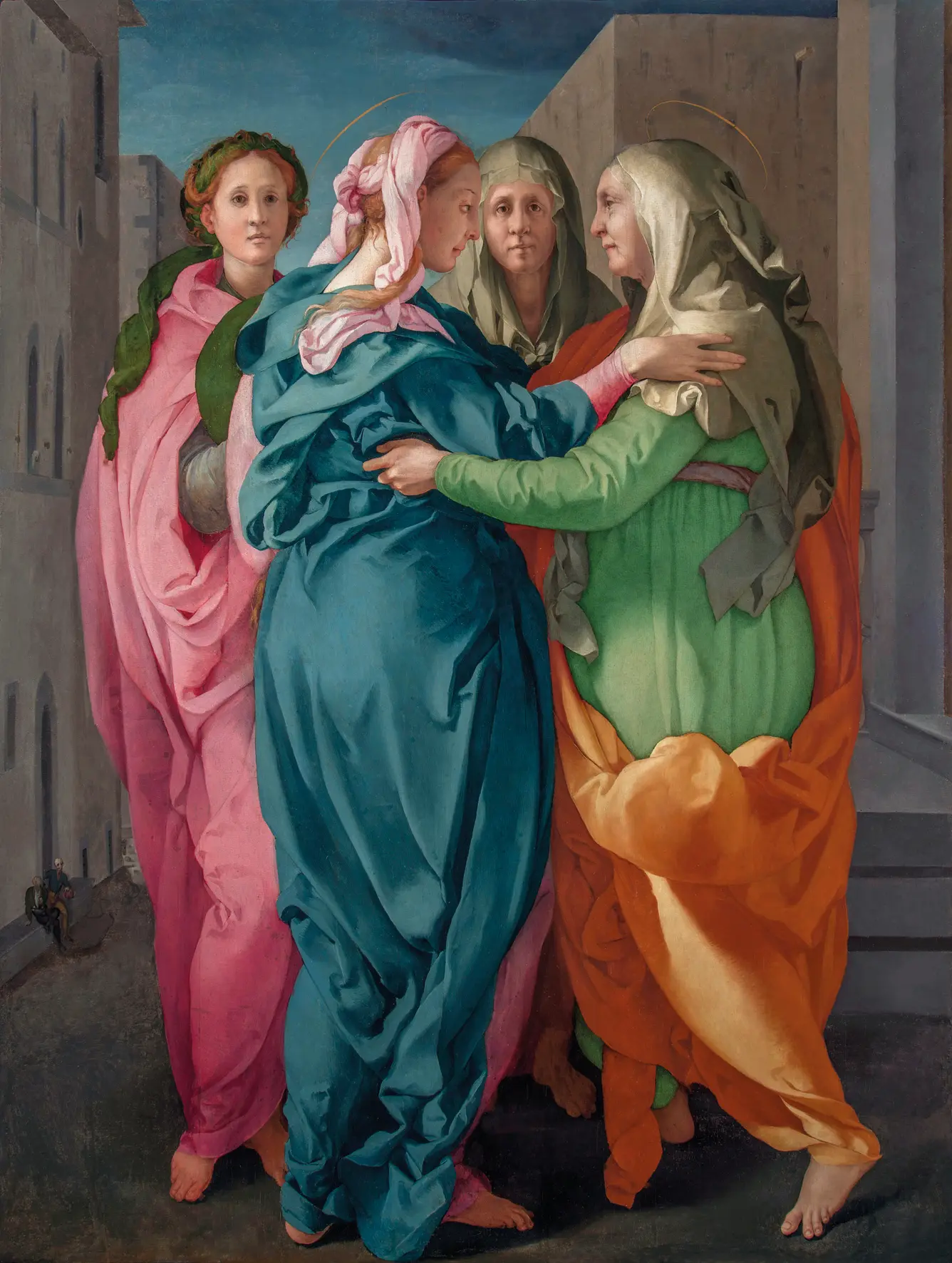
The moment Mary has received the most extraordinary news in human history, she sets out in haste to serve an elderly cousin in need. The mystery of charity is that it does not wait to be ready. It moves.
Jacopo Pontormo, The Visitation, c. 1528 to 1529. Pieve di San Michele, Carmignano.
2nd Joyful Mystery · Prayed Monday & Saturday
The Visitation is the second Joyful Mystery of the Rosary. Carrying Christ in her womb, Mary travels in haste to her cousin Elizabeth, the infant John leaps for joy, and Mary sings the Magnificat (Luke 1:39 to 56). It is prayed on Mondays and Saturdays, and its fruit is love of neighbor.
What is the Visitation?Visitatio
Fruit of the Mystery: Love of Neighbor
During those days Mary set out and traveled to the hill country in haste to a town of Judah, where she entered the house of Zechariah and greeted Elizabeth. When Elizabeth heard Mary's greeting, the infant leaped in her womb, and Elizabeth, filled with the Holy Spirit, cried out in a loud voice and said, "Most blessed are you among women, and blessed is the fruit of your womb." Luke 1:39–42
What happened at the Visitation?
The ink on Gabriel's departure is barely dry. Mary has just said yes to something that will upend every plan she had for her life — betrothal to Joseph, a quiet household in Nazareth, the ordinary cadences of Jewish domestic life. She has been told she will bear the Son of God. And the very next verse of Luke's Gospel is this: "During those days Mary set out and traveled to the hill country in haste."
Not after a period of reflection. Not after the initial vertigo settled. Immediately. In haste. Toward someone else's need.
This is the first movement of the Visitation: the speed of charity. Gabriel had mentioned, almost in passing, that Elizabeth — old, past the age of hope — was six months pregnant. He offered it as a sign: "For nothing will be impossible for God" (Luke 1:37). Mary receives it as a call. Her elderly cousin is in her final trimester. She goes.
The journey is not short. Nazareth to the hill country of Judah — traditionally identified as Ein Karem, eight kilometers west of Jerusalem — is somewhere between ninety and a hundred and forty kilometers, depending on the route. On foot, through a landscape that was not always hospitable to Jewish travellers (the most direct route ran through Samaria), the journey takes four to five days. Mary undertakes it alone, or with a small group, while carrying the Son of God in her womb and processing the fact of the Annunciation. She is heading toward the woman who will understand, if anyone can.
What happens when she arrives is one of the most compressed and layered scenes in the Gospels. She enters the house and greets Elizabeth. The moment she speaks, John the Baptist — still six weeks from his first breath — leaps in his mother's womb. Luke calls it eskirtēsen: he leapt, he bounded, the kind of movement that happens at sudden joy. And Elizabeth is filled immediately with the Holy Spirit — not before Mary speaks, but the moment her voice is heard. The encounter between the two women is simultaneously an encounter between the two children.
Elizabeth's cry comes from somewhere beyond ordinary greeting. She hasn't been told anything formally — no angel has appeared to her about Mary. She simply hears the voice and the Spirit speaks through her: "Most blessed are you among women, and blessed is the fruit of your womb." These are the words the Church still prays in the Hail Mary — the greeting Elizabeth gives here, joined to the angel's at the Annunciation. Elizabeth is the second person to address Mary as Gabriel addressed her — with the recognition that she is uniquely blessed. And then the question that shows Elizabeth knows more than she was told: "And how does this happen to me, that the mother of my Lord should come to me?" (Luke 1:43). She calls Mary the mother of her Lord. She knows who is in that womb.
Then Mary speaks. What she says is the Magnificat — ten verses of praise (Luke 1:46-55), woven through with the words of the Old Testament. She begins with her own soul and ends with the whole history of Israel. She starts from what God has done for her (a lowly handmaid, seen and exalted) and opens out to what God always does (lifts the lowly, fills the hungry, keeps his promise to Abraham). The Magnificat is not a personal journal entry; it is a theological reading of all of history from inside the experience of one unexpected grace.
Mary stays three months. Not for a visit — for the duration. She remains through Elizabeth's final trimester, through the last weeks of carrying, to the very threshold of John's birth. The text places her return home just as Elizabeth came to term (Luke 1:56). Three months of daily service, of ordinary help, of presence. The Visitation is not a spiritual experience that ends when the insight arrives. It is sustained, physical, humble charity — the kind that does laundry.
There is one more thing the mystery holds. John leaps in the womb when Mary greets Elizabeth. In Jewish thought, the soul of a person enclosed in a body still too young to speak or act is not therefore absent. John recognizes the presence of the Lord in Mary's womb and responds with the only response available to him: joy in the body, before he has any words. It is the act of a prophet who has not yet learned to speak. And it is the first meeting between John and Jesus — a meeting at which John does, as he always does, what he was born to do: he points toward the One greater than himself.
The Magnificat — The Theology in the Song
Mary's canticle (Luke 1:46-55) is saturated in the Old Testament. Scholars have counted approximately fourteen allusions to prior Scriptural texts in its ten verses, with the strongest structural parallel being Hannah's prayer after the birth of Samuel (1 Samuel 2:1-10). Hannah had been barren and was given a child through God's intervention. She sings of the same reversals Mary will sing: the proud scattered, the powerful toppled, the hungry filled, the lowly raised. The pattern is ancient and consistent. God works this way. Mary, steeped in the psalms and the prophets, recognizes the pattern and places herself inside it.
The Magnificat makes three claims, each more expansive than the last. The first is personal: God has looked on the lowliness of his handmaid, done great things for her, and from now on all generations will call her blessed (Luke 1:48-49). The second is moral: God's mercy extends from generation to generation to those who fear him; the proud are scattered, the powerful pulled down, the lowly lifted, the hungry filled, the rich sent away empty (Luke 1:50-53). The third is historical: God has helped his servant Israel, in remembrance of his mercy, as he spoke to Abraham and his descendants forever (Luke 1:54-55).
These three claims — about Mary, about God's moral character, about God's faithfulness to Israel — are not separate thoughts. They are one thought at three scales. What God did for Hannah, he is doing for Mary. What God does for Mary, he does for all the lowly. What he does for all the lowly is what he promised to Abraham. The Magnificat is a song about the consistency of God.
The Church has prayed the Magnificat at Vespers — Evening Prayer — every single day since at least the 6th century. The Rule of St. Benedict (c. 530 AD) requires it. Every monk, nun, priest, and layperson praying the Liturgy of the Hours sings Mary's song at the close of each day. It has been prayed more times than any other non-biblical prayer in Christian history — and it was composed, according to Luke, by a teenage girl in the house of her elderly cousin during the first week of her pregnancy.
What is the spiritual fruit of this mystery?The fruit: Love of Neighbor
Ambrose of Milan, whose commentary on Luke (Expositio Evangelii Secundum Lucam, Bk. II) is one of the earliest and most perceptive readings of the Visitation, noticed something the text implies but does not say directly: when Elizabeth hears Mary's greeting and is "filled with the Holy Spirit" (Luke 1:41), she receives the Spirit through the sound of Mary's voice — through the greeting of the one who is herself full of grace. Ambrose draws out the ecclesial dimension: Elizabeth, the elder and barren one who has received an unexpected gift, represents Israel greeting the young Church, or the old dispensation recognizing the new. The leap of John in the womb is, for Ambrose, John exercising his prophetic office before he has any language to exercise it in — the prophet who cannot yet speak still points toward the one greater than himself. The model for the community is here too: to greet one another with the joy that comes not from circumstance but from the presence of Christ carried within.
The fruit of the Visitation is love of neighbor — and the mystery shows precisely what that love looks like when it is working correctly.
Augustine, in his sermon on the birth of John the Baptist (Sermo 293), marvels that John was declared a prophet while still in the womb, leaping at the arrival of Mary and marked out as Christ's forerunner before he was even born. Augustine's point is that the Visitation does not merely describe something that happened once between two women in a hill town. It is the pattern of every encounter between a person who carries Christ and a person who needs to encounter him. Mary walks into the house and Elizabeth is illuminated before Mary says a word about theology. The grace she carries is communicated through presence, through greeting, through the ordinary act of showing up. This is what charity actually looks like: it doesn't wait to have its argument assembled. It travels in haste and arrives.
Thomas Aquinas teaches that love of God and love of neighbor are not two separate loves but one love with two objects (Summa Theologica II–II, Q. 25). The soul that truly loves God cannot not love what God loves — and God loves every person made in his image. The Visitation demonstrates this logic with the immediacy of a theorem. Mary has just received the fullness of God's love, bearing the divine love itself within her. Her first movement is toward her neighbor. She doesn't stay in Nazareth to contemplate the gift. She travels to serve.
There is no gap between the receiving and the giving. In Mary's case, this is not just virtue — it is nature working properly. She loves God completely and therefore loves her neighbor immediately. The fruit of the Visitation decade is the invitation to close that gap in our own lives: to shorten the distance between the grace received and the service given.
Sacred site: The Church of the Visitation, Ein Karem — built over the traditional home of Elizabeth and Zechariah, 8 kilometers west of Jerusalem. The present church was completed in 1955, designed by Italian architect Antonio Barluzzi. The lower level contains a spring (traditionally the one Mary drank from during her visit). A wall in the courtyard is covered with ceramic tiles bearing the Magnificat in more than forty languages. Ein Karem is also the birthplace of John the Baptist, with a separate Franciscan church (Church of St. John the Baptist) marking the traditional site.
How to Pray This Decade
Announce the mystery: The Second Joyful Mystery — The Visitation. Pray one Our Father. As you pray the ten Hail Marys, hold the image of Mary entering Elizabeth's house — not as a visitor to be received, but as a servant who has come to help. Elizabeth's house. Three months. Daily work.
The question this mystery puts to you is: what neighbor is in need right now — not of a dramatic intervention, but of presence? The Visitation is not a spectacular act. It is the sustained, quiet, unglamorous service of showing up. The charity it models is not the charity of the one dramatic gesture but the charity that stays three months and does the laundry.
After the tenth Hail Mary, pray the Glory Be and the Fatima Prayer. Then the Third Joyful Mystery — the Nativity — where God continues the movement of self-emptying that the Visitation has already begun.
The Visitation is the Second Joyful Mystery of the Rosary, drawn from Luke 1:39-56. After the Annunciation, Mary travels in haste to visit her elderly cousin Elizabeth, who is six months pregnant with John the Baptist. When Elizabeth hears Mary's greeting, John leaps in the womb, and Elizabeth cries out: "Blessed are you among women, and blessed is the fruit of your womb!" Mary responds with the Magnificat. She remains with Elizabeth for approximately three months. The spiritual fruit of the mystery is love of neighbor.
What is the Magnificat?
The Magnificat is Mary's canticle of praise in Luke 1:46-55, beginning "My soul magnifies the Lord, and my spirit rejoices in God my Savior." It draws heavily on Hannah's prayer (1 Samuel 2:1-10) and contains approximately 14 allusions to the Old Testament in 10 verses. It proclaims God's preferential concern for the poor, the hungry, and the lowly — and God's faithfulness to the promise made to Abraham. The Church has prayed the Magnificat at Vespers (Evening Prayer) every day since at least the 6th century, making it one of the most frequently prayed texts in Christian history.
Why did John the Baptist leap in the womb?
John leapt in Elizabeth's womb when he heard Mary's greeting because he was in the presence of the Lord — Jesus, present in Mary's womb. Luke 1:41 says Elizabeth "was filled with the Holy Spirit" at the moment Mary spoke. John's leap is his first prophetic act: recognizing the Messiah before either child has been born. It fulfills Gabriel's earlier promise that John would be "filled with the Holy Spirit even from his mother's womb" (Luke 1:15). It is also the first meeting between John and Jesus — and John responds as he always will: by pointing toward the One greater than himself.
How far did Mary travel to visit Elizabeth?
Mary traveled approximately 90-140 kilometers from Nazareth in Galilee to the hill country of Judah (traditionally Ein Karem, about 8 kilometers west of Jerusalem). The journey on foot would have taken four to five days. Luke emphasizes that Mary set out "in haste" (Greek: spoude). The route either ran through Samaria — where Jews were not welcomed — or the longer Jordan valley route. That she went at all, and went quickly, while in the earliest weeks of her own pregnancy, is the first and most fundamental expression of the mystery's fruit: charity does not delay.
How long did Mary stay with Elizabeth?
Mary remained with Elizabeth for approximately three months (Luke 1:56). She arrived when Elizabeth was six months pregnant and left before John's birth. This means she was present through Elizabeth's most physically demanding period and helped with the daily work of late pregnancy in an elderly woman. The Visitation is not a brief spiritual encounter followed by a return to normal life. It is three months of daily, sustained, physical service. Mary leaves just before John is born — possibly to be home in Nazareth before her own pregnancy became visible.
Pray the Joyful Mysteries at Orabimus.
Step-by-step, with audio in English and Latin. Free, no account required.