Prima Mysteria Luminosa · Baptismus Iesu in Iordane
The Baptism of Christ
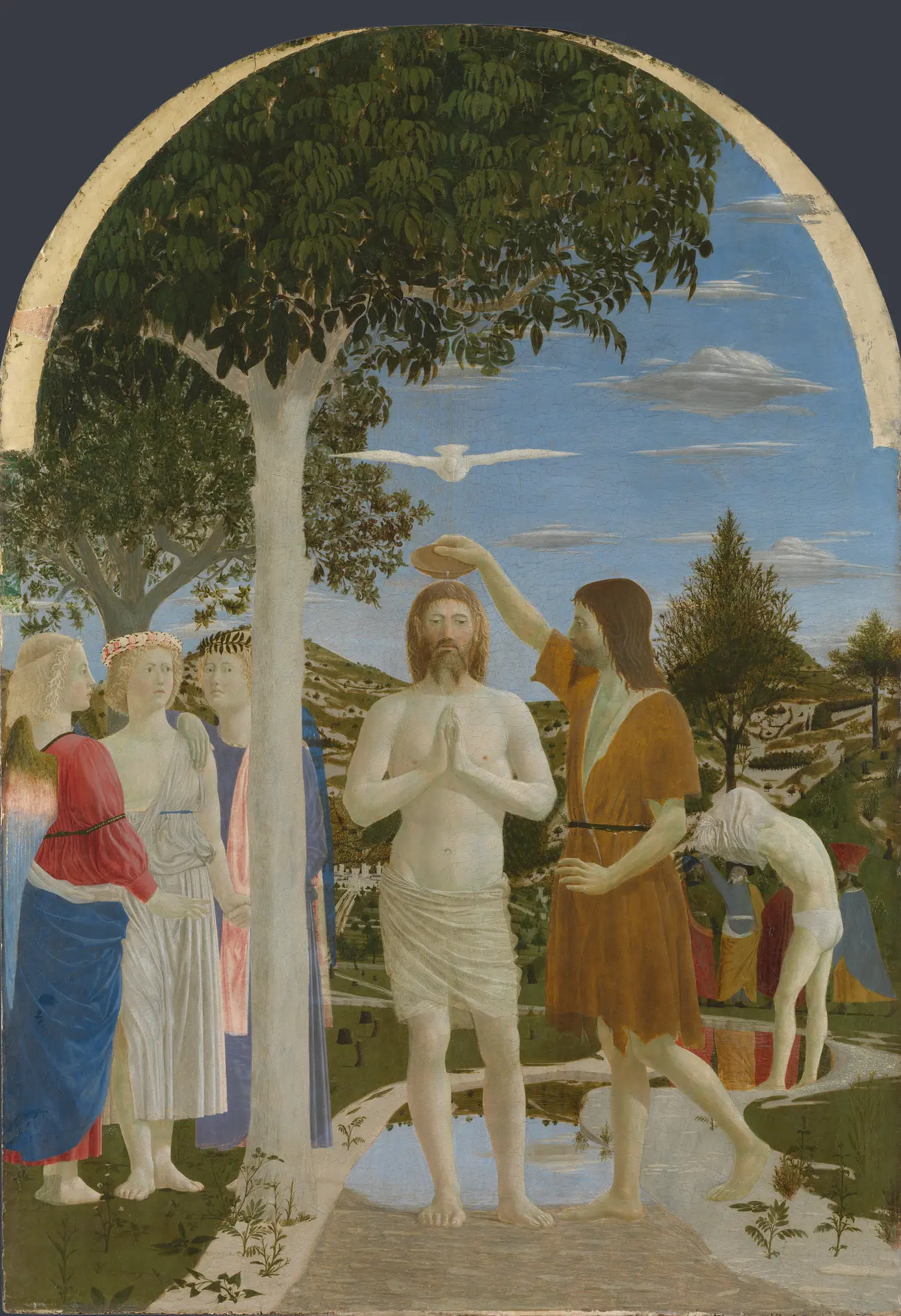
Jesus stands in the Jordan with the sinners whose sins he came to take. The heavens open. The Spirit descends. The Father speaks. The entire Trinity is present at the beginning of everything.
Piero della Francesca, The Baptism of Christ, c. 1450s. National Gallery, London.
1st Luminous Mystery · Prayed Thursday
The Baptism of Christ is the first Luminous Mystery of the Rosary. Jesus is baptized by John in the Jordan, the heavens open, the Spirit descends as a dove, and the Father names him the beloved Son (Matthew 3:13 to 17). It is prayed on Thursdays, and its fruit is openness to the Holy Spirit.
What is the Baptism of Christ?Baptismus Iesu
Fruit of the Mystery: Openness to the Holy Spirit
After Jesus was baptized, he came up from the water and behold, the heavens were opened for him, and he saw the Spirit of God descending like a dove and coming upon him. And a voice came from the heavens, saying, "This is my beloved Son, with whom I am well pleased." Matthew 3:16–17
What happened at the Baptism of Christ?
John the Baptist has been preaching in the wilderness of Judea — a locust-and-wild-honey prophet, dressed in camel hair, calling the people of Israel to repentance and baptism in the Jordan before "the one who is coming" (Matthew 3:11). People have been traveling from Jerusalem and all of Judea to hear him. He baptizes in the Jordan — the same river Joshua led Israel across to enter the Promised Land. The geography is deliberate: the Jordan crossing is the new Exodus.
Then Jesus comes from Galilee. He presents himself for baptism. John recognizes him — "I need to be baptized by you, and yet you are coming to me?" (Matthew 3:14). This is the question that has exercised every serious reader since: why does the sinless Son of God submit to a baptism of repentance? What is Jesus repenting of? The answer is not about sin. It is about solidarity. Jesus takes his place in the line of sinners, not because he is one, but because he is with them. He is baptized into the human condition he came to redeem. The one who will take away the sin of the world stands in the water with those whose sins he will take.
Jesus insists — "allow it now, for thus it is fitting for us to fulfill all righteousness" (Matthew 3:15) — and John consents. Jesus is baptized. He comes up from the water. And the heavens open.
Three things happen simultaneously. The Spirit descends like a dove. The voice of the Father speaks: "This is my beloved Son, with whom I am well pleased" (Matthew 3:17). The entire Trinity is present at this moment — the Son in the water, the Spirit descending, the Father speaking from heaven. The baptism of Jesus is the first public Trinitarian theophany in the New Testament. It will be repeated at the Transfiguration and implied at the Resurrection.
The dove carries the full weight of its symbolism. In Genesis 1:2, "the Spirit of God was hovering over the face of the waters" — the same creative Spirit who moved over the formless void now descends over the waters of the Jordan, signaling a new creation. In Genesis 8:8-12, Noah sends out a dove from the ark to find dry land after the flood — the dove that returns with an olive branch signals that the destruction is over and life is beginning again. Here, the Spirit-dove descends over the one who is making all things new.
The voice says "beloved Son" — in the Greek, huios agapētos, which carries an echo of the Septuagint's translation of Isaac in Genesis 22:2: "Take your son, your beloved son, Isaac." The one who was to be sacrificed but was spared. Jesus is the beloved son who will not be spared.
What is the spiritual fruit of this mystery?The fruit: Openness to the Holy Spirit
Gregory of Nazianzus, preaching at Epiphany in his Oration 39 (the feast then commemorating the Baptism of Christ), gives the clearest patristic answer to the question everyone asks: why was the sinless Son of God baptized? "Jesus comes to be baptized — perhaps to sanctify the Baptist himself, but certainly to bury the whole of the old Adam entirely in the water." He continues: "He sanctifies the Jordan for our sake and in readiness for us; he who is Spirit and Flesh comes to begin a new creation through the Spirit and water" (Or. 39.15–16). The Baptism is not about Jesus's own need but about what his act does to the waters — and through the waters, to every baptism that will follow. Ambrose, summarizing the same insight in his commentary on Luke, puts it with maximum compression: "Our Lord was baptized not to be cleansed but to cleanse the waters."
Tertullian, writing around 200 AD in his treatise On Baptism (De Baptismo 4), had already seen the cosmic dimension of Christ's descent into the Jordan: "The Spirit of God, who in the beginning moved over the waters, would continue to linger over the waters of the baptized as the bringer of holiness." The dove that descends at the Baptism is for Tertullian the same Spirit who hovered over the primordial chaos in Genesis 1:2 — now hovering over the waters of the Jordan, consecrating them as the site of new creation. What makes Christian baptism efficacious is not the water itself but the Spirit who hallowed all water at the Baptism of Christ.
The fruit of the Baptism of Christ is openness to the Holy Spirit — the disposition to receive what the Spirit gives, to go where the Spirit sends, to allow the same Spirit who drove Jesus into the wilderness immediately after his baptism (Matthew 4:1) to move through one's own life without resistance. Christian baptism participates in Christ's baptism: the same Spirit descends, the same Father speaks, the same sonship is conferred. "Do you not know that all of us who were baptized into Christ Jesus were baptized into his death?" (Romans 6:3). The Baptism of Christ is the template of our own.
Openness to the Spirit means, first, recognizing its movements — in Scripture, in prayer, in the voices of others, in the unexpected events that redirect a life. And second, it means not suppressing what the Spirit gives: "Do not quench the Spirit" (1 Thessalonians 5:19). Paul makes the consequence explicit: "Now you are not in the flesh but in the Spirit, since the Spirit of God dwells in you" (Romans 8:9). The Baptism of Christ decade is a good place to pray through whatever is currently being quenched.
Sacred site: The traditional site of Jesus's baptism is identified as Bethany beyond the Jordan (John 1:28), on the eastern bank of the Jordan River in present-day Jordan. The site — called Al-Maghtas — has been confirmed by archaeologists and is recognized by the Vatican. It is a UNESCO World Heritage Site. On the western (Israeli) side, the site of Qasr el-Yahud is also venerated.
How to Pray This Decade
Announce: The First Luminous Mystery — The Baptism of Christ in the Jordan. Pray one Our Father. As you pray the ten Hail Marys, hold the moment of the opened heavens: the Spirit descending, the voice speaking "You are my beloved." In your own baptism, the same event occurred. The same voice was spoken over you.
The Baptism of Christ is the First Luminous Mystery of the Rosary, drawn from Matthew 3:13-17 and parallels. Jesus presents himself to John the Baptist for baptism in the Jordan River. As he emerges from the water, the heavens open, the Spirit descends like a dove, and the Father's voice declares: "This is my beloved Son, with whom I am well pleased." The full Trinity is present simultaneously. The spiritual fruit is openness to the Holy Spirit.
Why did Jesus need to be baptized?
Jesus submitted to baptism not because he needed repentance — he was sinless — but because of solidarity. He took his place in the line of sinners not as one of them but as the one who would take their condition upon himself. "Allow it now, for thus it is fitting for us to fulfill all righteousness" (Matthew 3:15). The Baptism is an act of identification with humanity, the first step in the descent that would culminate at Calvary. It is also the moment of his public commissioning: the Father identifies him, the Spirit anoints him, his ministry begins.
What does the dove represent at the Baptism of Jesus?
The dove at the Baptism carries multiple layers of meaning. In Genesis 1:2, the Spirit of God hovered over the waters of creation — the same Spirit now descends over the waters of the Jordan, signaling a new creation. In Genesis 8:8-12, Noah's dove returned with an olive branch, signaling the end of the flood and the beginning of renewed life. Here, the Spirit-dove descends over the one who is the new creation and the end of the flood of sin. The dove is the Spirit made visible.
Pray the Luminous Mysteries at Orabimus.
Step-by-step, with audio in English and Latin. Free, no account required.